
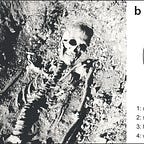
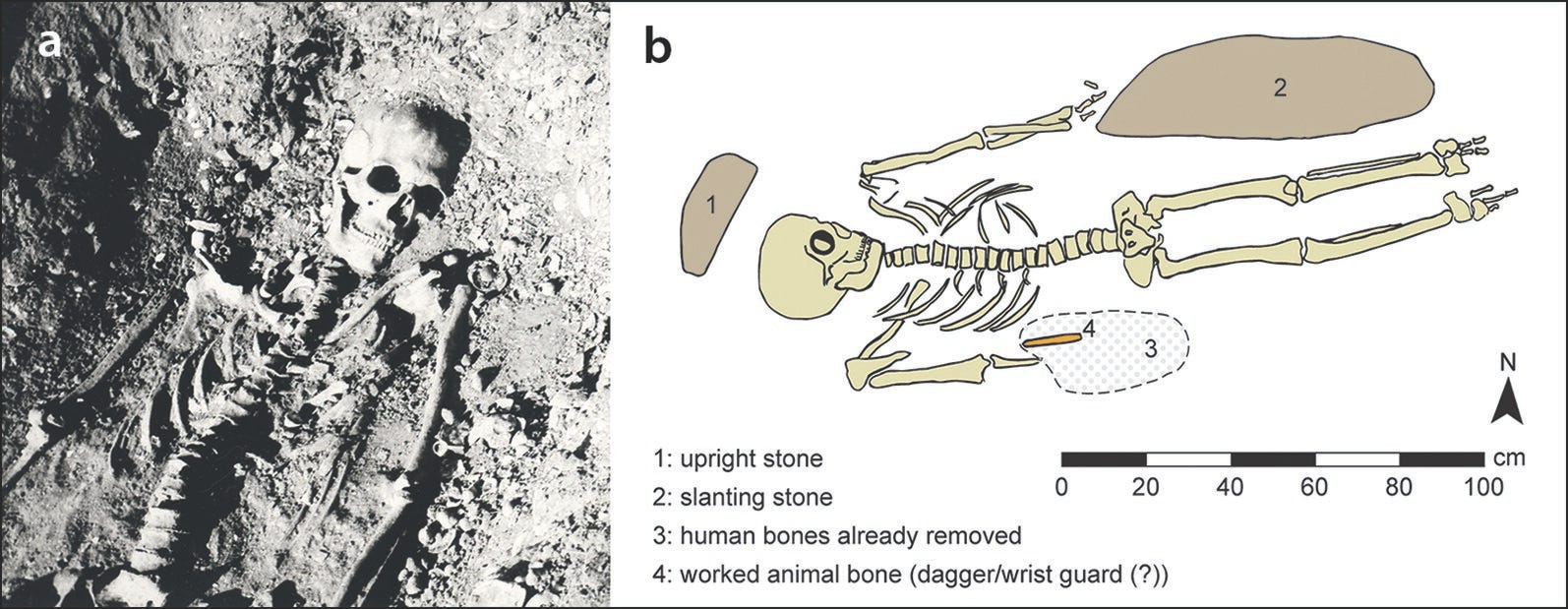
In 1956, residents digging for artifacts in a Stone Age shell midden called Rødhals, on the Danish island of Sejerø, found a nearly complete human skeleton under an unbroken shell layer about 20 centimeters thick. Ole Klindt-Jensen of the Danish National Museum lifted the skeleton, now known as Rødhals Man, in pouring rain, and his notes describe a bone object about 140 millimeters long between the man’s right forearm and lower ribs. A museum employee apparently later redescribed it as an “unformed piece of bone, strongly water-rolled,” and discarded it. A new study suggests it may have been an archer’s wrist guard, an object with parallels in graves of the early Funnel Beaker Culture, the Early Neolithic farming culture of Denmark (c. 3800–3500 cal BC).
The object matters because of what most readers believe about the Neolithic transition in Denmark, the shift from Mesolithic hunting and fishing to Neolithic farming. A 2024 study1 2 of 100 ancient Danish genomes by Morten Allentoft and colleagues found that farmers with ancestry traced to Anatolia arrived in the fourth millennium BC and replaced the local hunter-gatherers rather abruptly. Rødhals Man has long sat awkwardly in that picture. His bones carry the seafood diet of a Late Mesolithic forager, but radiocarbon put him in the Early Neolithic, when marine food all but vanishes from Danish human bone chemistry.
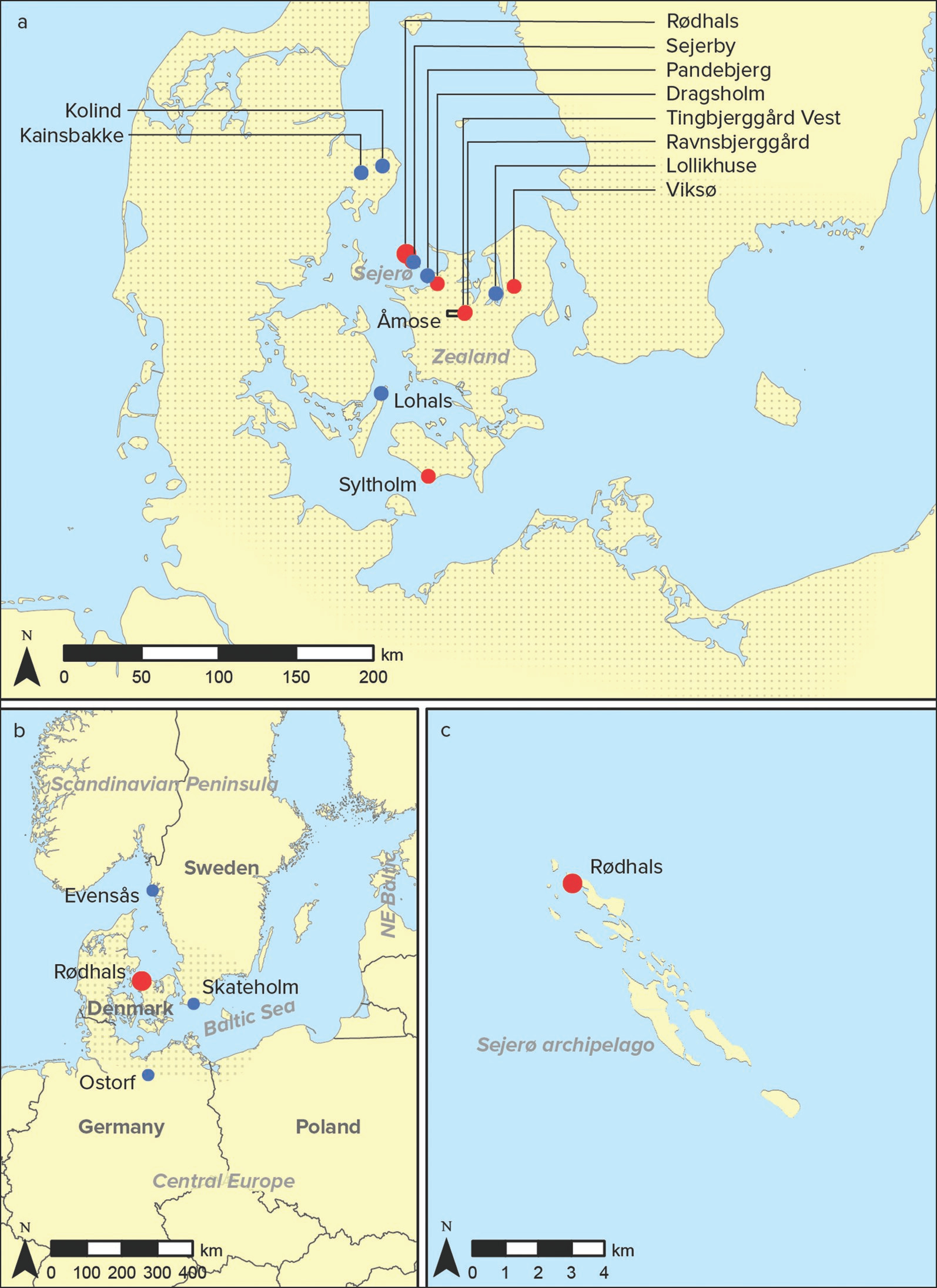
In Antiquity,3 Dr. Anders Fischer of the University of Gothenburg, John Meadows of the Leibniz-Zentrum für Archäologie and 15 co-authors report that, corrected for his diet, the radiocarbon dates place Rødhals Man’s death between 3930 and 3710 cal BC (95 percent probability), most likely between 3890 and 3770 cal BC, where cal BC means calendar years BC from calibrated radiocarbon dates. His genome, published in 2024, shows entirely Western Hunter-Gatherer ancestry, the genetic profile of Europe’s Mesolithic foragers, and he lived mainly on seafood all his life. That currently makes him the most recent securely dated person in Denmark with both unmixed hunter-gatherer ancestry and a coastal forager’s diet.
The result I find more interesting comes from one of his teeth, because it records a change inside a single life. As a child he ate like most people of the Ertebølle Culture, the Late Mesolithic culture of Denmark and its neighbors (c. 5400–3800 cal BC), drawing protein mostly from shallow eelgrass meadows. From adolescence on, around the time domestic cattle and sheep first appear in Denmark, this fisher of purely local forager ancestry ate sharply more food from land while still depending mainly on the sea, and the authors argue the land food was probably farmed.
How do isotopes in a tooth record a change in diet?
Collagen, the main protein in bone and in the dentine of teeth, is built from the protein a person eats. Ratios of heavier to lighter isotopes of carbon, nitrogen and sulfur in it differ between food webs, and animal bones and mollusk shells from the Rødhals midden separate two marine sources: the shallow eelgrass meadows, with their shellfish, flatfish and eel, and the deeper offshore channels where haddock and mature cod lived. Land food is the third source, and a person’s values plotted against all three give the share of protein from each.
Bone renews its collagen through life, so a femur sample averages many adult years. A tooth root grows in sequence through childhood and early adolescence, and slicing it into thin increments matched to approximate ages gives something close to a yearly record. The team sacrificed the root of his lower-right first premolar and got a series from about age seven into his early teens. They compared it with his left femur and with data from 65 other Danish Mesolithic individuals spanning c. 9700–3950 cal BC.
Eelgrass foods dominate the whole sequence. Around age eight or nine his diet was slightly more terrestrial, and from about 11 more offshore fish came in. Between the increments the paper’s Figure 6 assigns to ages 12 and 13, the values swing hard toward land food, and the adult femur stays on that side. Against the comparison group, his childhood diet is typical for a coastal Ertebølle person, while his adult diet is unusually rich in land food for someone from the coast.
Getting his date right depends on that diet reconstruction. All five radiocarbon dates on the skeleton read too old because of the marine reservoir effect: carbon in seawater is older, in radiocarbon terms, than carbon in the air, so a heavy seafood eater builds bones that test older than they are. The team corrected for this in a Bayesian model, a statistical method that combines the measured dates with corrections for his estimated diet and for how long before death each sample’s collagen formed. I think this is the most careful part of the paper, because the old error ran in a predictable direction and the authors model it in the open, though any error in the diet estimate carries into the date.
Was Rødhals Man eating farmed food?
The authors handle this claim more carefully than the press release does, stating that isotopes from his femurs and ribs cannot show whether the extra land protein came from hunting and gathering or from farming and herding. They also raise the alternative themselves: he might have spent his adolescence and adulthood foraging on a larger landmass with red deer to hunt, the nearest being Zealand, 18 kilometers away across open water, and come back to Sejerø late in life.
Their answer rests on two observations. Typical inland foragers ate freshwater fish, and Rødhals Man shows none at isotopically visible levels; his adult diet also looks unlike any other Mesolithic individual’s over a sustained period. I find the first weaker than it sounds, because it excludes the lakeshore forager while saying nothing about a coastal man crossing to Zealand for deer. The second is stronger, though a diet nobody else in the sample shared also fits a man who was simply unusual.
A separate line of evidence comes from the grave. Danish Late Mesolithic graves typically show ochre staining, and this one has none. The body lay on its back between two large stones with their flat faces turned toward it; the larger may be a boulder that was already there, but the smaller seems to have been set on edge deliberately. The authors find that arrangement closer to local burials of Early Neolithic farmers. I give the stone frame more weight than the wrist guard, because the frame is in Klindt-Jensen’s field sketch and the wrist guard is a reading of a description of an object no one can now examine.
I worked through the timing myself from the paper’s numbers. Directly dated cattle and sheep bones put the first Danish economy with domesticates at c. 3950–3850 cal BC. On the Sejerø islands, the earliest directly dated individual with farmer ancestry, the Sejerby Female, was buried 2.5 kilometers from Rødhals and 200 to 300 years after him. Rødhals Man died between 30 and 40, probably near the upper end, so his diet turned roughly 20 to 28 years before his death. A death within the model’s most likely range puts that change between about 3920 and 3790 cal BC, after domesticates appear, while a death at the old end of the 95 percent range puts it around 3950 cal BC, at the very first domesticate dates.
What the Rødhals Man study can’t show
The plainest limit is that this is one man. Fischer said as much in a statement from Antiquity: “It is only one person’s story, and only one generation.” The argument depends on Rødhals Man being exceptional, and one exceptional skeleton cannot show whether it marks a historical change or a man with unusual habits.
There is also a gap in the diet record. The dentine series ends in his early teens and the next point is the femur, an average over adult years, so whether the land food built up steadily or arrived late in life is invisible. The paper also leaves open whether the first herders in the Danish islands were incomers with Anatolian ancestry or local people who took up herding from neighboring regions, which matters for any claim that he met farmers.
The press release claims more than the paper in three places. It says radiocarbon placed him “well after the arrival of farming on nearby Zealand in about 3900 BC,” but his 95 percent range begins at 3930 cal BC and the first domesticates date to c. 3950–3850 cal BC, so the two overlap. It says he “ate significantly more terrestrial foods than other foragers,” where the paper says his adult diet was unusually terrestrial for a coastal Ertebølle individual; another man of the same ancestry and similar date, known as Dragsholm Man, ate far more land food. And its phrase “regularly interacted with farmers” hardens the paper’s suggestion that he adopted a partly Neolithic lifestyle or at least interacted closely with farmers.
His status as the last of his kind is provisional too. Dragsholm Man shares his ancestry and roughly his date, and so does Lola, a woman known only from DNA in a piece of chewed birch tar from Syltholm. Their date ranges overlap too much to rank, so the title holds only for a forager with a coastal, seafood-based diet, and only until another midden yields a later one.
What would confirm that Rødhals Man ate farmed food?
My verdict is that the paper is convincing on who Rødhals Man was and when he died, and partly convincing on why his diet changed. The genome is published, and the shift in his early teens is measured in the tooth itself. The step to farmed food is where the argument thins, because it rests on the shape of his grave and on regional dates that overlap his life without placing farmers on Sejerø during it. I would call farming the best explanation on offer. What the paper changes is the scale of the evidence: the replacement picture from the 2024 genomes still stands, now with one forager inside it whose diet shifted while herding and the indigenous population overlapped in Denmark.
Two samples would test the farming explanation. The hypothesis predicts domestic animals or crops on or near the Sejerø islands while he was a teenager, so a directly dated cattle or sheep bone or cereal grain from the archipelago within his lifetime would turn a regional inference into a local one. The other is a tooth from Dragsholm Man, if a suitable one survives. An incremental dentine series showing a seafood childhood turning to land food in adolescence would give Rødhals Man company. If Dragsholm Man ate mostly land food from early childhood, a land-heavy diet among the last foragers would need no farmers to explain it, and the case for Rødhals Man as a participant in the Neolithic transition would rest almost entirely on his grave.
Allentoft, M.E. et al. 2024a. Population genomics of post-glacial western Eurasia. Nature 625: 301–11. https://doi.org/10.1038/s41586-023-06865-0
Allentoft, M.E. et al. 2024b. 100 ancient genomes show repeated population turnovers in Neolithic Denmark. Nature 625: 329–37. https://doi.org/10.1038/s41586-023-06862-3
Fischer, A., J. Meadows, M.L. Jørkov et al. 2026. Rødhals Man: a life at the end of the Mesolithic world. Antiquity 2026: 1–17. https://doi.org/10.15184/aqy.2026.10476


