

Between 500 and 1900 CE, the estimated height of women in Japan fell at a rate of 10.7 centimeters per thousand years. That number comes from a new compilation of ancient human height across Europe and Asia, and the authors count it among the steepest declines in their dataset. The paper gives Chinese women a rate of 1.51 centimeters per thousand years, so the Japanese rate is about seven times faster. For Japanese men across the same centuries, the change is not statistically significant (P = 0.115).
Japan also matters to the paper’s larger argument. Citing earlier work, the authors note that early modern Japan had both exceptionally high population density and very short people, which is the combination an old line of economic reasoning predicts. Most readers assume the opposite without saying so. They assume that the inventions which let a society feed more people, such as new crops and irrigation, also left each person better fed.
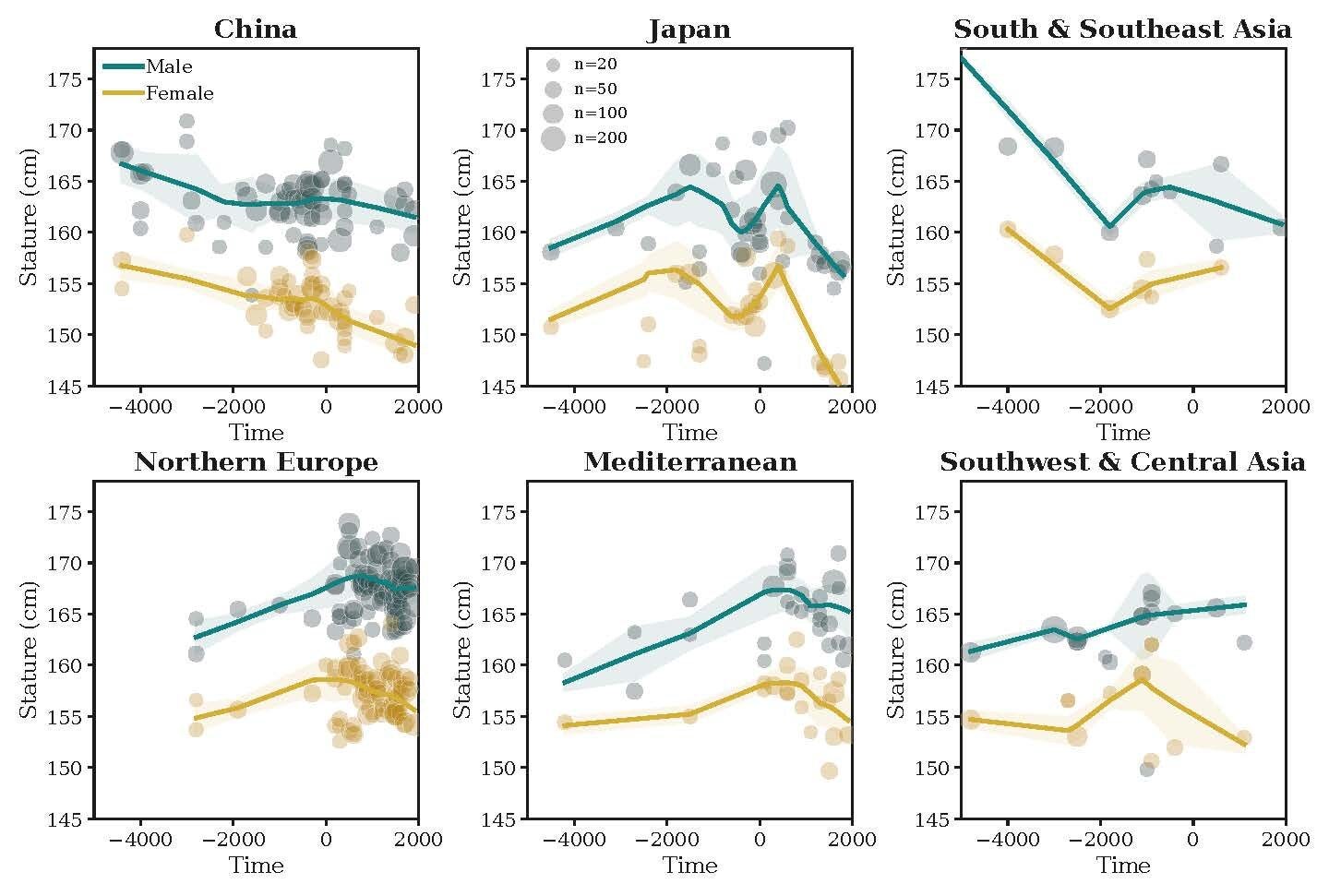
The study was published in PNAS1 on November 16. Its authors are Jörg Baten and Manon Stephan of the University of Tübingen, Mark Hudson of the Max Planck Institute of Geoanthropology in Jena and 21 coauthors. They assemble 18,457 adult stature estimates from 783 sites in 45 modern countries, spanning 5000 BCE to 1900 CE. China alone contributes 4,938 observations, where an earlier compilation by Stock and colleagues2 had 570 for China before 1800. The paper rests on two results. Stature fell in most regions of Asia and Europe between 500 and 1900 CE. And technology predicted how densely people lived but had no statistically significant link to how tall they grew.
The authors read that split as support for a 2011 model3 by Ashraf and Galor. In that model, technological gains before modern economic growth went into larger populations and did not become lasting improvements for each person. Ashraf and Galor found a similar split using Maddison’s estimates4 of national income. Those estimates are debated, by Maddison among others, especially before 1500 CE. The new paper finds the same pattern using a physical measurement in place of those reconstructions. My view is that the dataset is the real achievement, and that the test of the Malthusian model is weaker than the press release suggests.


