

Beneath the wooden floor of a corridor that once led out of a dwelling at Paipelghak, on the northeastern shore of the Chukchi Peninsula in Russia, an aged male dog lay in anatomical position. Permafrost had kept the fur along with the skeleton, and the fur shows possible harness traces, which is the only reason anyone calls him a sled dog. A walrus baculum lay near his tail beside a cut piece of reindeer antler, and radiocarbon places the burial between 1170 and 1540 cal AD. His teeth were heavily worn, and his lumbar vertebrae carried numerous osteophytes, the small bony spurs that some archaeologists have proposed as a mark of hauling loads.
That last detail carries the assumption this essay is about: that a working animal’s skeleton keeps a record of the work, so that a dog which pulled a sled should show it in the spine and joints, and that the way to find sled dogs in the archaeological record is to look for wear. Spondylosis deformans, the technical name for those spinal spurs, was proposed as evidence of sled use in 1979 (Arnold), and a systematic evaluation by Kathryn Latham and Robert Losey in 2019 questioned its diagnostic value. The one other attempt the authors know of to identify habitual sled pulling without relying on pathology, a 2025 study of entheses (the attachment sites of muscle and ligament) by Sick and colleagues, offers no quantitative framework for diagnosis.
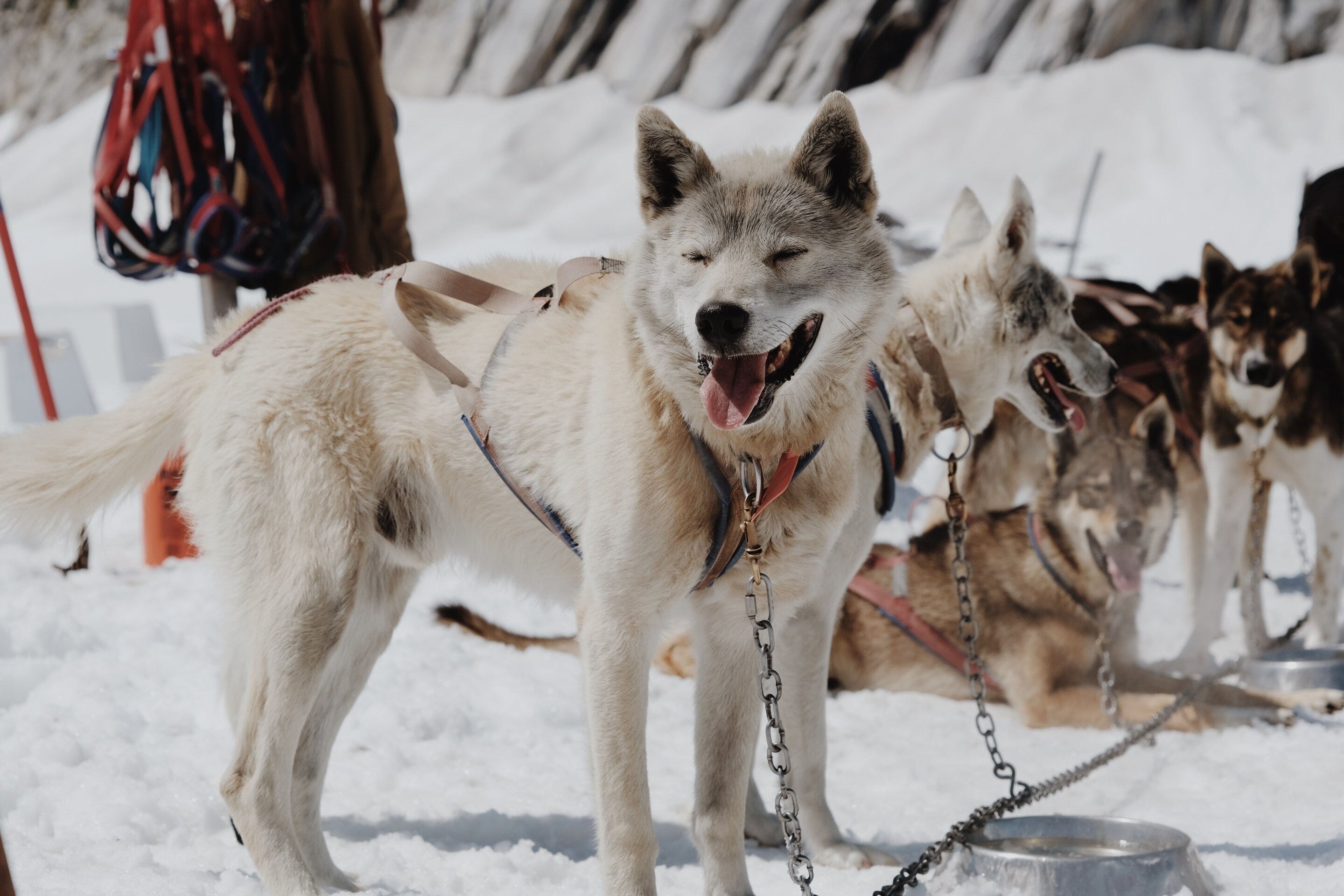
A team led by Mitya Kletzerman at the School of Archaeology and Maritime Cultures, University of Haifa, argues in iScience1 that the whole approach starts from the wrong end. Pathology, in their reading, marks a mismatch between the load imposed on an animal and what its skeleton could bear. A population bred for traction over many generations would have lost the dogs that broke down and kept the ones that did not, which leaves the evidence in inherited proportions, in the shape of the animal, and in much less of it on any one individual’s bones.
The stakes are practical. Sled parts rarely survive in the ground, so the question of when dog sledding began and how it spread has rested on a thin run of finds: sled parts alongside dog remains on Zhokhov Island about 9,000 years ago, then a long gap, then the same pairing at Ust’-Polui in northwestern Siberia about 2,000 to 1,500 years ago. Inuit culture was taking shape in what remained of Beringia at roughly that time, and its eastward expansion across the Bering Strait region around 1,000 to 800 years ago replaced the Paleo-Inuit traditions of the Eastern Arctic; the arrival of the Inuit is marked by more dog remains and more sled equipment. Morey and Aaris-Sørensen suggested in 2002 that the rise in dog remains reflects the emergence or intensification of sledding. The Haifa team states that the claim has never been tested empirically.


