

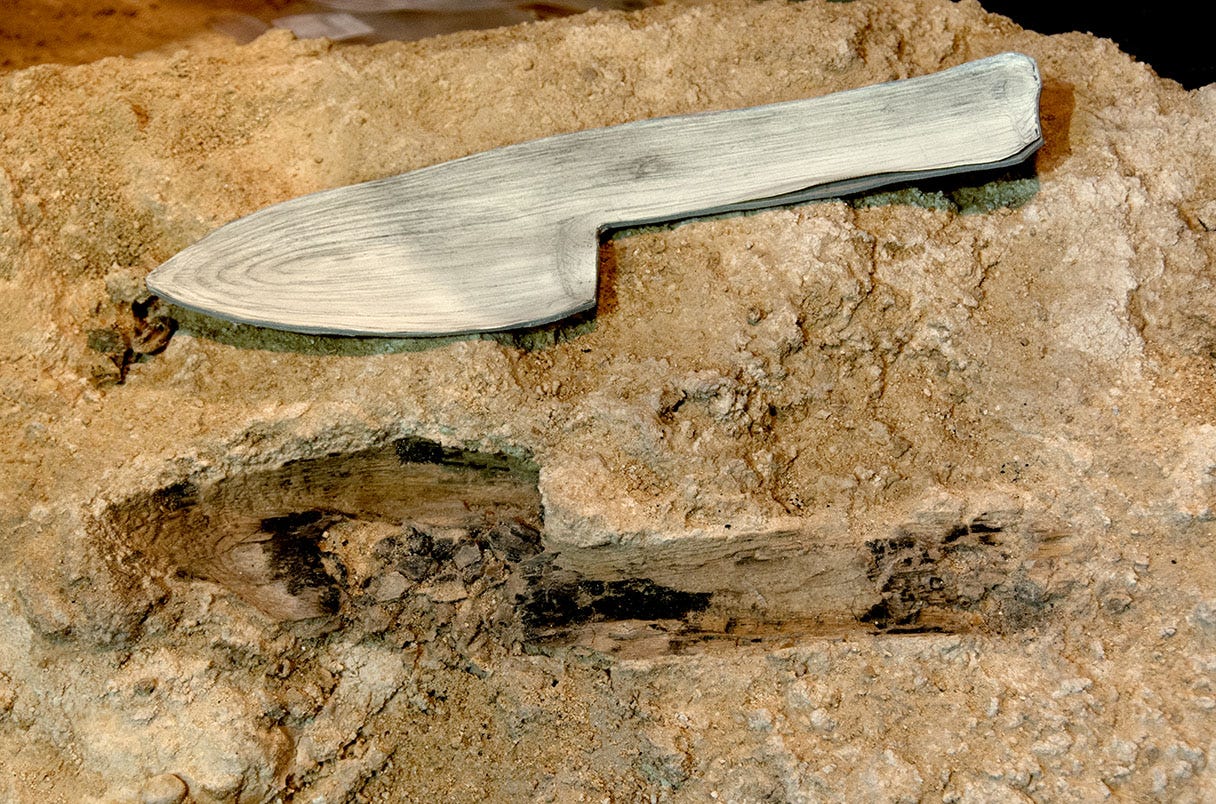
In level P of Abric Romaní, a rock shelter west of Barcelona, there is a cavity shaped like a club. The wood that filled it has decayed, but the mineral that grew around it kept a handle 16 centimeters long and 4.2 wide, an abrupt 90-degree turn, and a head 14.2 centimeters tall that thins to a tip 0.4 centimeters across. The authors of a paper in Science Advances1 say no similar object is known from the prehistoric record of the Old World, so everything anyone can say about this piece of Neanderthal woodworking comes from a hollow in rock.
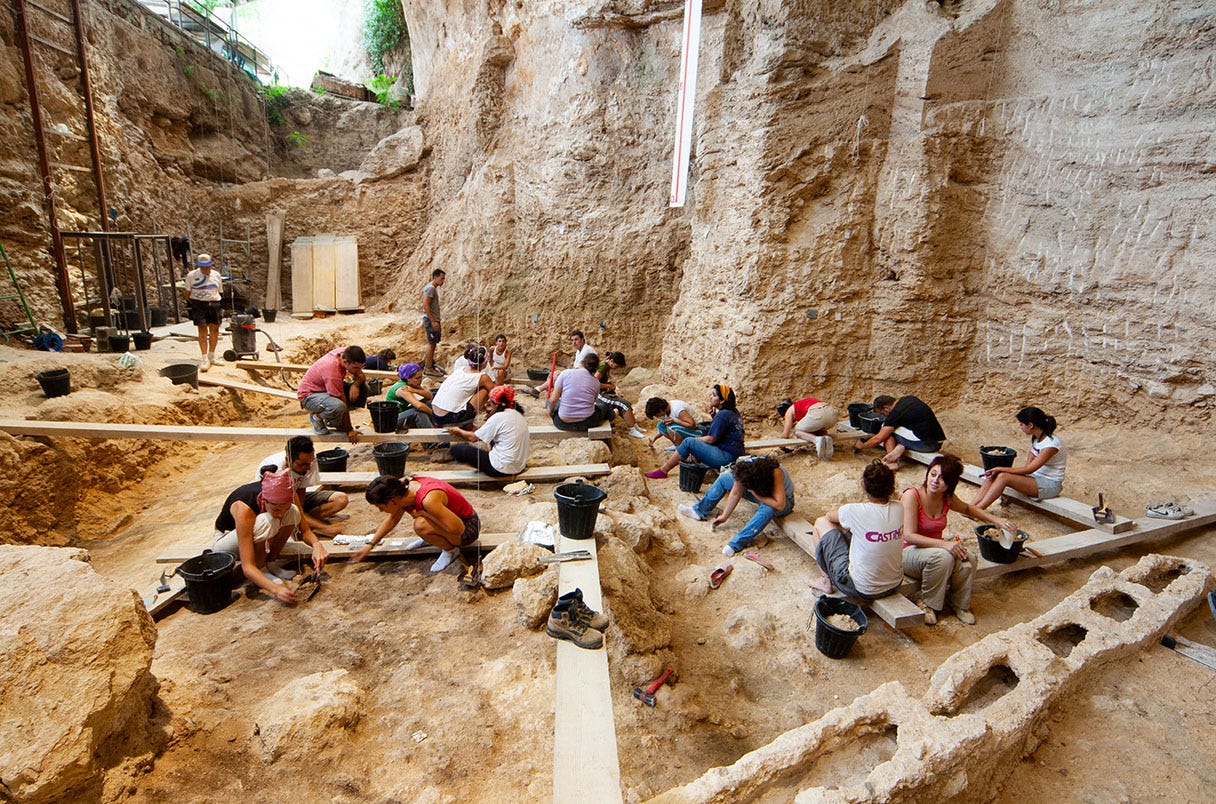
Most of what we picture when we picture Neanderthals was built from what archaeologists dig up, and what archaeologists dig up is stone: flakes, scrapers, cores. The era carries the material in its name. Wood, bark, hide and fiber rot, so a Paleolithic toolkit reconstructed from the ground is a toolkit with its perishable portion deleted, and a reader who assumes Neanderthal technology was knapped flint plus perhaps a sharpened stick at the margins is mistaking an artifact of preservation for a fact about people. At Abric Romaní, where flooding and travertine sealed wood in place, the deleted portion can be counted.
The count is 597 wooden specimens from 16 of the shelter’s lettered levels, dated to roughly 62,000 to 40,000 years ago. Most are trunks, branches, twigs, roots and firewood, whether natural or carried in by people. The team of Palmira Saladié, M. Gema Chacón, Josep Vallverdú and colleagues, working from the Catalan Institute of Human Paleoecology and Social Evolution (IPHES-CERCA), singles out 13 as worked or used: four bark trays, two structural pieces, four pointed implements of differing size, two spears, and the club. Each survives in one of three forms. A wood imprint is the travertine mold alone, a charred wood imprint is a mold with charcoal adhering to it or filling part of it, and charred wood is charcoal larger than five centimeters.
The trays, from levels H and O, are charred slabs of bark 30 to 55 centimeters long with a shallow concave profile, and the authors concede that bark which fell off a tree is hard to tell from bark someone shaped; they lean on the size, the regularity, the nearness of hearths, and the use of juniper (Juniperus) where pine dominates nearly everything else.
A pole from level N, 510 centimeters long and stripped of its branches, lay beside five hearths in an 18 square meter patch with few other finds, between two dripping domes and the back wall of the shelter. The authors read it as the third side of a lean-to or windbreak, then add that current debate about Middle Paleolithic architecture, which turns on how to separate a built feature from the planned use of space, calls for caution about exactly this sort of reading.
The spears carry more weight. One from level Ra is 245 centimeters long and 3.66 centimeters across at its thickest, and that thickest point falls 121.5 centimeters from one end, at 49.5 percent of the preserved length. A second, in Rinf, is 199 centimeters, smooth-shafted with the knots of cut branches, and tapers over its last 13 centimeters to a point 0.6 centimeters wide. Level Ra held the remains of at least four red deer, the only ungulate there, including three adult male skulls with antlers still attached, which the team takes to mean autumn or winter kills. They compare the spear to those from Schöningen in Germany, where wooden spears and throwing sticks about 300,000 years old were recovered, and call it consistent with a thrusting spear while warning that several of the comparison objects are incomplete or deformed. No cut marks on the deer bones record a spear being used, which the authors note is typical.


