

On a shelf of red bedrock in Caprock Canyons State Park, in the Texas Panhandle, lie the bones of bison killed over roughly 3,000 years, in a spot no bison can walk to. The shelf sits 50 meters above the valley floor and 20 meters below a cliff, ringed by scarps too steep to climb, and the park’s free-ranging bison never turn up on it today. According to a new study, the Nighthawk site is a Texas bison jump, where people drove bison off the edge above on at least seven occasions between the Late Archaic period and the Protohistoric.
By the standard account, that should not have happened this far south. Bison jumps are best known from the northern Plains, where hundreds are reported, while southern evidence has been sparse and disputed; in Texas the one well-known candidate was Bonfire Shelter in Val Verde County, whose older bone bed has long drawn skepticism. In 1997 Kent Buehler suggested, in a paper1 titled “Where’s the Cliff?”, that the region lacked suitable precipices, and many archaeologists came to assume southern Plains people did not use jumps at all. The mass kills known from the Texas and Oklahoma Panhandles are nearly all arroyo traps, steep-walled gullies where a herd could be cornered.
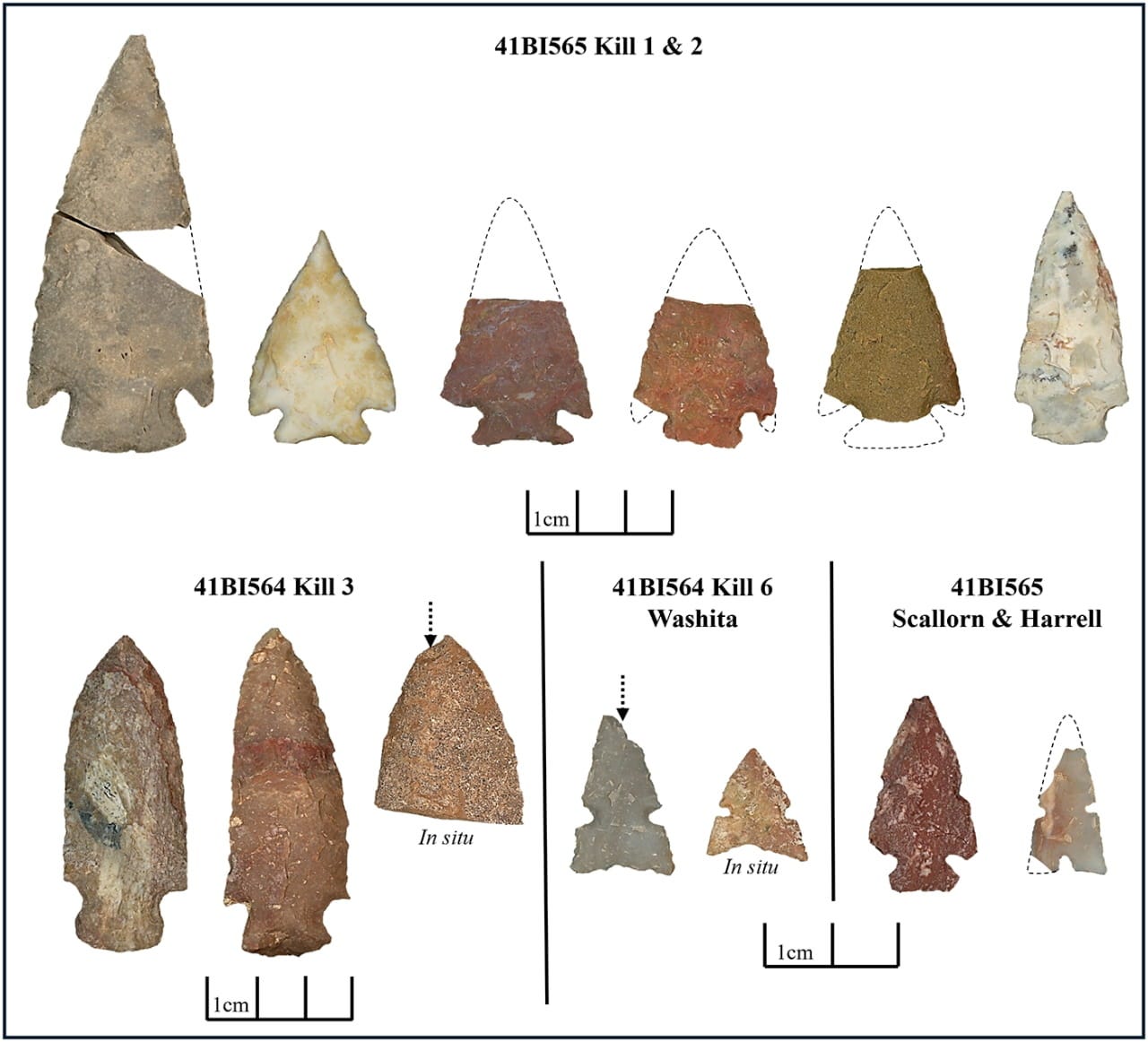
The study, in American Antiquity,2 is led by August “Gus” Costa, adjunct lecturer of anthropology at Rice University, with seven coauthors. Twenty-seven radiocarbon dates, 25 on bone collagen and 2 on charcoal, sort into at least seven kill events between about 3500 and 400 cal BP (calibrated radiocarbon years before present), and the 2,143 bone specimens, all of Bison bison, represent at least 27 animals. The team now counts eight jumps, Nighthawk included, within 15 square kilometers in and around the park, and argues that erosion and archaeologists’ blind spots explain much of the southern scarcity, though not all of it.


