

At Kolodyste 2, a Copper Age settlement in the Southern Buh and Dnipro interfluve of central Ukraine, the published drawings of the excavated vessels include a sphero-conical pot and a biconical one, set side by side as examples of a shift in shape that played out over generations. The biconical form gradually took over. That swap is a small piece of a larger change in Trypillia pottery between roughly 4100 and 3600 BCE, during which the number of decoration classes in the region fell from six to one while the settlements producing the pots were growing.
Most readers, and a fair number of archaeologists, carry a working assumption that a more complex society makes a more varied material world: more specialists, more occasions to mark, more kinds of pot. Bigger towns should mean more styles. A paper published on 7 October in PLOS One1 by Aleksandr Diachenko (Institute of Archaeology, National Academy of Sciences of Ukraine, Kyiv) and Detlef Gronenborn (LEIZA, Mainz, and Johannes Gutenberg University) sets out to explain why societies on similar trajectories can leave opposite signatures in their ceramics, and why the same curve on a graph can mean quite different things.
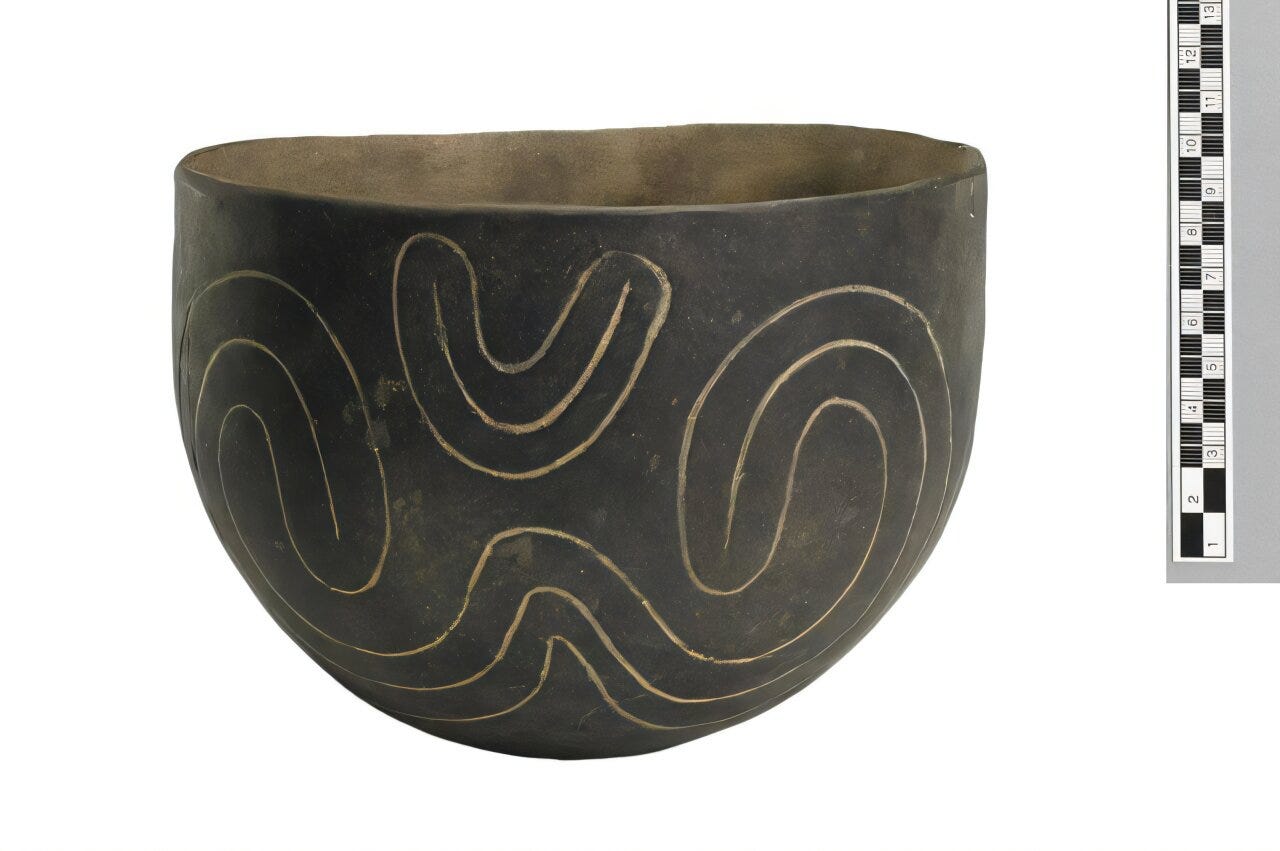
The contrast they draw is with Gronenborn’s earlier work on the Linear Pottery culture (Linearbandkeramik, or LBK) of southwestern Germany, 5400 to 5000 BCE, where decoration was read as a code for identity. In that sequence the diversity of the primary decoration, the band types running around the vessel, climbed alongside the population proxy and then began to fall before the population itself did, while the diversity of secondary motifs went on rising. The authors take this as a shift in emphasis from a broad regional identity toward the self-identification of sub-groups, and the figurines typical of the early phases drop out of the record along the way. In LBK, in other words, a rise in pottery diversity tracked a rise in social complexity, which is the intuitive reading.


