

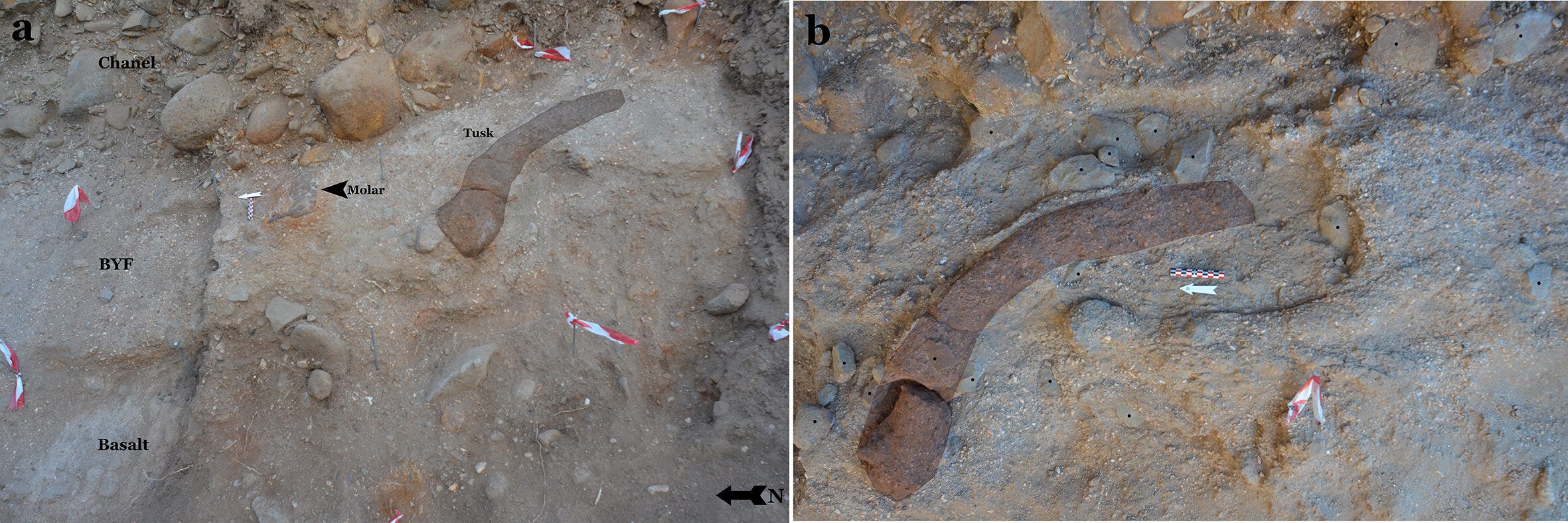
In 2022, in Area B of the North Bridge Acheulian (NBA) site, two kilometers north of Gesher Benot Ya’aqov in the upper Jordan Valley, excavators uncovered the molar and several pieces of tusk of a straight-tusked elephant. They lay among basalt handaxes and cleavers. The molar was almost entirely wrapped in breccia, the cemented sediment that had held it for something like 700,000 years. Reaching the chewing surface for microwear casts meant cutting relief grooves into the crust with a Dremel fitted with a diamond disc, stopping several millimeters short of the enamel, and then tapping the edge of each cut with a chisel until the breccia let go.
The straight-tusked elephant, Palaeoloxodon antiquus, has a settled reputation as an animal of warm interglacial Europe. Its bones turn up as far north as Britain, Denmark and western Russia. At Neumark Nord in Germany, around 125,000 years ago, Neanderthals worked elephant carcasses, and carbon isotopes in the teeth from that site place the animals under a forest canopy. The Levant, meanwhile, is usually described as a corridor, a strip of Mediterranean habitat between Africa and Eurasia that swung between conduit and barrier as glacial cycles turned. Hold both pictures at once and a straight-tusked elephant in Israel looks like a forest animal at the dry edge of its range, passing through a gap. The NBA tooth points to an animal that stayed near water, ate a steady diet, and drank something quite unlike local rain.
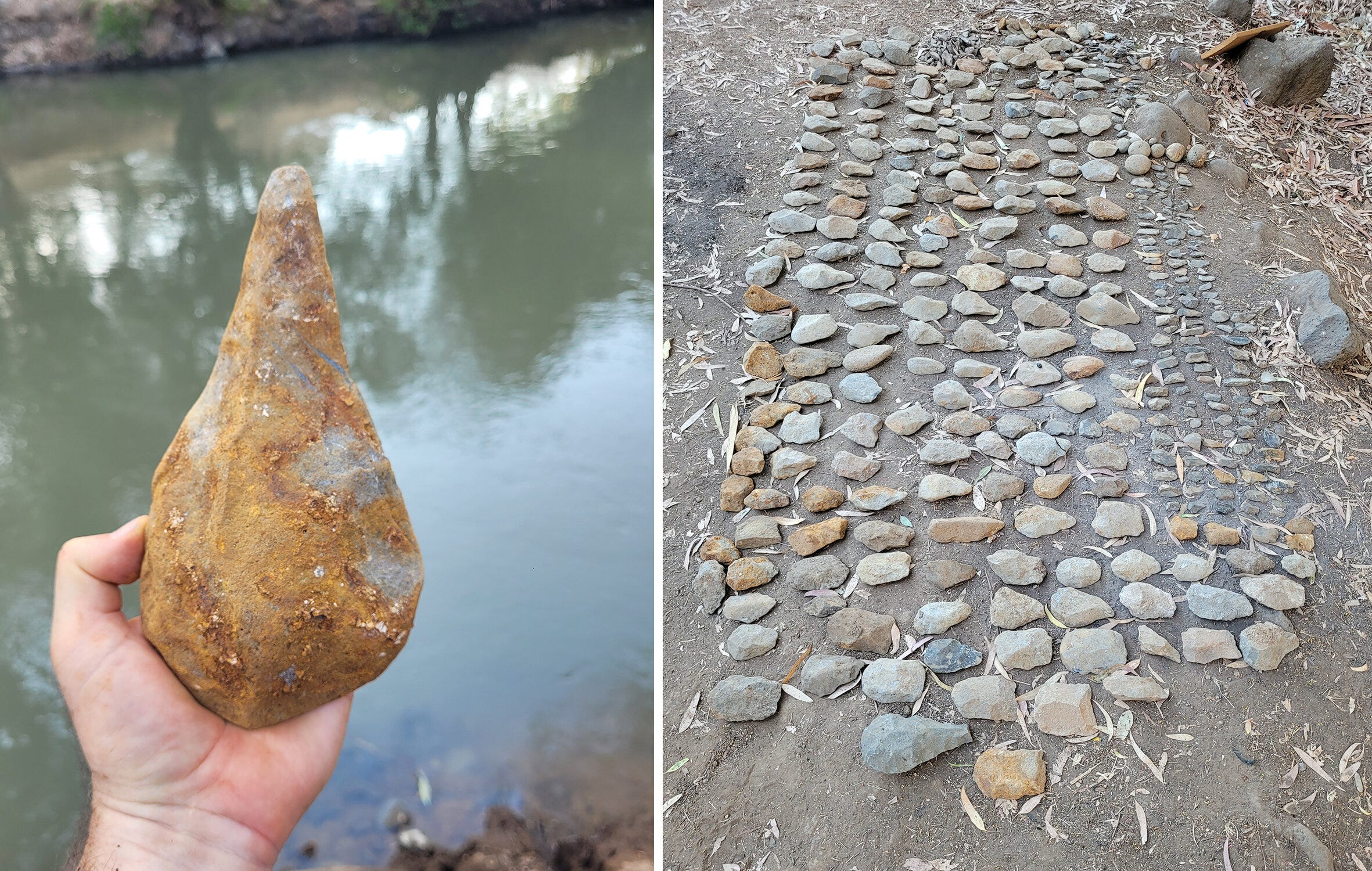
The question the tooth can answer is what grew and flowed along this stretch of the corridor at a resolution of years. Hannah Farrell of the University of Haifa and her colleagues note1 that regional reconstructions lean on distant sea cores and climate simulations, which are imprecise for a narrow Mediterranean zone. An elephant tooth found in direct association with handaxes records conditions over a span they compare to hominin lifetimes.
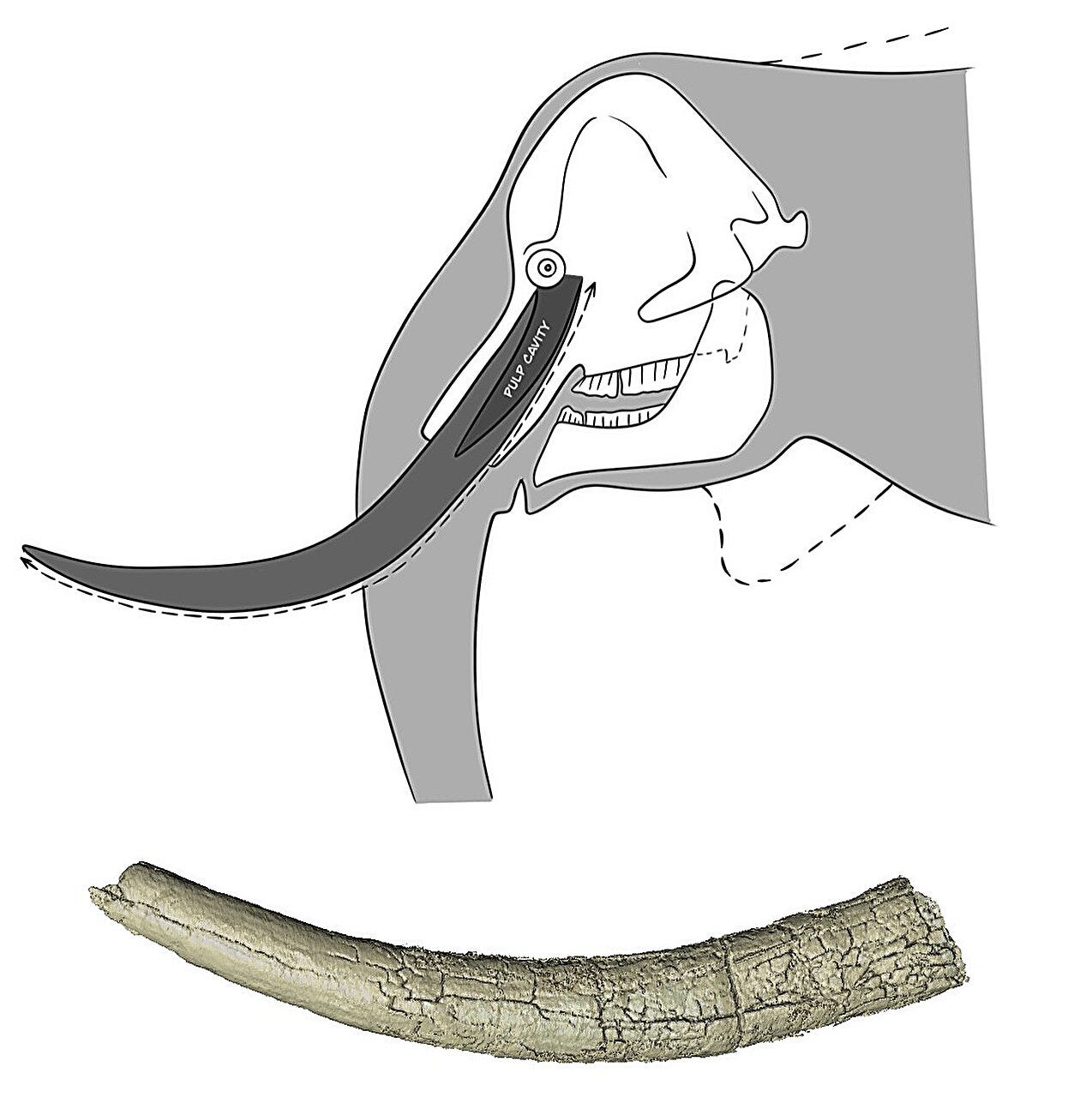
CT scans taken in the radiology lab at Rambam Hospital in Haifa, and 3D models built from them, identified the tooth as the left lower third molar of an adult P. antiquus. Eleven enamel plates survive, an undercount because the front of the tooth broke away before burial, and the plate frequency is 5.37 per ten centimeters.
The hypsodonty index, crown height over crown width, was 2.574, where values above 2.0 are common in Palaeoloxodon antiquus and rare in most Mammuthus species.
The age needs some care. The NBA horizon sits above a basalt flow that argon-argon dating placed at 658 ± 15 thousand years ago in 2010 (Sharon and colleagues). New dating of the same flow gave 696.8 ± 6.7 thousand years, a result the paper cites only as a personal communication from Gonen Sharon of Tel-Hai University, so it has not yet appeared in a publication of its own. The two figures differ by nearly 40,000 years. The authors describe the elephant-bearing unit as slightly younger than 700,000 years and assign it to Marine Isotope Stage 17, an interglacial during the Mid-Pleistocene Transition, when glacial rhythms were lengthening toward the 100,000-year cycle.


