

Two aurochs bones from Scania, in the far south of Sweden, were sequenced a second time for a paper in The Holocene,1 which raised their coverage to 1.19X for the animal called Ska1 and 2.18X for Ska3. That was enough to read their runs of homozygosity, the stretches where the copies of a chromosome inherited from each parent are identical. Counting only runs longer than a megabase, the totals came to 918 megabases for Ska1 and 917 for Ska3, a near tie between two animals that were not necessarily contemporaries. No other aurochs in the comparison set carries as much uniform DNA, including the Sicilian animal, the Jutland animal, and every mainland European and British genome the team lined up beside them.
Most people who know the aurochs know how it ended: the last cow died in a Polish forest in the 17th century, and people did it. The authors accept that for Poland. They do not accept that it explains Scandinavia, where the species was gone thousands of years before, and where the usual suspect, the Mesolithic hunter with a spear, turns out to have been busy at the wrong time and in the wrong places to carry the whole blame. A second belief sits underneath the first, namely that the animals were cut off from the continent by about 10,000 years ago and began their slow decline in isolation. The genomes do not quite say that either.
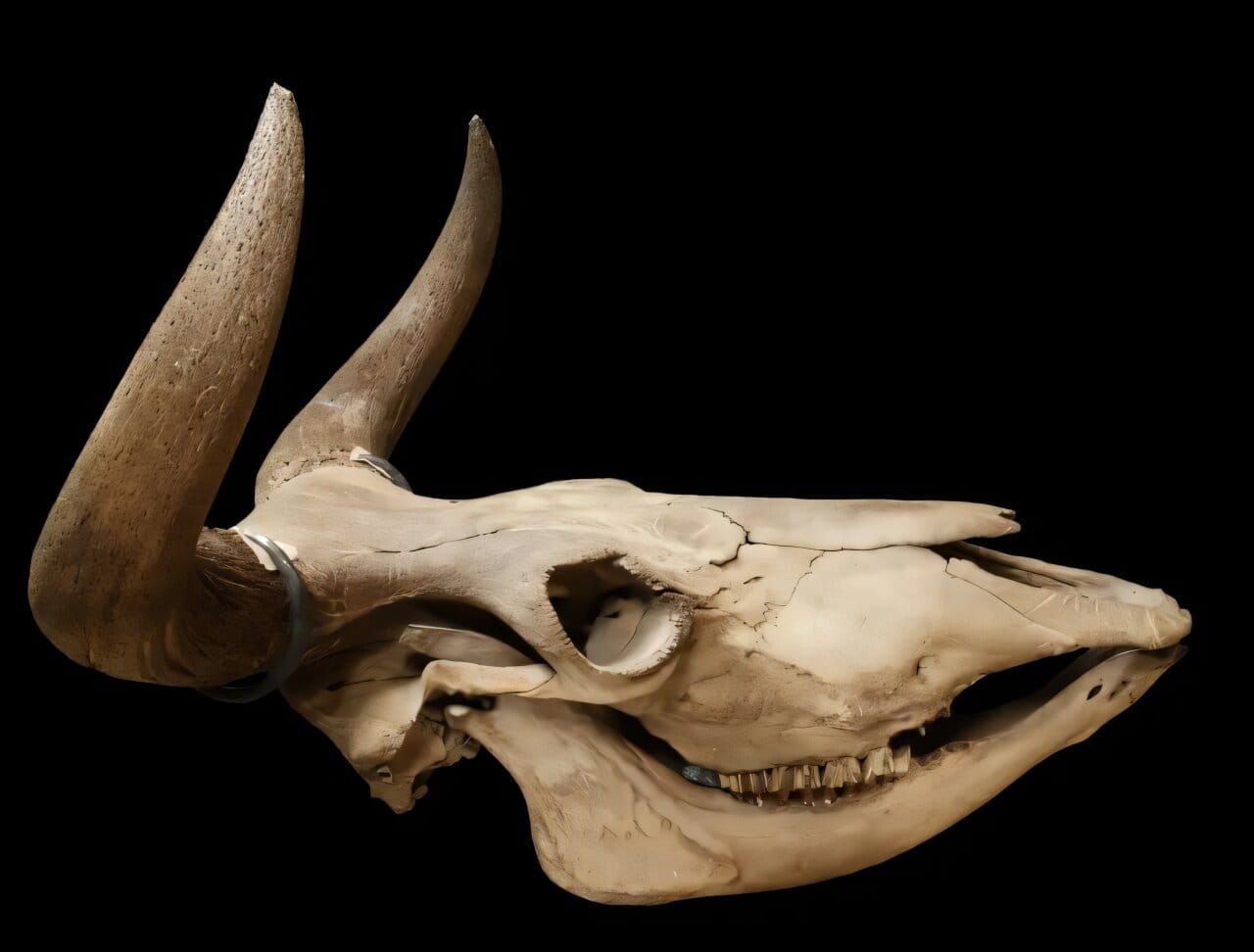
Start with the isolation, since the genetics speak most plainly there. All 11 sampled Scandinavian aurochs belong to the P1 mitochondrial haplogroup, and their common maternal ancestor lies somewhere between 18,200 and 12,500 years ago (cal BP, 95% highest posterior density). They cluster with western European sequences, which fits a colonization out of a Franco-Iberian refugium after the ice, across a land bridge that low seas and rebounding land had opened in the western Baltic. For a long time the working assumption was that a river and lake system draining across present-day Denmark cut the Scandinavian population off as early as 10,000 cal BP. The nuclear genomes agree that the animals had drifted apart from the mainland; in a multidimensional scaling of allele sharing, the Scanian, Zealand and south-central Swedish samples sit in a tight group far from the western European one, with the Zealand and Swedish animals the most drifted. But the mitochondrial tree, built from 34 mitogenomes of which 11 are Scandinavian, shows lineages that still join up with continental ones as recently as 10,300 to 8,500 cal BP, and the pattern suggests some contact with the mainland lasted until the Danish-Swedish straits finally flooded around 8500 to 8000 cal BP. The Jutland animal, Hjo1, diverges from the Scanian and Zealand sequences at 9,900 to 8,500 cal BP.
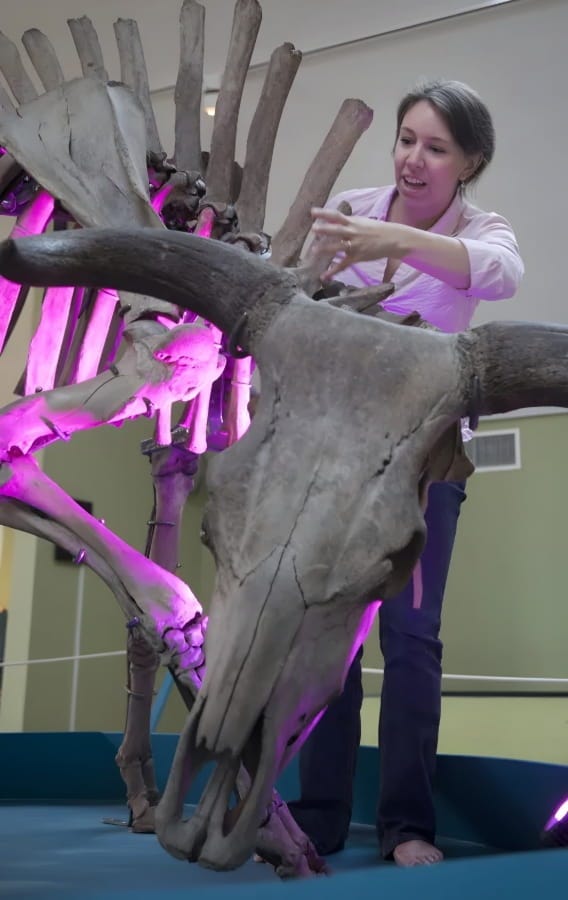
The cost of arriving was already written in the genomes by then. The long runs of homozygosity that mark recent matings between close relatives are almost absent in Ska1 and Ska3, and what fills their profiles instead is a heavy load of short and medium runs, which the authors read as the signature of a population that had been small for a long time, a bottleneck during colonization, rather than of parents who were cousins. Hjo1, the more recent animal from North Jutland, has the larger fraction of long runs, so inbreeding in the strict sense does show up, but later and farther north. The authors keep saying how thin this evidence is: the demographic inference rests on two individuals, and each genome, they note, carries the genealogies of hundreds of ancestors, which helps without settling anything. They also decline to say that inbreeding killed the species. The woolly mammoth went through a severe bottleneck and still lasted roughly 6,000 years on Wrangel Island (Dehasque and colleagues, 2024), so a poor genome can be a very long sentence.


