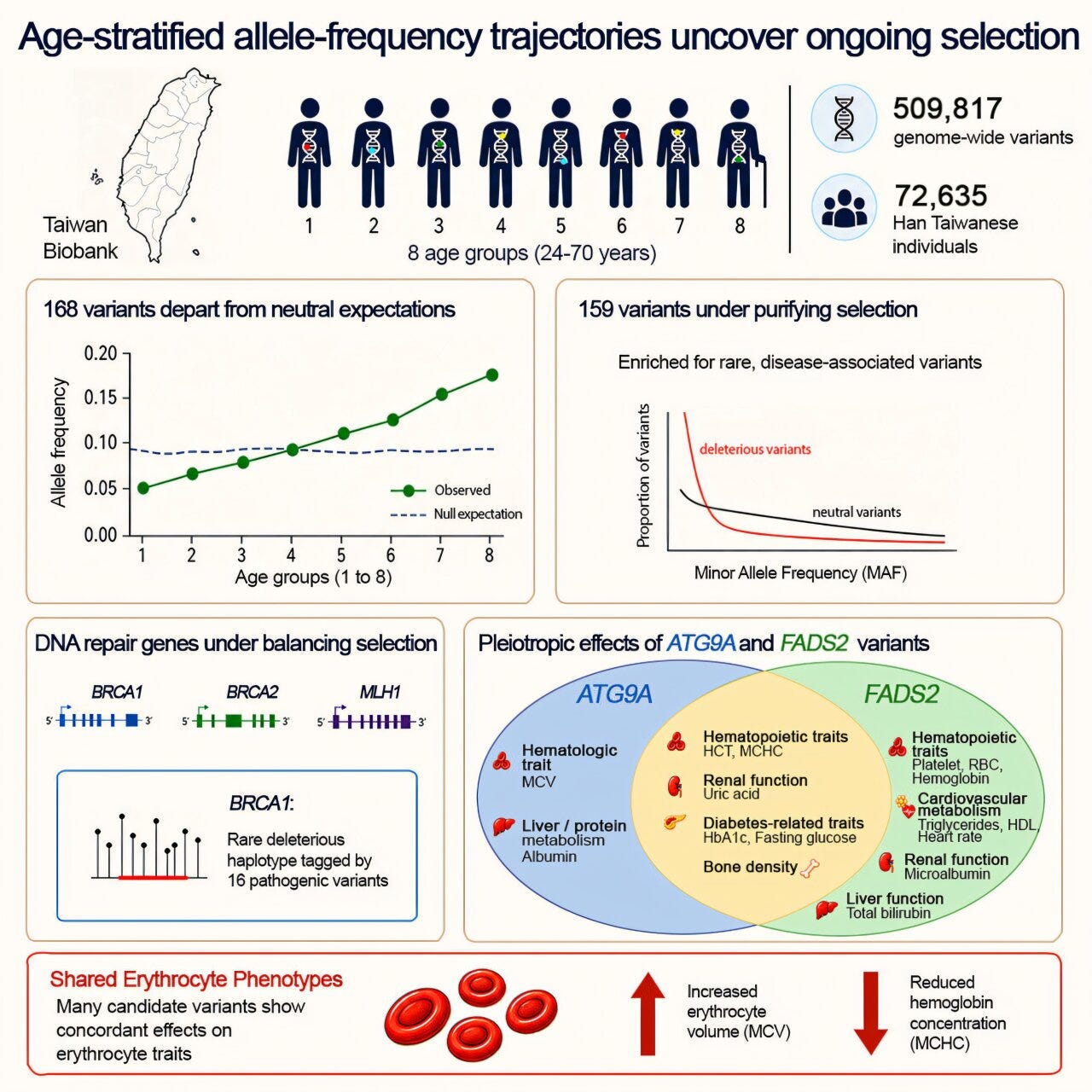
Somewhere on chromosome 17, in the DNA of tens of thousands of Han Taiwanese people, there is a stretch of BRCA1carrying sixteen variants that should not still exist. Fifteen of them are classified as pathogenic. Fourteen cause frameshifts, the kind of mutation that scrambles a protein’s reading frame past the point of repair. This haplotype is rare, present in roughly six of every ten thousand copies of the gene, and it is getting rarer. Purifying selection is doing what purifying selection does: quietly deleting a bad genetic sentence, one generation at a time.
But a few hundred kilobases away, in the same gene, in the same population, a completely different haplotype is thriving. It carries variants at a frequency of about 37 percent, common enough to be unremarkable, and it shows the unmistakable genomic signature of positive selection, the kind normally associated with something being actively favored rather than tolerated. Whatever is happening at BRCA1 right now, it is not one story. It is two, running in opposite directions, in the same gene, in living people.
That is the strange, quietly startling core of a new study in The American Journal of Human Genetics,1 led by Jing-Lian Chen and Wen-Ya Ko’s team at National Yang Ming Chiao Tung University, working with Yoko Satta at SOKENDAI. The tool they used to find this wasn’t a fossil, an ancient genome, or a cross-population comparison. It was a biobank, and a fairly simple idea about age.