

Chimp B, one of three adult male common chimpanzees, Pan troglodytes, trained at Stony Brook University to walk on two legs, never heel-struck. Across forty-three recorded strides down an eleven-meter runway lined with force plates, walking the way he had been taught to for at least six months, an hour a day, three to five days a week, in exchange for food, some other part of his foot always touched the ground first: the ball, the outer edge, anything but the heel. Chimp A, tested on the same runway, used a heel-strike in thirty-one of seventy-six steps. Chimp C used one most of the time, seventeen of twenty-nine. All three chimpanzees were physically capable of putting their heel down first, and two of them sometimes did; the third, across every one of his recorded steps, simply never touched heel to ground.
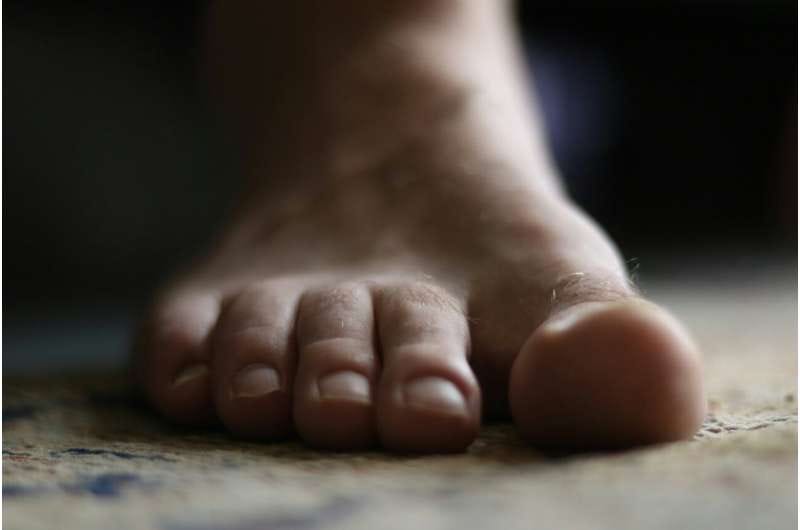
A heel-strike is exactly what it sounds like: the heel touches down first, before any other part of the foot, and only then does the weight roll forward across the sole toward the toes. Every person reading this does it, at every step, and has done it since somewhere around the age of two, regardless of how long or short their legs happen to be. It is such a stable, unremarkable piece of anatomy that biomechanists studying the origins of human bipedalism have mostly looked past it, chasing flashier explanations involving the pelvis, the spine, the size of the gluteal muscles. Landing on the heel seemed like a detail.
New data, published today in the Proceedings of the National Academy of Sciences1 by a team led by Nicholas Holowka, an assistant professor of anthropology with a joint appointment at the Huck Institute of Life Sciences at Penn State, argue that it is not a detail. Heel-striking, in their account, is a genuine adaptation, one that appeared somewhere along the hominin lineage and had to be paid for twice over: once in energy spent, and once in force absorbed by bone.
The team’s clearest evidence for how strange the human heel-strike really is comes from how little it varies. Nine barefoot adults, walking at their own pace across a rigid runway at the University at Buffalo while an eight-camera motion-capture system tracked reflective markers on their legs and pelvis, produced a foot-strike angle, the angle the foot makes with the ground at the instant of contact, that ranged across the whole group by only 10.3 degrees, from 12.3 to 22.6. A single chimpanzee, walking on a comparable runway, could swing, individually, across 2.4 to 8.6 times that range from one step to the next. Chimp A’s own range, all by himself, was 39.7 degrees. Chimp C’s was 23.8. Chimp B, oddly, was the tightest of the three at 11.1 degrees, closer to human consistency than either of the other two, but centered on an angle that never once crossed into heel-strike territory. He had found his own fixed setting, just not the one that includes a heel.
What that fixed human setting buys is efficiency, and the researchers finally have a number for it. Eleven of the human volunteers walked on a treadmill while breathing into a K5 portable respirometry system, which tracks oxygen consumption and carbon dioxide output breath by breath, first using their normal heel-first gait and then using a deliberately altered one: contacting the ground near the outside edge of the forefoot, close to the base of the pinky toe, before letting the heel drop, a posture the researchers call a midfoot-strike. Volunteers needed about ten minutes of practice to manage it without stumbling. Walking heel-first cost an average of 2.59 joules per kilogram per meter traveled. Walking midfoot-first cost 3.46, a jump of 26 to 41 percent, and one the authors note is roughly six times larger than the metabolic penalty measured in an earlier study of runners switching from heel-strikes to midfoot-strikes. The same volunteers who saved that energy heel-striking also absorbed considerably more force doing it.
Loading rates, how fast the impact force arrives after the foot touches down, were 121 to 162% higher when volunteers heel-struck than when they used a midfoot-strike.
Impact peak forces followed the same pattern, 168 to 206 percent higher for heel-strikes, even though the overall maximum force each foot experienced across the full stance phase barely moved, drifting by less than two percent in either direction. The difference lives in the first few milliseconds of contact: a sharp spike that a midfoot-strike smooths away almost entirely.
Nathan Thompson, an associate professor at the New York Institute of Technology’s College of Osteopathic Medicine and a co-author on the study, put the mechanism in domestic terms.
“Imagine you are trying to sneak across a creaky wooden floor,” he said. “You tend to walk on the balls of your feet, because this reduces the rate of loading on the floor and creates less creaking. It’s a softer way to walk.”
That, more or less, is what the chimpanzees were doing, especially on two legs. Chimps A and C both used fewer heel-strikes when walking bipedally than when they were on all fours, and bipedal loading rates in the chimpanzees were 57.9 to 138.1 percent higher on the strides where they heel-struck than on the ones where they used a midfoot-strike instead. “It seems that when walking on two legs, chimpanzees prefer the ‘softer’ way to land on their feet,” Thompson said. A 2003 study of plantar pressure in seven bonobos found the same avoidance, more midfoot contact bipedally than quadrupedally, and researchers observing the terrestrial behavior of wild orangutans, who spend most of their lives in trees but do sometimes come down and walk upright, have reported similar reluctance to heel-strike. Something about standing on two legs seems to make heel-striking a worse bargain if you are an ape and not a hominin.
Nicholas Holowka, assistant professor of anthropology at Penn State, explains the differences between human and chimpanzee walking styles and why humans evolved to walk heel first. Credit: Ben Manning / Penn State


