

At White Sands National Park in southern New Mexico, 152 human footprints were measured in a single trench, and 72 of them fall into a size class that matches children of about six years old (6.3 years, give or take a tenth, in the authors’ estimate). Another 60 match adolescents or adults of at least 13.8 years, 12 match children near 11.8, and 8 belong to a child under four. The authors treat these ages as approximations, since the tracks had to be pooled across horizons to reach usable numbers, but the picture is still odd enough: a trench in a drying lake basin, and in it mostly children.
The trench cuts through 20 separate sediment horizons that carry human footprints, spread across roughly 1,800 years, between 23,500 and 21,700 years ago. The obvious reading, the one most educated readers would reach for, is that twenty layers means a place people returned to and lived beside, and that the gaps between layers mean the people had gone. Two papers published this year, one in Science Advances1 led by Kathleen Springer of the US Geological Survey and one in Fossil Studies2 by Matthew Bennett of the University of Reading and Sally Reynolds of Bournemouth University, complicate that reading considerably.
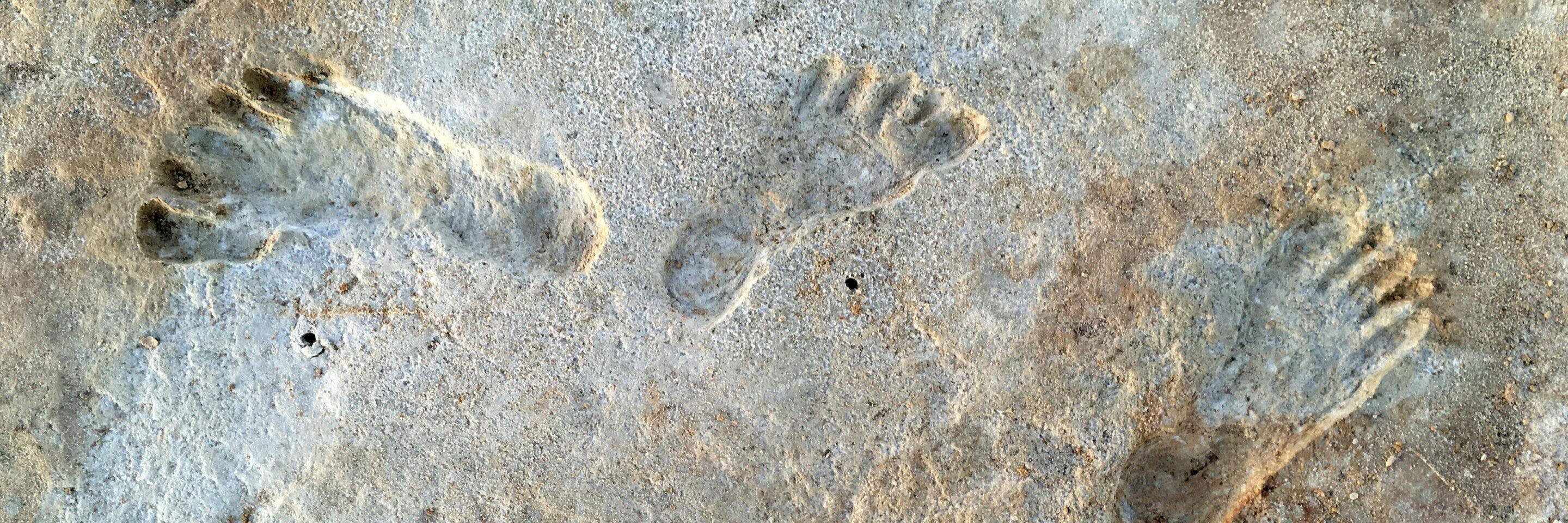
The excavation behind the first paper was physical work. In January 2020 and again in January 2022 the team cut the trench to a final length of 25 meters, exposing about 2.7 meters of stratigraphy, using a dirt-rated chainsaw to score the lateral edges and a pry bar to lever up blocks of sediment along their natural bedding planes. Those planes often carried footprints on their upper faces. Outlines show up as faint color shifts and changes in grain size, and in many places the tracks sat on hard gypsum-rich layers and appeared once the overlying silt was removed. The loose sediment was sieved in both seasons, and no artifacts were recovered.


