

The inside of a lugged pot from the chamber of Korshøj, one of the Neolithic passage tombs of western Zealand in Denmark, has been eaten down to the clay body. Like every corroded pot in a new study of the region’s pottery, it dates to the Middle Neolithic, c. 3200–2900 BC. The stone grit (temper) in its clay now stands proud of the surface where the finer material around it has dissolved. A white residue coats the damaged zone up to the liquid line, with a thin brown crust above it, and small white deposits sit in pits on the outer wall, where the authors think the residue may have seeped through.
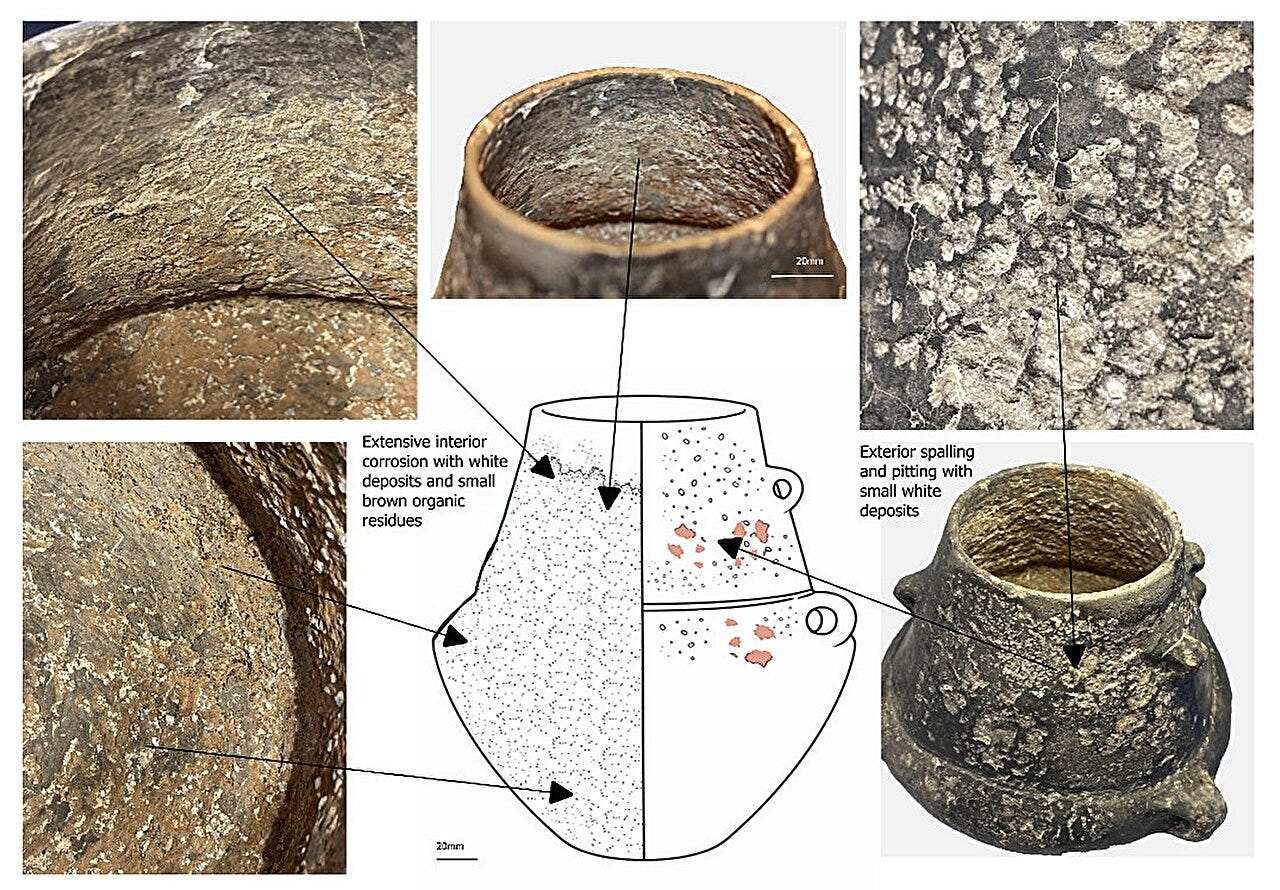
Korshøj is one of 31 corroded vessels in the study, and 29 of them came from inside tomb chambers. Readers who know these tombs tend to think of their pottery, some of the most elaborately decorated of the period, as valued for the vessels themselves. The study’s lead author, Lone Claudi-Hansen, from the University of Copenhagen and Museum Vestsjælland, asked in a statement accompanying the paper: “was it the vessels themselves or their contents that mattered?” Behind that sits a second assumption: when a pot’s interior has been chemically eaten away, archaeologists usually reach for beer, because the best-documented modern cases come from brewing households among the Gamo of southwestern Ethiopia (Arthur 2002,1 20032) and in Bedik villages in Senegal (Debels et al. 20243).
Claudi-Hansen and Adam Cordes, of Aarhus University and the National Museum of Denmark, publish the work in Antiquity.4 They examined 330 vessels of the Funnel Beaker culture, the term for the farming societies of southern Scandinavia in the Middle Neolithic (c. 3300–2800 BC), from 24 sites, and then filled nine replica pots with liquids relevant to Neolithic foodways. Fresh, unpasteurized milk that grew substantial mold over ten weeks gave the closest match to the ancient damage, and fermenting beer and mead gave none. The authors conclude that the corroded vessels held reactive, transformed contents, possibly dairy, and were selected for the tombs. I think the distribution of the pots supports the first half of that conclusion well, while the dairy half rests on a single replica, which the paper admits more readily than the press release does.


