

Sometime between 2.8 and 2.1 million years ago, a young Australopith at Sterkfontein in South Africa carried a mandibular torus, a thick bar of extra bone along the inside of the lower jaw. The jaw, Sts 52b, was recovered from the Member 4 deposits by Broom and Robinson in 1949 and attributed to Australopithecus africanus. It fits against an upper jaw, Sts 52a, and together they form most of one individual’s middle and lower face, catalogued as Sts 52. Its second molars had erupted and taken slight wear, but its third molars had not fully emerged, which makes it a late subadult.
Mandibular tori are benign outgrowths of bone, common in some living populations: about 60 percent of people in circumpolar groups have one, against under 4 percent in sub-Saharan Africa. The usual explanation is mechanical. Years of heavy chewing, along with clenching and grinding the teeth, are thought to load the jaw until it lays down extra bone, and in living people the trait most often appears between ages 30 and 50. A large torus on a jaw still waiting for its third molars fits that explanation poorly, and so does the trait’s near absence from the fossil record.
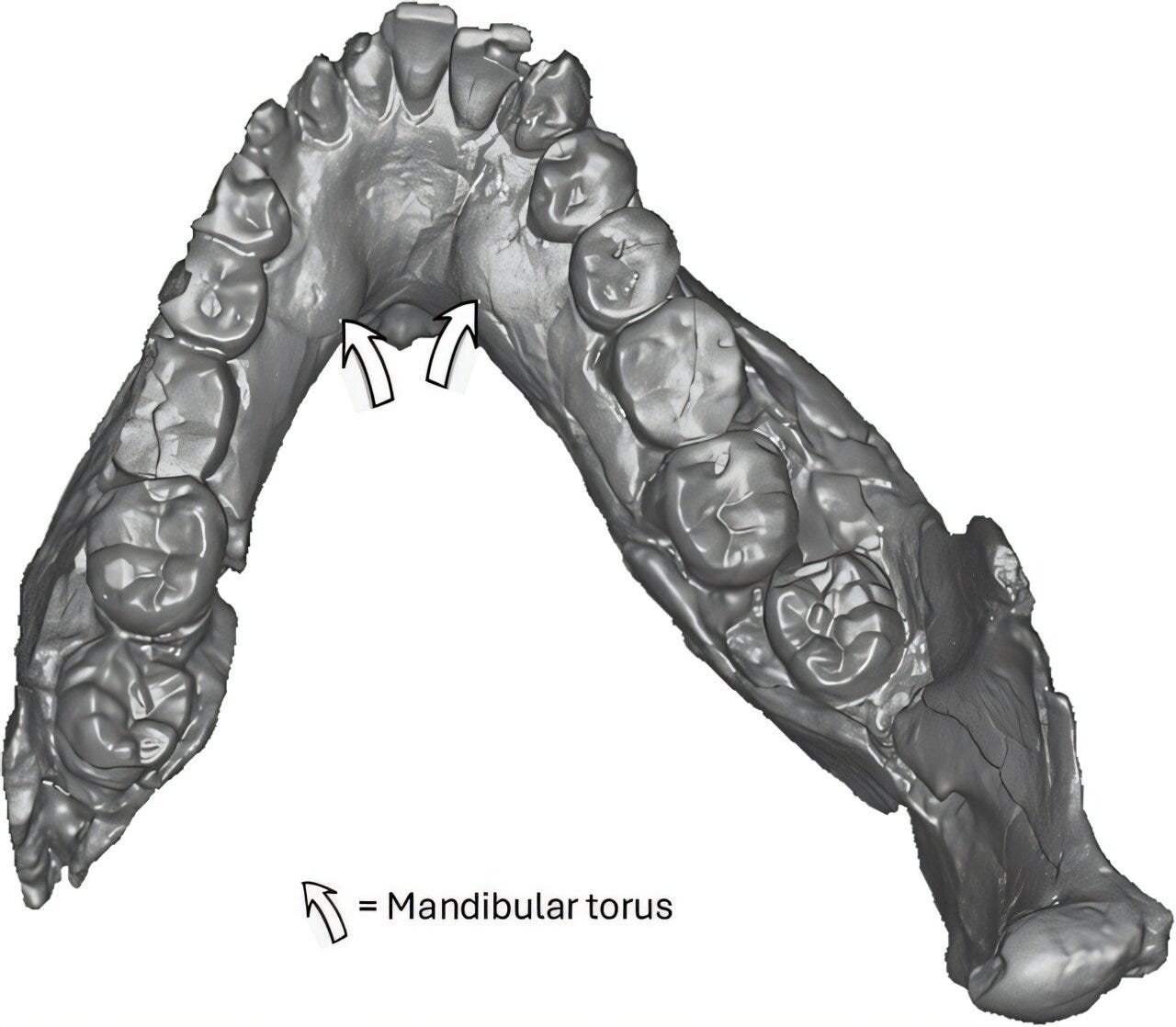
Luca Morris-Obst, a Ph.D. student at La Trobe University, and ten co-authors describe the torus in Evolutionary Human Sciences,1 scoring it at grade 3, perhaps 4, on a scale from 0 (absent) to 5. They call Sts 52b one of the earliest and most pronounced examples in the hominin fossil record. Partly on the strength of this jaw, and partly because no torus has been seen in Paranthropus robustus, they argue that chewing force alone is not enough to explain the ridge. T. D. White had noted the feature in his 1977 doctoral dissertation,2 so I think the paper’s real contribution is putting it into print with CT sections and a grade that other jaws can be compared against.


