

Most of the river gravel in the Huangping and Binchuan basins of northwest Yunnan, on the southeastern margin of the Tibetan Plateau, is something other than trachyte, a fine-grained volcanic rock. Archaeologists sampled 469 cobbles from gravel near the rivers, and about 28% were trachyte. Trachyte still makes up about 96% of the 166 Quina stone tools the same team collected from the surface of river terraces in those basins. Quina is a way of making and maintaining heavy scrapers. It belongs to the Middle Paleolithic, roughly 300 to 40 ka (thousand years ago). Whoever made these pieces chose their stone with little regard for what lay closest to hand.
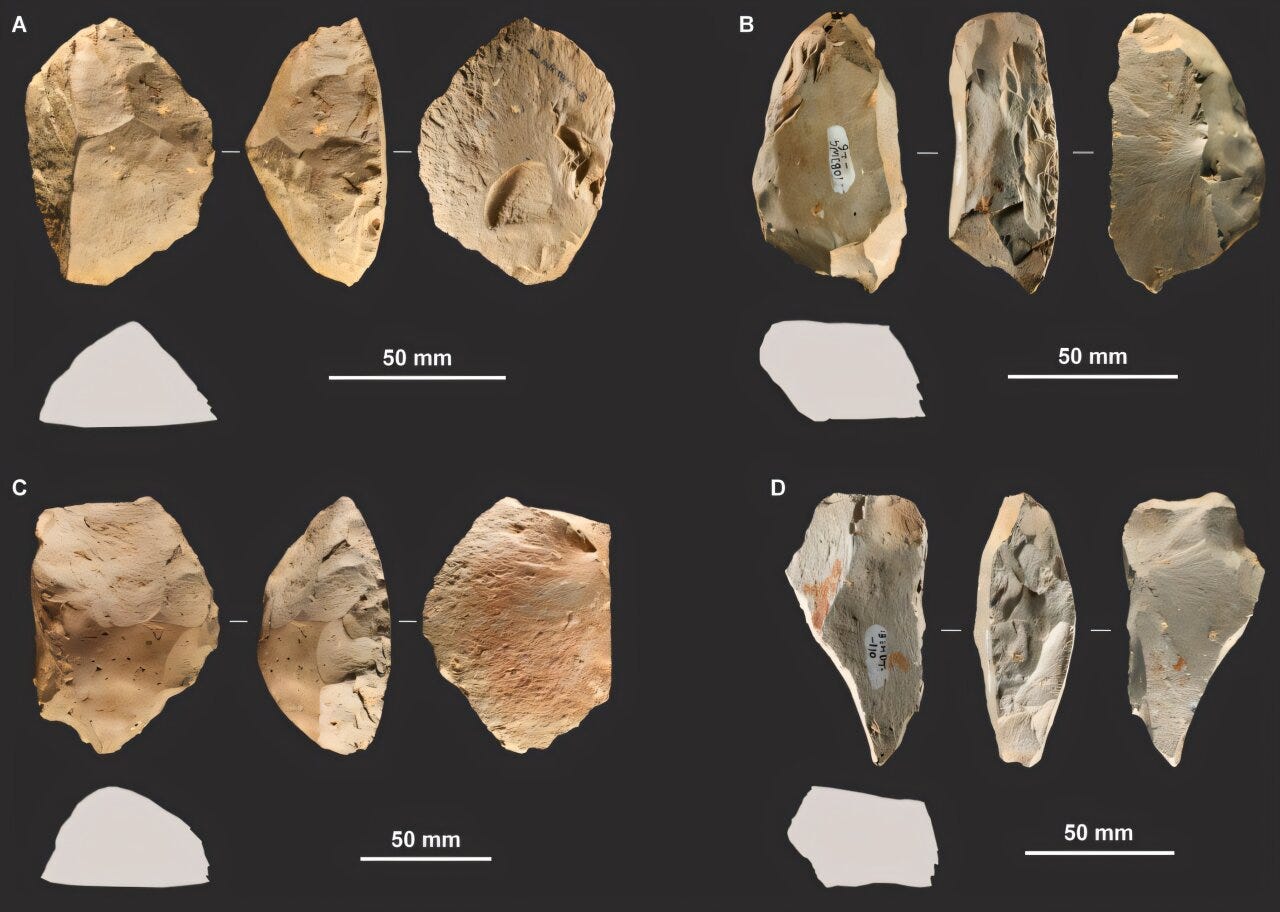
Quina is strongly identified with Europe. In its strict form the system is documented mainly in western and southern Europe during Marine Isotope Stages 4 and 3. These are climate phases of the last glacial period, numbered from deep-sea sediment records. In Europe the method is closely tied to Neanderthals. The paper also describes the conventional view of East Asia: the region had no phase corresponding to the western Middle Paleolithic, and new ways of making stone tools were deferred until the Upper Paleolithic. Longtan, a site in the Huangping Basin, cut against both ideas in 2025. That year members of this research team reported a complete Quina system there, dated to about 60–50 ka. Other archaeologists have challenged its classification and its dating. Until now it was fair to treat Longtan as a single disputed site that might prove to be an anomaly.
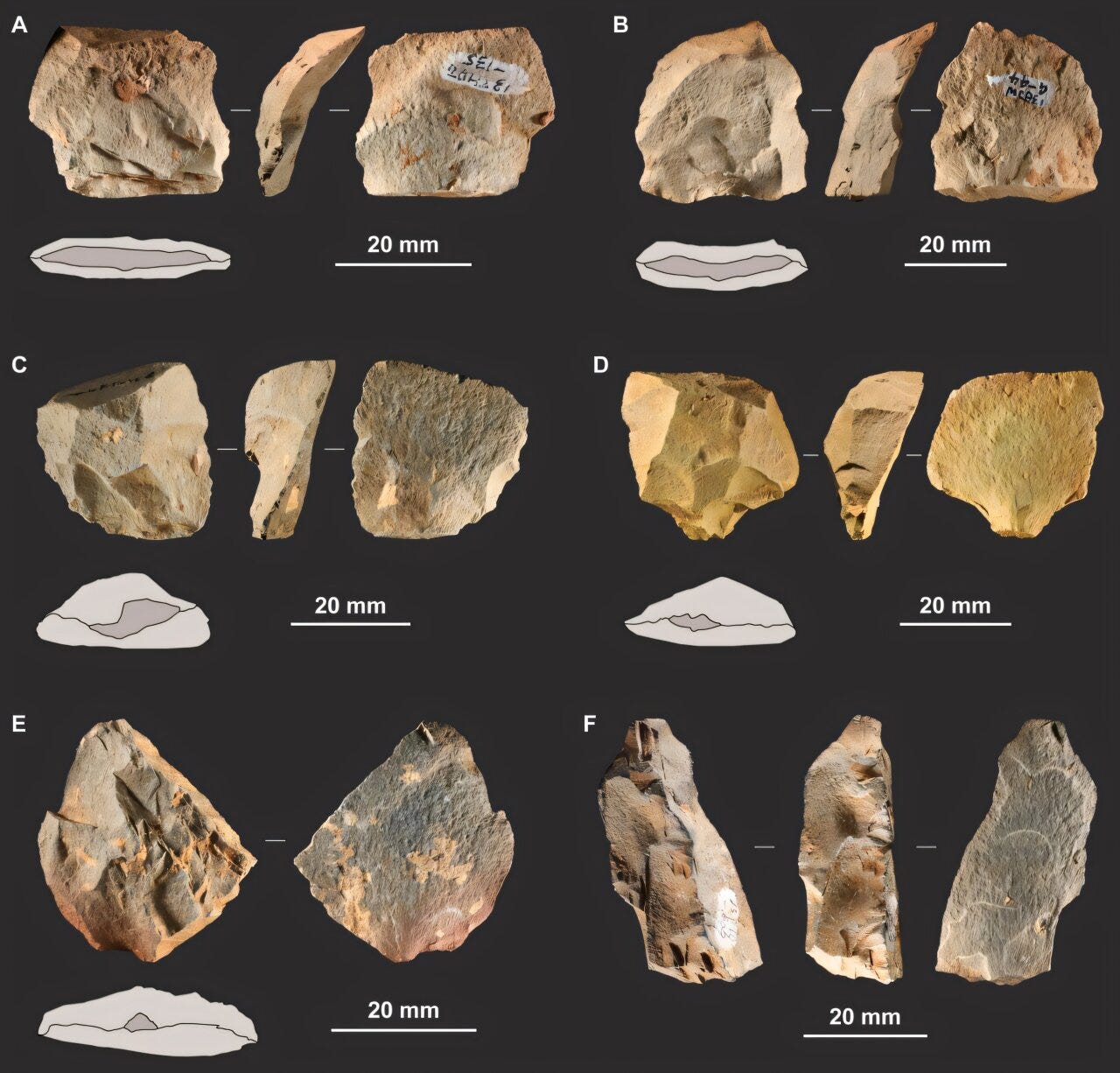
The new paper appears in Palaeogeography, Palaeoclimatology, Palaeoecology.1 Pei-Yuan Xiao of the Chinese Academy of Sciences and nine co-authors examine 166 Quina scrapers and 58 resharpening flakes from 27 surface localities in the two basins. Resharpening flakes are the small flakes knocked off a scraper when its edge is renewed. Surface localities are places where stone tools lie exposed on the ground, not buried in layers that can be dated. The authors report that the surface scrapers are technologically consistent with Longtan’s excavated Quina scrapers. Both groups differ significantly from Longtan’s non-Quina scrapers. From this they conclude that Longtan belongs to a regional Quina system. They also propose that the method may have answered an ecological problem like the one European Quina makers faced. They leave open whether that reflects convergence (independent invention under similar conditions) or diffusion (knowledge spreading between populations). I think the paper makes the regional case well for how the tools were made. It cannot yet speak to when they were made, because none of the surface material has been dated.


