

Partway along chromosome 14, in a stretch of DNA that codes for no protein, most people in sub-Saharan Africa carry the four letters TTGT. Many people in Europe and Southwest Asia do not; their copies of the chromosome skip straight past the spot. Hugo Zeberg and Svante Pääbo of the Max Planck Institute for Evolutionary Anthropology in Leipzig checked the same position in the five Neanderthals whose genomes have been sequenced at high coverage. Every read from every one of them showed the gap.
In a paper published in PNAS1 on November 16, the pair tie that gap to a slightly smaller occipital lobe, the region at the back of the brain that holds the visual cortex, and to a lower risk of schizophrenia. They find no measurable link to intelligence. To my eye this is one of the cleaner results in a crowded field, because the Neanderthal origin is demonstrated rather than assumed and the brain effect ranks first in the whole genome for one particular region.
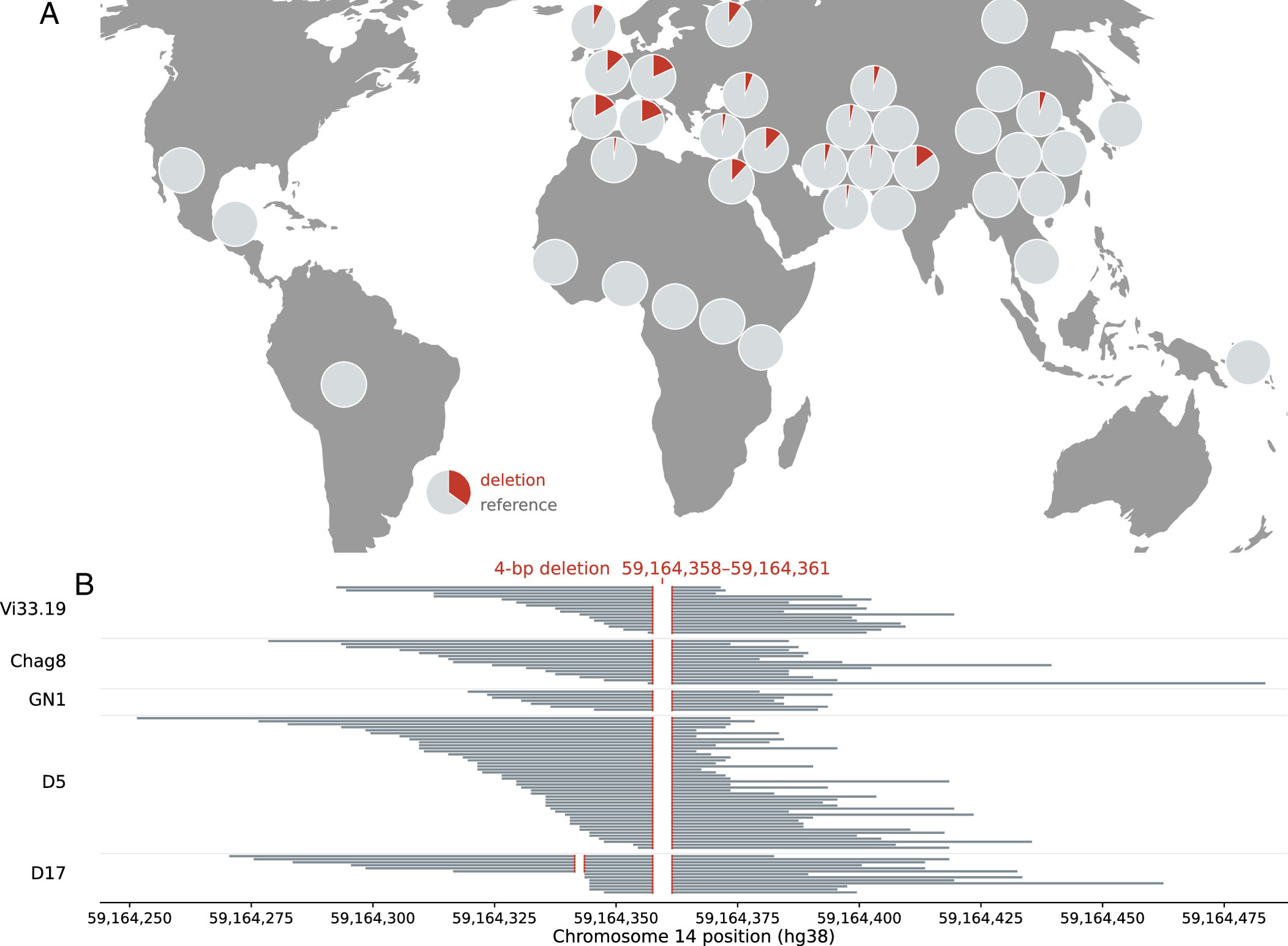
The paper juggles several related things, so some terms first. The variant is the four-letter deletion itself. It sits on a longer block of Neanderthal-derived sequence, about 59,700 letters long, called a haplotype, and everything on that block tends to be inherited together. Genotyping chips record short deletions badly, so the team followed the haplotype through a single-letter marker that travels with the deletion almost perfectly. The nearest protein-coding gene, DAAM1, begins about 24,300 letters downstream of the deletion. Its protein helps cells arrange their internal scaffolding and orient themselves within a sheet of tissue, both jobs that matter while the brain is first taking shape.
Proving a Neanderthal origin took two steps. The deletion is absent south of the Sahara and present in all five high-coverage Neanderthal genomes, from Vindija Cave in Croatia, Goyet in Belgium, and Chagyrskaya and Denisova Caves in Siberia’s Altai Mountains, individuals who lived roughly 45,000 to 120,000 years ago. Both high-coverage genomes from Denisovans, the Asian sister group of Neanderthals known mainly from DNA, carry the full TTGT. That pattern could still fit a very old variant, inherited by both lineages from the population that preceded their split, roughly 550,000 to 765,000 years ago by one widely used estimate. Old variants sit on short blocks, though, because recombination cuts chromosomes a little in every generation, and the authors put the chance that a block this long survived intact since that ancestral population at about 1.2 in 100,000. The likelier route is interbreeding, which genetic dating places in an extended episode between about 50,500 and 43,500 years ago.
For the anatomy, the pair turned to the Oxford BIG40 resource, which links genetic variants to about 4,000 measurements from brain scans of UK Biobank volunteers. Of all of them, the Neanderthal marker is most strongly tied to the volume of the left cuneus, a wedge of visual cortex on the inner face of the occipital lobe, and the deletion is the variant most strongly associated with cuneus volume anywhere in the genome, in both hemispheres. Across the whole occipital lobe, each copy goes with about 0.85 cubic centimeters less tissue, so people with two copies average roughly 1.7 cubic centimeters less than people with none. Because the volumes were adjusted for head size, the effect falls on the lobe rather than on the brain as a whole. A separate genome-wide study of cortical folding ranks the same marker second in the genome for a pattern of surface-area variation spread across the cortex.
None of the 21 variants on the haplotype changes a protein. The deleted letters fall inside predicted landing sites for several gene-regulating proteins, and the spot overlaps a site where SOX2, a protein required to maintain neural progenitor cells, binds DNA in lab-grown stem cells. Chemical marks of active DNA in the region show up mainly in embryonic and induced stem cells, while in adult brain tissue the region looks dormant, and the haplotype’s influence on DAAM1 activity in adult tissues is modest and inconsistent. All of it points to an effect exerted while the brain is being built.
The authors then checked the marker against the best-powered genetic studies of 16 behavioral and psychiatric traits, and one result survived correction for testing that many. Each copy of the Neanderthal haplotype carries an odds ratio of 0.95 for schizophrenia, and two copies about 0.91, close to a 10 percent cut in relative odds. That describes a population, not a ten-point drop in anyone’s personal risk, and the authors note it is an ordinary size for a variant this common. There was no link to bipolar disorder, major depression, ADHD, autism or intelligence. Educational attainment gave a weak signal that failed correction, and even at the edge of its confidence interval it amounts to 13 fewer days of schooling per copy, set against an average of about 15 years.
Social measures from UK Biobank produced faint hints. Carriers were marginally more likely to belong to sports clubs or religious groups, with odds ratios of 1.02 and 1.03, but none of it survived correction and no second cohort exists to check it. The authors favor the duller explanation: withdrawal from organized activity is a recognized feature of schizophrenia, so a variant that lowers liability might raise participation as a side effect. They add, as speculation only, that genetic liability to schizophrenia partly overlaps with working in creative professions, and the protection could carry some cost there.
Is Neanderthal DNA protective against schizophrenia in general? Across thousands of roughly independent variants, 54.9 percent of Neanderthal alleles inside inherited Neanderthal segments went with lower risk, against 54.4 percent of matching alleles elsewhere in the genome, a difference indistinguishable from chance. The protection looks specific to this one locus. A preprint posted in April2 by Zeloni and colleagues, using overlapping UK Biobank imaging data, independently flagged the region near DAAM1 for its effects at the back of the brain. It has not been peer reviewed, and the shared data mean it cannot count as a replication.


