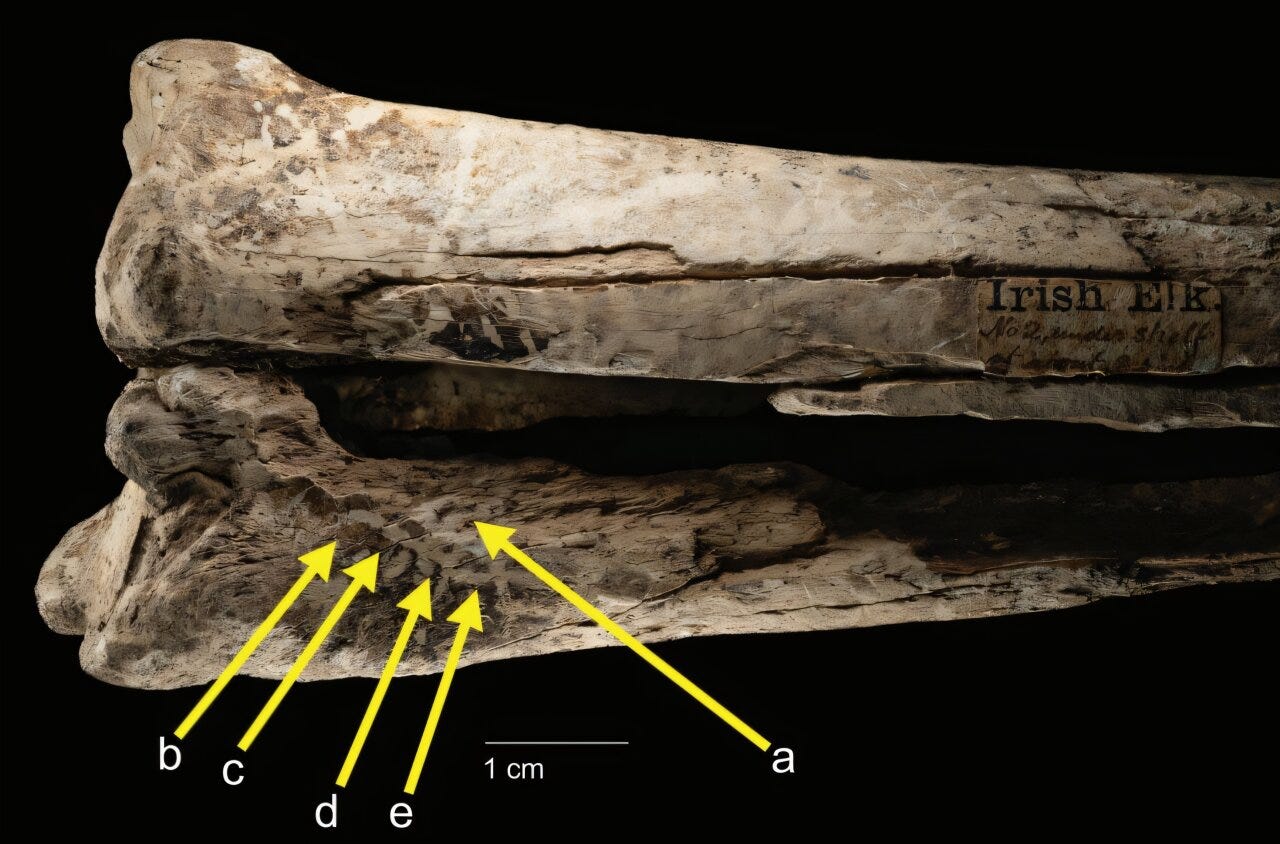
Around 13,500 years ago, the left metatarsal of a giant deer, the long bone of the lower hind leg, was split open lengthwise, apparently while still fresh, and its pieces ended up in Ballynamintra Cave in County Waterford. If people split it, the bone is the oldest trace of humans in Ireland. They came out of the cave when Richard Ussher and Leith Adams1 dug there in 1878 and 1879, and the bone was reported at the time as split deliberately for marrow; Ussher’s note on the cave presented its Irish elk, the old name for the giant deer, as apparently contemporary with people. In 1997 the Irish Quaternary Fauna Project rejected that reading, and the bone stayed in the National Museum of Ireland as ordinary Ice Age fauna.
That dismissal fit the accepted picture. In the authors’ assessment, the only convincing evidence of humans in Ireland before the Mesolithic (the hunter-gatherer period after the Ice Age) is a brown bear kneecap with stone-tool cut marks from Alice and Gwendoline Cave in County Clare, dated to about 12,800 to 12,600 years ago (Dowd and Carden 20162). Late Upper Palaeolithic hunter-gatherers had begun moving into Britain around 15,000 years ago. Ireland’s thinner record has been blamed partly on a second belief: that nineteenth- and early twentieth-century antiquarians had largely emptied the country’s “bone caves.”
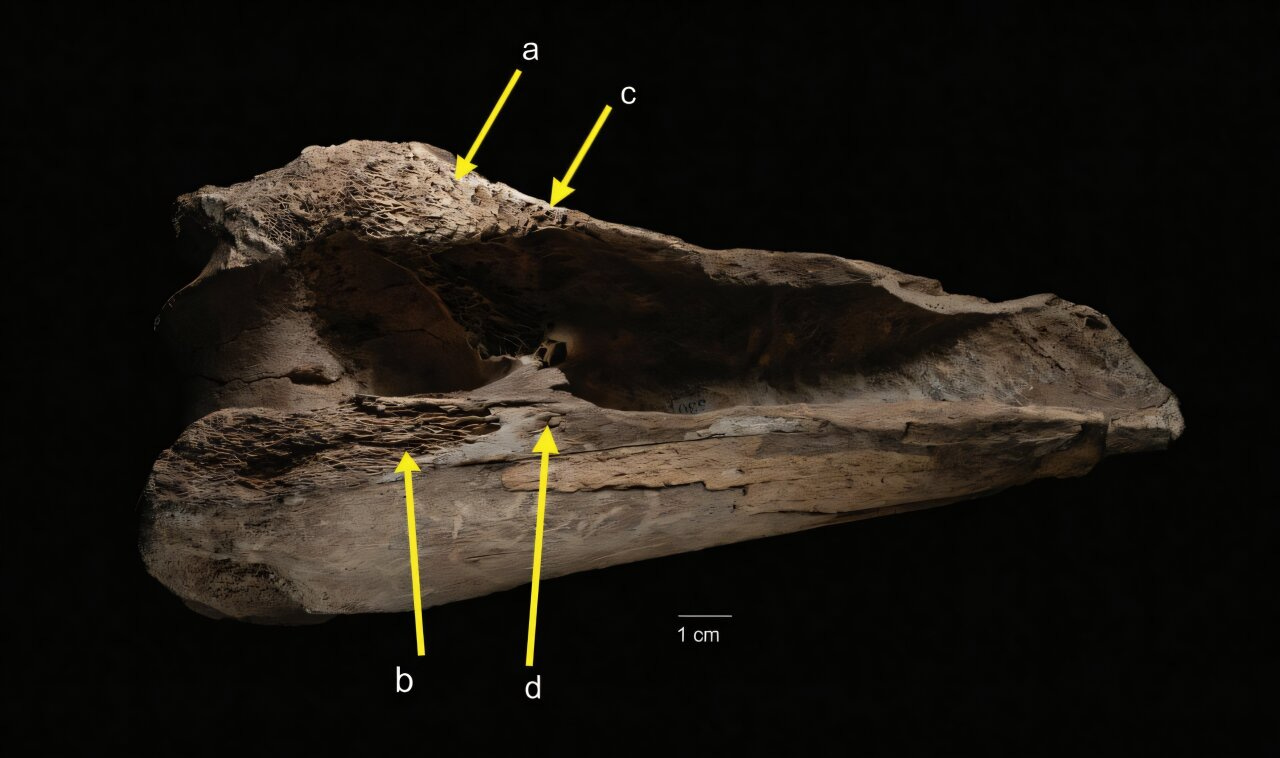
A new paper in the Proceedings of the Royal Irish Academy,3 led by Richard Jennings of Liverpool John Moores University with Barry Fitzgibbon, Cóilín Ó Drisceoil and colleagues, reopens both questions. Excavating between 2014 and 2018, the team found Late Glacial sediment, laid down at the end of the last Ice Age, that the Victorians had missed, with giant deer (Megaloceros giganteus) and red fox bones dated to roughly 13,600–13,100 cal BP (radiocarbon ages converted to calendar years before present). They also argue that two giant deer bones in the museum, Ussher’s metatarsal and a partial humerus from the upper foreleg, show possible butchery. The metatarsal dated to 13,573–13,321 cal BP and the Clare kneecap is no older than 12,890 cal BP, so if the metatarsal was butchered, people were in southern Ireland roughly 400 to 900 years earlier than the accepted evidence shows. “Possible” is the authors’ word, and I think it is the right one.