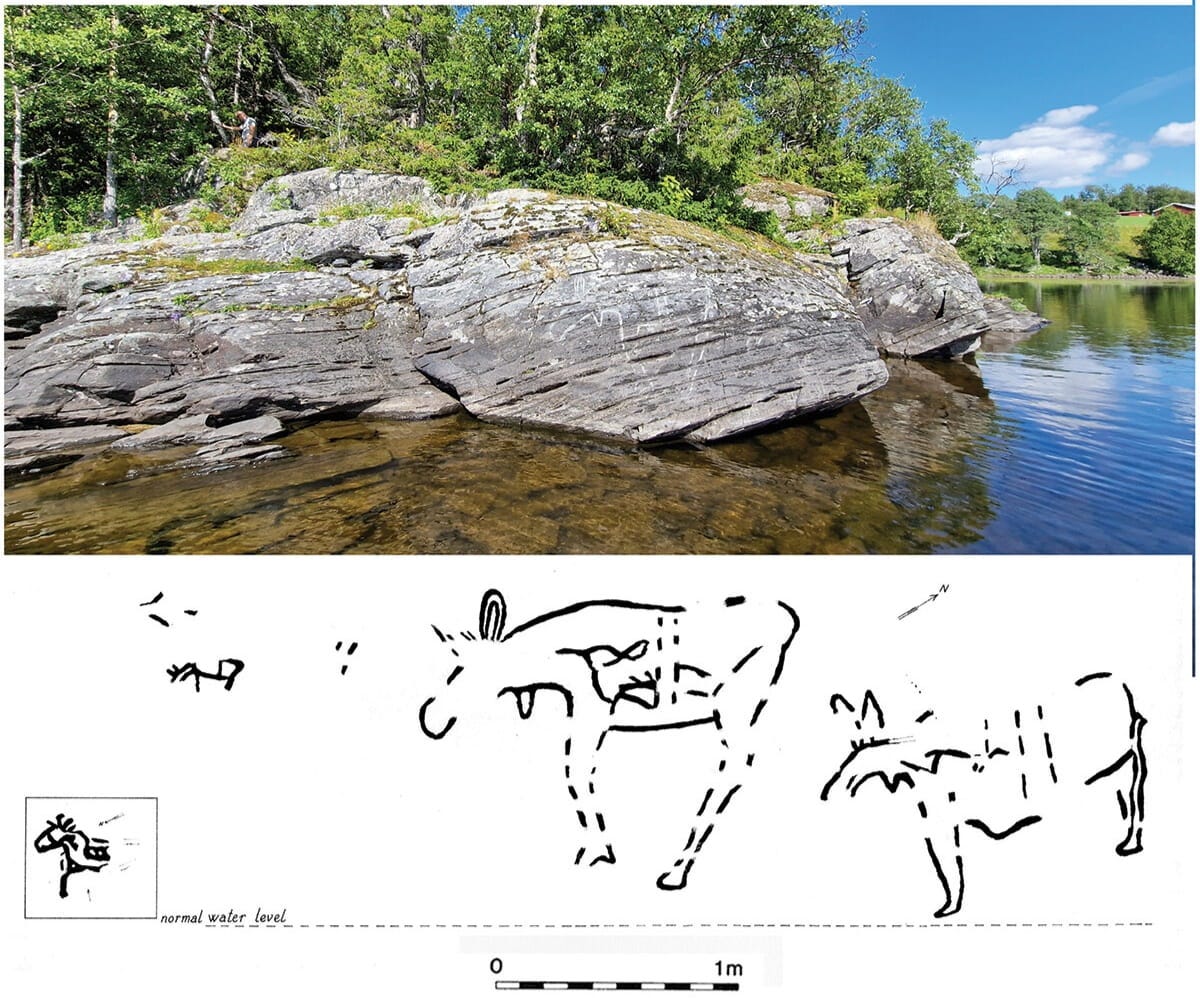
At Landverk, on the north shore of Lake Ånnsjön in Jämtland, Sweden, two large elk, probably carved in the late Mesolithic or early Neolithic, stand on a rock sloping into the lake. Their hooves sit at a waterline that rises over them in some seasons. The larger one, 1.65 meters long, has front legs drawn shorter than its back legs, as if lowering its head to drink or stepping in to swim. Most of the lines carved across its body sit over the heart and lungs.
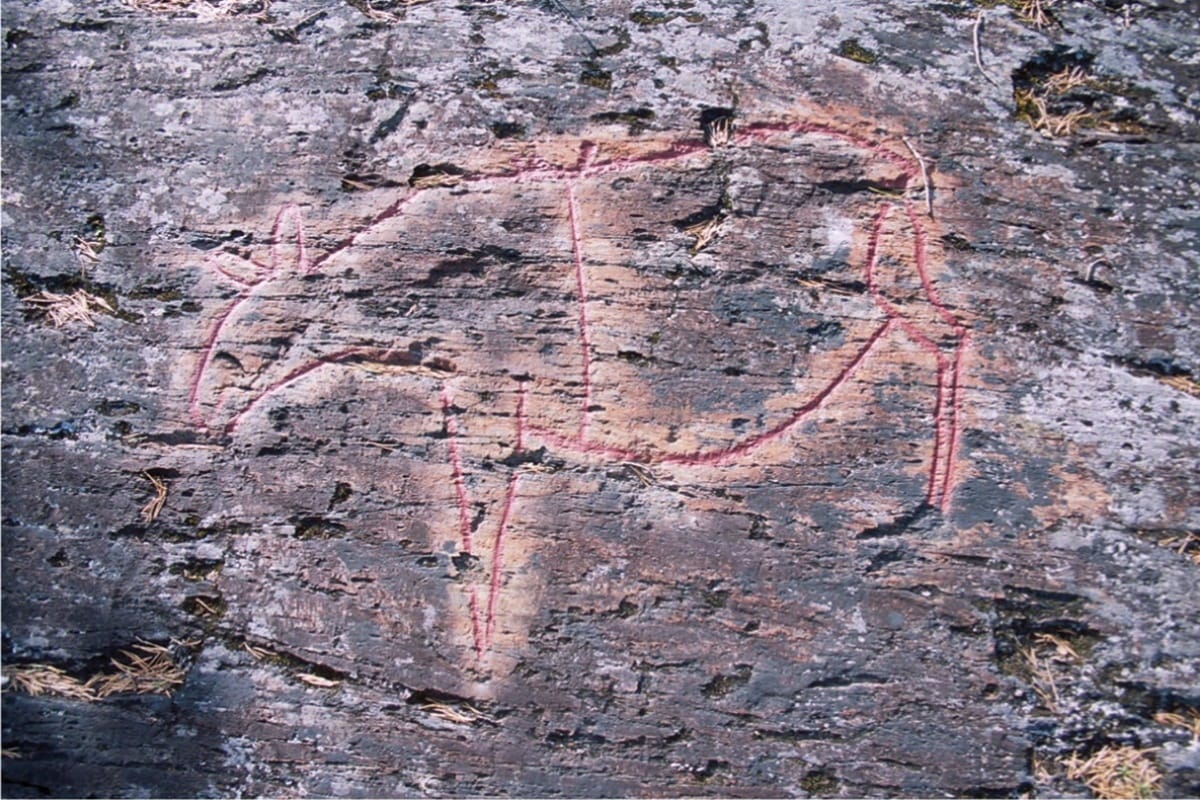
Landverk belongs to the oldest tradition of Scandinavian rock carvings: large and sometimes life-size images of elk (Alces alces, the animal North Americans call moose) and reindeer. The tradition ran from about 9000 to 4000 BCE. The animals usually stand without any scene around them, and they tend to sit near water. Explanations for that closeness have often been cosmological. Goldhahn1 linked carvings at rapids to a river heard as alive and to shamans traveling between worlds, and Helskog2 read the water’s surface as a gateway to an underworld.
A new paper in World Archaeology3 argues that these elk had a practical job. Tomas Persson, a cognitive scientist at Lund University, studied four sites with coauthors Peter Skoglund, Michael Ranta, Jan Magne Gjerde, and Anna Cabak Rédei. One is Stykket in Trøndelag, Norway, and the other three are Landverk, Gärde, and Duved in Jämtland, Sweden. Each panel, they argue, sits where elk crossed water or could be driven into it. The carvings acted as “road signs, of sorts” that pointed people passing by canoe or along the far bank to good hunting.
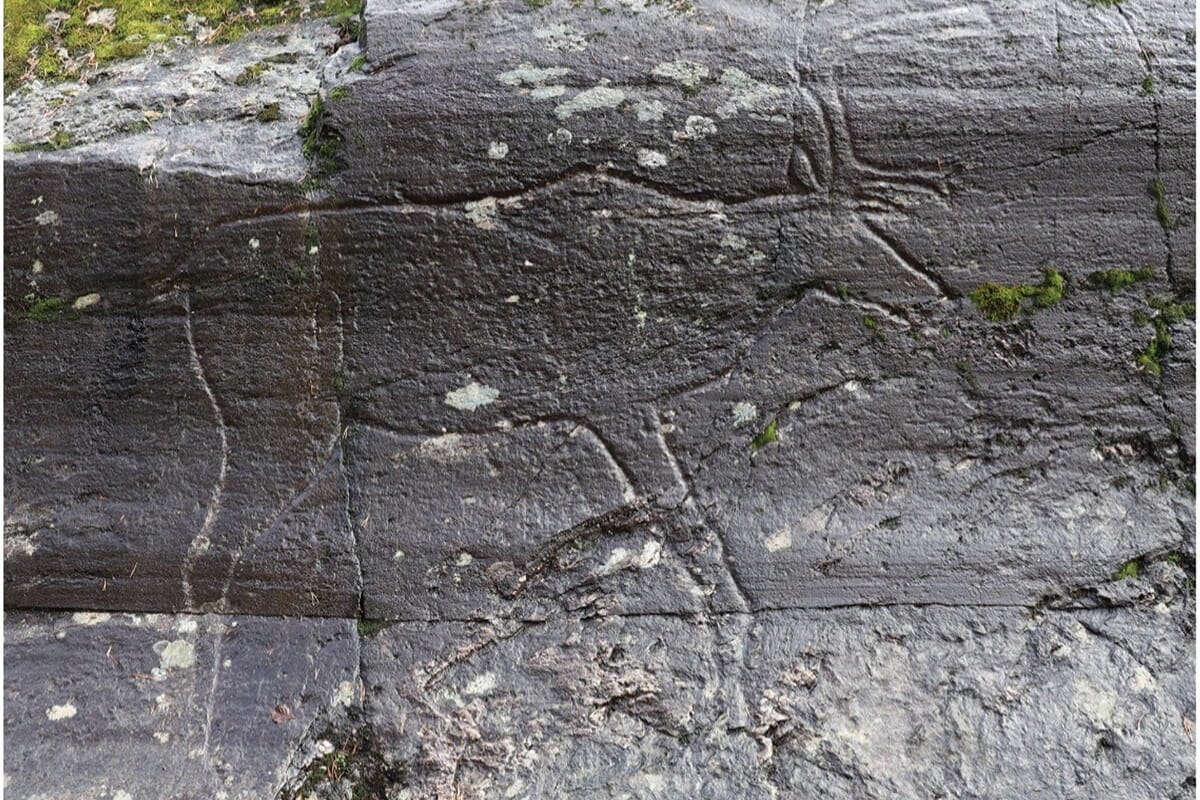
Persson and colleagues call this implicit narrativity, using terms from pictorial semiotics. A realistic, near life-size elk is iconic: it carries meaning by resembling an elk. Placed beside a crossing, the authors argue, it also became indexical. That means it pointed to something nearby, the way a pecked line on rock points to a person having been there. To a viewer who knew the place, it said what could be hunted there.
The contrast is with what came after. From around 5000 BCE, carvers in Scandinavia turned to small figures in scenes of people and elk together, as at Nämforsen in northern Sweden. Because those scenes carry their story on the rock, they no longer had to sit where the events happened. The paper is part of a Swedish Research Council project on this narrative turn. So I read the four elk sites partly as the “before” half of a larger argument, and that argument benefits from a sharp contrast.