
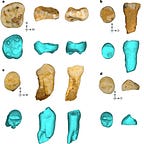
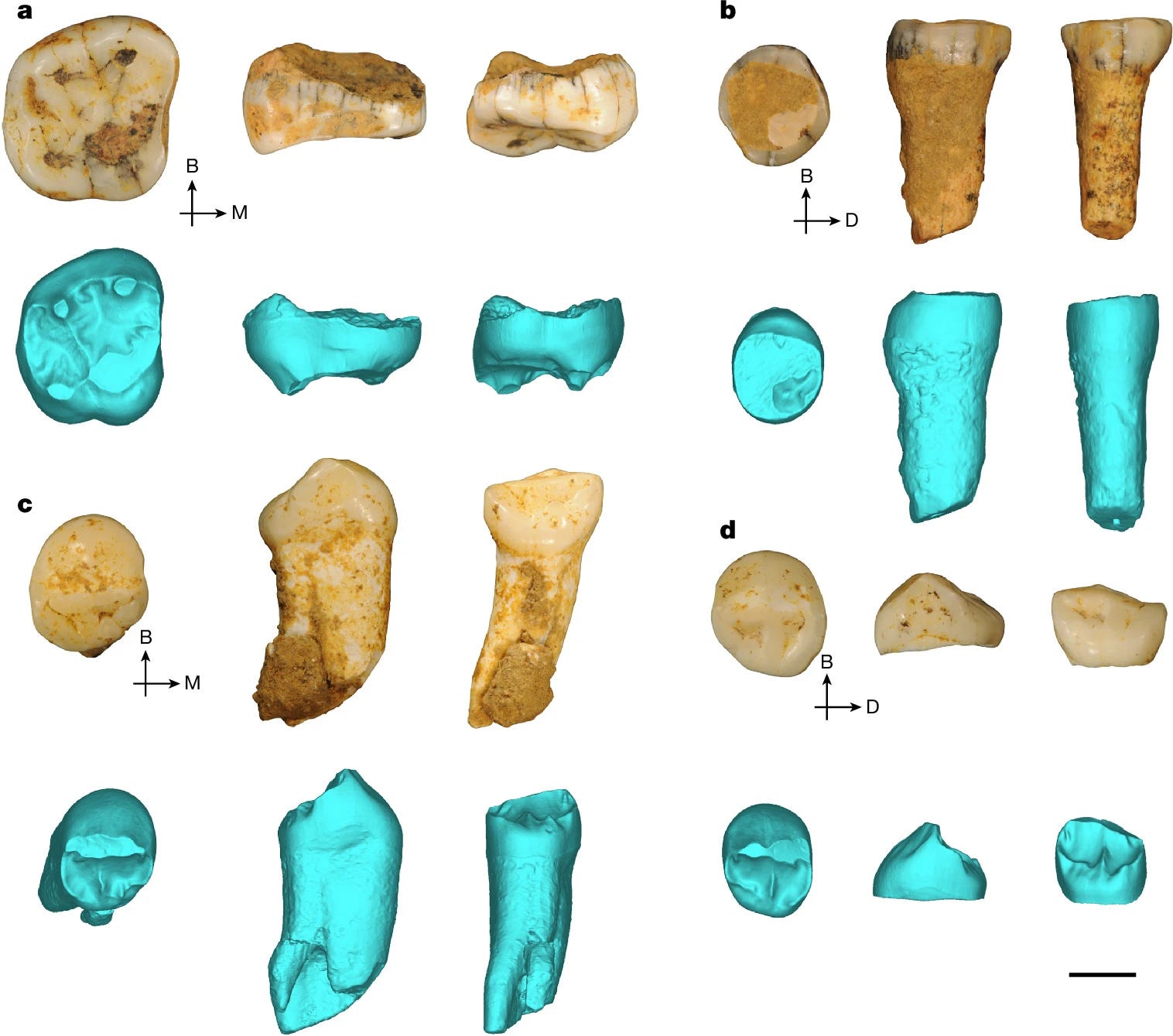
In a band of greyish-brown sandy silt cemented to the wall of a cave entrance in Long’an County, in southern China’s Guangxi region, two lower premolars lay about 20 centimeters apart. One is a left and one a right, worn to the same degree, and the team that described them thinks both probably came from one man. The survey that found them was meant in part to test how far Denisovans in southern China ranged. The right premolar turned out to carry a glycine at position 253 of an enamel protein called ameloblastin. In the paper’s comparison tables, the only other fossils with that glycine are teeth assigned to Homo erectus from Zhoukoudian, Hexian and Sunjiadong, the late East Asian populations that include the fossils once called Peking Man.
That one amino acid lands in a story that had been getting simpler. Over the past two years, ancient proteins have moved one Chinese fossil after another into the Denisovan column, among them the Harbin skull in the northeast and a forearm bone and teeth from Bianfu Cave in the southwest. This autumn the same research group used proteins to identify the Xujiayao skull as Denisovan and argued that most East Asian fossils of the period share one Denisovan build. Denisovans are an extinct branch of humanity first identified from DNA in a Siberian cave, and they were becoming the default answer for any archaic human in East Asia. The new paper’s first sentence grants that the evidence points that way for most of these fossils. Then it asks whether “most” was hiding anyone else.
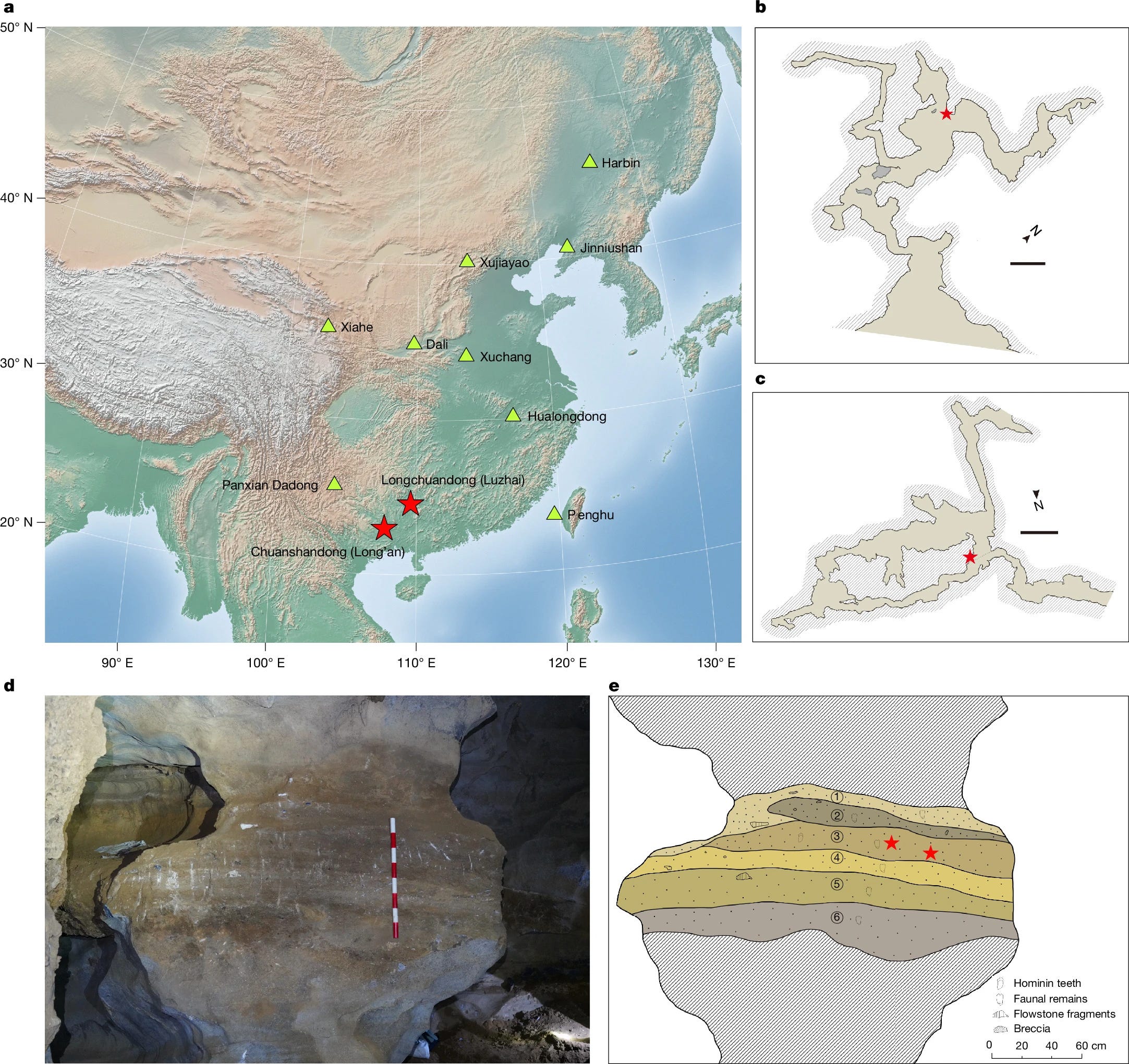
The study, published in Nature1 on November 25, comes from that same group. Song Xing, who led the Xujiayao work, shares first authorship with Huiyun Rao, Guangmao Xie and Fan Bai. The senior author is Qiaomei Fu of the Institute of Vertebrate Paleontology and Paleoanthropology (IVPP) in Beijing. They describe four isolated teeth from two caves. The teeth turned up in surveys that have run since 2016 along a corridor more than 500 kilometers long, from Chongzuo City in southwestern Guangxi to Guilin in the northeast. Two of them come from Longchuandong, in Luzhai County: an upper molar at least 42,600 years old and a lower premolar at least 104,500 years old. Both match Denisovans in their proteins, and the molar also matches them in shape. The two Chuanshandong premolars, at least 100,800 years old, match nothing cleanly. The authors call their owner an “unresolved archaic Homo,” a phrase chosen with care. Xing was looser with China’s Science and Technology Daily.
“It may be an ‘independent branch’ on the human family tree.”
Song Xing, co-first author and researcher at the Institute of Vertebrate Paleontology and Paleoanthropology, Chinese Academy of Sciences, to Science and Technology Daily (translated from Chinese)
How do ancient proteins tell Denisovans from Homo erectus?
The team turned to proteins because DNA rarely survives here. The paper notes that warm, humid conditions in southern China destroy it, while proteins in tooth enamel can last. Each protein is a chain of amino acids spelled out by a gene. When a gene differs between populations, the protein sometimes differs at a single position, called a single amino acid polymorphism. A few of these in enamel separate Neanderthals, Denisovans, modern humans and H. erectus. The team etched three of the four teeth with dilute acid and collected the dissolved protein fragments, called peptides. They identified the peptides by mass spectrometry, which weighs each fragment and the pieces it breaks into.
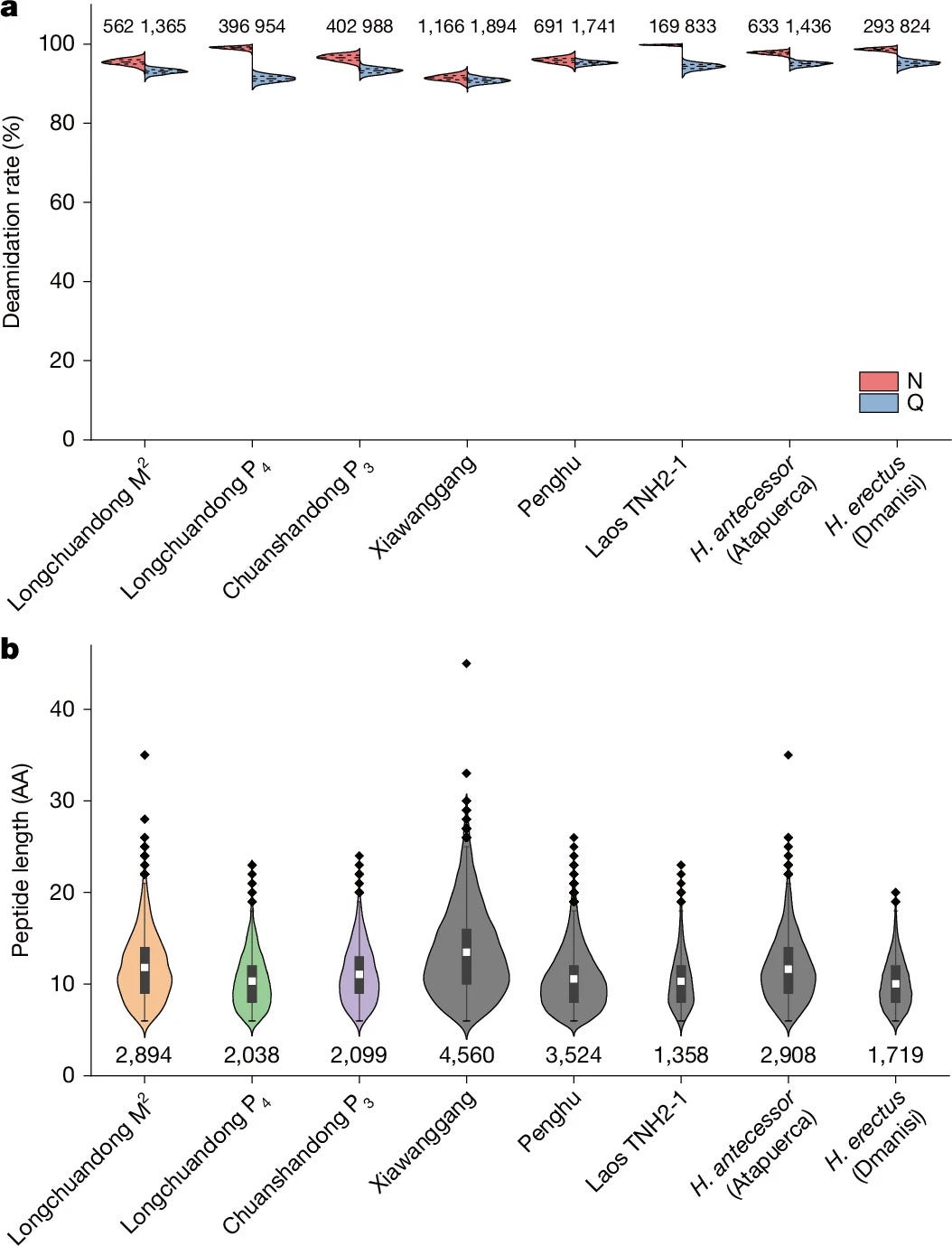
Genuine ancient proteins show their age in two ways. They break into short pieces, and two of their amino acids, asparagine and glutamine, slowly change through a reaction called deamidation. The Guangxi peptides were short and heavily deamidated. The team also processed a blank extraction alongside the teeth and threw out anything that turned up in it. That left 2,894, 2,038 and 2,099 peptides. All three teeth contained fragments of AMELY, the form of the enamel protein amelogenin that only males make, so all three came from men. The team checked eight positions known to vary among hominins, using three separate software programs, and four positions passed. One of those only confirmed sex, so the entire argument rests on the other three.
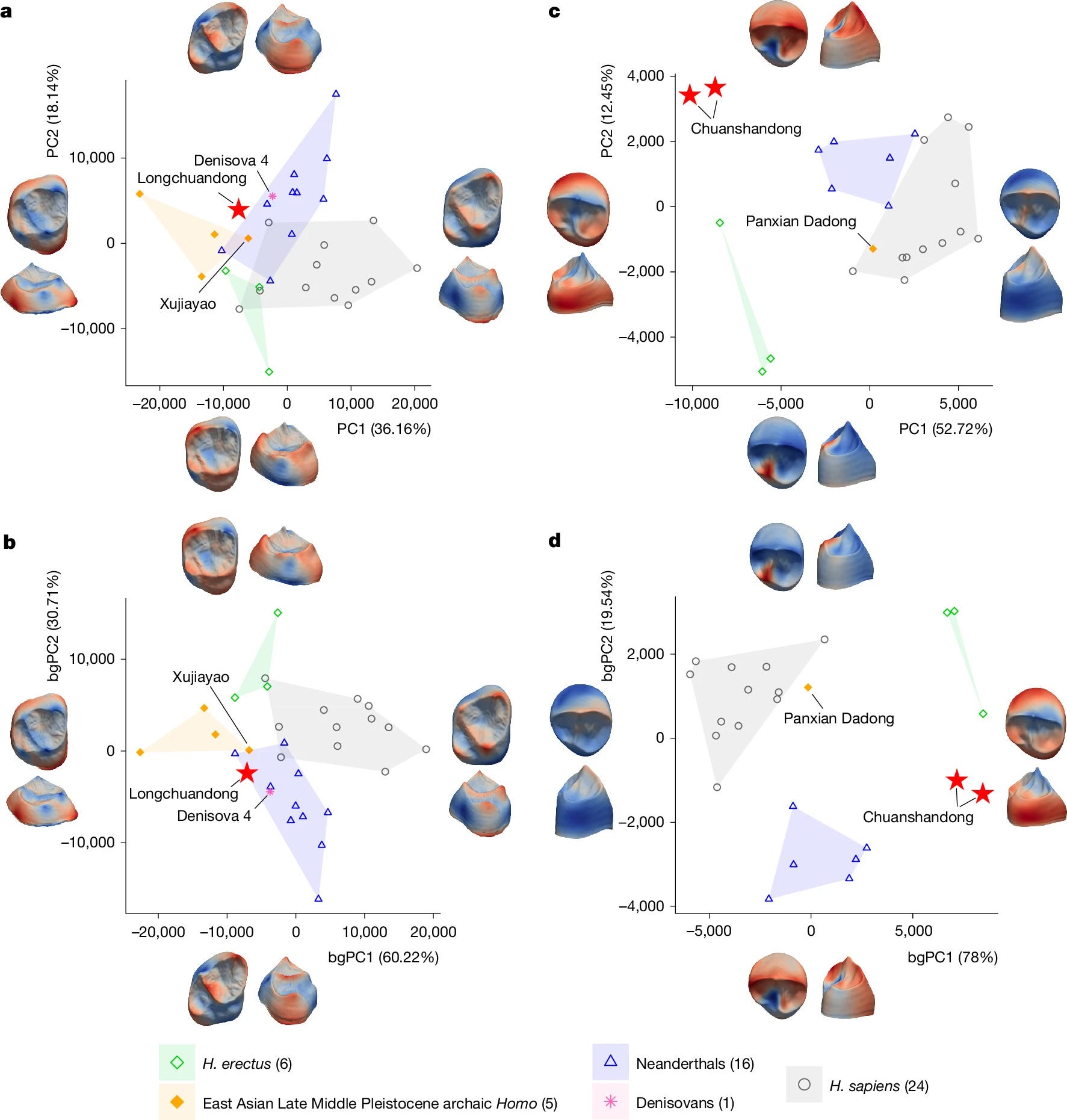
For Longchuandong, the position that matters is 273 in ameloblastin. Both teeth carry valine there, backed by 55 and 59 peptides. The same variant turns up in the Harbin, Penghu and Bianfu Cave Denisovans and in Denisova 3, whose high-coverage genome was published in 2012. In the team’s protein tree, the two teeth grouped with Denisova 3 with 100 percent support. High-resolution X-ray scans let the team rebuild the molar’s enamel–dentine junction, the buried surface where enamel meets dentine. That surface keeps the crown’s original shape after chewing wears the outside away. On that surface and on the outline of the crown, the Longchuandong molar came closest to Denisova 4, a molar from Denisova Cave in Siberia.
I find that attribution fairly secure, though less airtight than the headlines suggest. Valine at 273 is not unique to Denisovans. Table 1 shows it in East Asian H. erectus, and at a frequency of 0.007 percent in gnomAD, a large database of genetic variation in living people. Most of those carriers live in Southeast Asia and Oceania, where Denisovan ancestry runs high. So shape has to separate Denisovans from H. erectus, and here it does: the molar lacks the wrinkled, branching enamel–dentine surface of H. erectus. But Figure 3 compares that molar with 16 Neanderthals, 24 modern humans, six H. erectus and exactly one Denisovan tooth, and the molar also plotted near the Neanderthals. The authors call the population “Denisovan-affinity,” and that caution is justified.
How old are the Guangxi teeth?
I slowed down most at the dates, because they are stranger than any summary lets on. The teeth were dated directly by uranium-series. A buried tooth absorbs uranium from groundwater, and the method measures how much of it has decayed into thorium. Uranium can keep seeping in after burial, so the result is a minimum age. The two Chuanshandong premolars, probably from one mouth, gave 100.8 ± 0.2 thousand years (ka) for the left and 62.1 ± 0.3 ka for the right. That is a gap of almost 39,000 years between teeth that may have sat centimeters apart in the same jaw. The Longchuandong premolar and molar, from the same clay, gave 104.5 ± 0.4 ka and 42.6 ± 0.4 ka.
The cave sediment is younger still. Optically stimulated luminescence dates when quartz grains last saw sunlight, and it put the Chuanshandong fossil layer at 49.5 ± 2.6 to 34.2 ± 4.1 ka. The layer is soil from outside the cave that weak, intermittent water carried in. The teeth probably worked their way down a slope that drops about 5 meters from the entrance, which would explain why they are older than the soil around them. Mammal teeth within a meter of the premolars ranged from 211.1 to 37.8 ka. Neither cave yielded a stone tool.
“The burial age of the fossils may substantially lag behind their true age.”
Xing et al., Nature (2026)
The paper handles this honestly. It gives the Chuanshandong man as older than 100.8 ka and the Longchuandong teeth as 104.5 to 42.6 ka. The press release from Spain’s Centro Nacional de Investigación sobre la Evolución Humana (CENIEH), where Xing also holds an affiliation, says the Longchuandong teeth were “dated to 104,500 and 42,600 years ago, respectively.” Those are minimum ages, and the difference matters. A Denisovan-affinity individual alive 42,600 years ago would be later than the roughly 300 to 45 ka span the paper gives for northern Denisovans. One that is merely older than 42,600 years would be nothing unusual.
Did Homo erectus survive in southern China?
The case for Chuanshandong rests on three positions in two proteins. At ameloblastin 253 the premolar carries glycine. Table 1 lists alanine there for Homo antecessor from Atapuerca in Spain, H. erectus from Dmanisi in Georgia, every Denisovan tested, nine Neanderthals, living people and the great apes. At ameloblastin 273 it carries methionine, like Neanderthals and modern humans. Most Denisovans have valine there, as do the late H. erectus teeth from Zhoukoudian, Hexian and Sunjiadong (the Zhoukoudian group, for short). At position 179 of AMELY it carries methionine again. That is the ancestral state, shared with H. antecessor and the great apes; Neanderthals, Denisovans and modern humans carry leucine.
I trust the first of these calls more than the last. Glycine at 253 is backed by 9, 14 and 17 peptides in the three programs, and methionine at 179 by 7, 4 and 16. Spectra are the instrument’s readouts of each fragment. Seven spectra bracket the glycine from both sides, but only two bracket the methionine. The weaker call is the one that ties Chuanshandong to Atapuerca.
There is also a dispute over whether glycine at 253 marks H. erectus at all. The label comes from Fu’s own group, which reported glycine at 253 and valine at 273 in six specimens from Zhoukoudian, Hexian and Sunjiadong in May. John Hawks, an anthropologist at the University of Wisconsin-Madison who was not involved, argued on his blog at the time that those teeth, around 400,000 years old, might be early Denisovans, though he allowed that both readings were possible. This month, teeth from Baxian and Naxian caves showed the same glycine, and he returned to how little that label rests on.
“That’s like scanning a barcode that only has two stripes.”
John Hawks, University of Wisconsin-Madison, on his blog, November 18
Hawks told Live Science he would not call Chuanshandong an unknown Homo. In his view the real question is which known group carried this protein variation, and nobody yet knows whether it was H. erectus or the Denisovans. Table 1 supports his caution. Position 273, the supposedly Denisovan site, varies among Denisovans themselves: a molar from Laos has methionine, Penghu and Bianfu have valine, and Harbin has both. Before this study, position 253 had been read in only seven Denisovans and position 179 in five. A variant carried by a minority of Denisovans could easily go unseen in samples that small. So I can’t exclude that this man was an unusual Denisovan, even though the shape of his teeth shows no clear Denisovan affinity.
Laid side by side, the three positions show a pattern I find more telling than the tree. The Zhoukoudian group has glycine at 253 and valine at 273. Denisovans have only the valine, and the Chuanshandong man has only the glycine. Each later group holds a different half of the older pair, and the paper’s abstract says Denisovans most likely inherited their valine from H. erectus. Interbreeding tends to leave exactly this kind of split inheritance. So does an ancestral population that was already variable at both sites.
That is why I’d give less weight than it is getting to the H. antecessor link, which the CENIEH release mentions by name. Methionine at 179 is the old condition the great apes still have, and sharing an old trait shows only that two groups both kept it. Table 1 has a dash where H. erectus should be, because no H. erectus in the paper’s comparison has yielded position 179. H. erectus split off before the ancestors of Neanderthals, Denisovans and modern humans acquired leucine, so you would expect it to carry methionine. If it did, every odd thing about these proteins could trace to H. erectus ancestry, with no detour through Spain.
AMELY adds a complication the paper doesn’t mention. The gene sits on the Y chromosome, which is why it marks a tooth as male, and it passes only from father to son. In a mixed population, one paternal line can carry an old variant long after most of the genome has changed.
The tree also needs care. It places Chuanshandong outside the group formed by Neanderthals, Denisovans and modern humans with a posterior probability of 100 percent; that figure is the model’s confidence in the branch. But the Methods list the tree’s comparison set as Denisova 3, three Neanderthals, five great ape species, a gibbon and a macaque. Neither H. erectus nor H. antecessor is in it. The Chuanshandong sequence also covers only 14.68 percent of 4,108 positions. A short sequence with one ancestral variant, in a tree whose only branches are later humans and apes, would land about where this one did.
In the past two weeks, H. erectus has started to look like a much closer option. On November 18, Nature published studies of Baxian and Naxian caves near Chongzuo, at the southwestern end of the same corridor Xing’s team surveyed. They reported eight teeth identified as H. erectus, by shape and, for several, by enamel proteins, with estimated ages of 324,000 to 184,000 years. National Geographic noted that H. erectus had been thought gone from mainland Asia by about 400,000 years ago.
“H. erectus was considerably more ecologically adaptable than many of us have assumed.”
Chris Stringer, Natural History Museum, London, to Live Science
Those identifications still have to survive Hawks’s barcode objection. If they do, the gap between H. erectus in the Guangxi rainforest and a man at least 100,800 years old with one H. erectus-linked amino acid shrinks to tens of thousands of years. The authors favor a primitive lineage that “may have survived into the Late Pleistocene in a geographical refugium,” meaning a pocket where an old population held on. They suggest that admixture among archaic groups or gene flow from H. erectus could explain its odd mix of traits. Austin Whittall, who writes the Patagonian Monsters blog, went further the day after publication.
“The tooth may even belong to a recent erectus individual!”
Austin Whittall, Patagonian Monsters
I wouldn’t go that far, and I would rank admixture above a surviving refuge population. The premolar has an H. erectus-like short enamel–dentine junction and complex roots of even breadth. But it also has a less lopsided crown and other features shared with later humans, plus the methionine at 273 that the Zhoukoudian group lacks. That mix is hard to get from unchanged H. erectus and easy to get from a population carrying some H. erectus ancestry.
What the Guangxi teeth can’t tell us yet
The authors state the main limit in a sentence most of the coverage skipped.
“Such phylogenetic inference based on the limited proteomic data is preliminary.”
Xing et al., Nature (2026)2
The unresolved lineage is one man, with one tooth sampled for protein and about 600 amino acid positions recovered. Both caves held water-sorted teeth with no other hominin bones and no tools, so they say nothing about how either population lived.
The publicity has gone well past all of this, especially in Chinese. The IVPP release on the Chinese Academy of Sciences website announces an unknown archaic human lineage. Fu told Science and Technology Daily that the result breaks a simplifying view, that East Asia’s Middle Pleistocene archaic humans probably all belonged to the Denisovans. Xinhua’s English report says the people of Longchuan Cave, its name for Longchuandong, “belong to Denisovans.” The CENIEH release calls them the first evidence of Denisovans in Lingnan and says the region’s ecology may have sheltered archaic populations. The paper’s main text makes neither claim and never mentions Lingnan. English-language headlines spoke of a new branch of the family tree (Live Science) and an unknown species (La Brújula Verde). The paper names no species, and when Live Science asked Fu directly, she was as cautious as her paper.
“It’s not clear whether they are our cousins.”
Qiaomei Fu, director of the Ancient DNA Laboratory at the Institute of Vertebrate Paleontology and Paleoanthropology, to Live Science
My verdict is different for each cave. I’m fairly confident that people with Denisovan affinities lived in subtropical Guangxi at least 104,500 years ago. Enamel shape and a protein variant agree, and the result fits a range that already took in the Altai, Laos and the Taiwan Strait. For Chuanshandong, I’m persuaded the man was not a typical Denisovan, Neanderthal or modern human. I’m not persuaded he belonged to a primitive lineage that survived unchanged in a refuge. A population with some H. erectus ancestry explains his teeth at least as well. On Hawks’s reading, so might a population of Denisovans more variable than anyone has sampled. I’d call the central claim partly convincing, and “unresolved,” the paper’s own word, is the right one.
Two tests would move this forward. The first is the left Chuanshandong premolar, the tooth that gave the 100.8 ka date, which was dated but never sampled for protein. If it shows the same glycine at 253 and methionine at 179, the calls hold up in a second tooth from the same man. If it doesn’t, the lineage argument loses its footing. The second test needs a male H. erectus, because none in the paper’s comparison has produced AMELY position 179. Leucine there would rule out H. erectus as the source of the Chuanshandong methionine. Methionine would make H. erectus ancestry the simplest explanation for everything odd in this man’s enamel. The Baxian and Naxian teeth are already yielding proteins at the far end of the same survey corridor, so they are the obvious place to look, provided one of them came from a man.
Further Reading
Institute of Vertebrate Paleontology and Paleoanthropology, Chinese Academy of Sciences. “我国南方发现未知古人类支系” (Unknown archaic human lineage found in southern China). November 26, 2026. https://www.cas.cn/syky/202611/t20261126_5125118.shtml
Xinhua. “Fossils Extend Denisovan Range into Subtropical South China, Reveal Unknown Human Lineage.” November 26, 2026. Republished by the Chinese Academy of Sciences: https://english.cas.cn/newsroom/cas-in-media/202611/t20261126_1220924.shtml
Larson, C. “Homo erectus May Have Survived in China 200,000 Years Longer Than We Thought.” National Geographic, November 18, 2026. https://www.nationalgeographic.com/history/article/homo-erectus-china-rainforest
Fu, Q. et al. The proteome of the late Middle Pleistocene Harbin individual. Science 389, 704–707 (2025). https://doi.org/10.1126/science.adu9677
Rao, H. et al. Ancient proteins identify various Denisovan remains from Southwest China. Nature (2026). https://doi.org/10.1038/s41586-026-10976-9
Tsutaya, T. et al. A male Denisovan mandible from Pleistocene Taiwan. Science 388, 176–180 (2025). https://doi.org/10.1126/science.ads3888
Fu, Q. et al. Enamel proteins from six Homo erectus specimens across China. Nature 655, 141–147 (2026). https://doi.org/10.1038/s41586-026-10478-8
Welker, F. et al. The dental proteome of Homo antecessor. Nature 580, 235–238 (2020). https://doi.org/10.1038/s41586-020-2153-8
Meyer, M. et al. A high-coverage genome sequence from an archaic Denisovan individual. Science 338, 222–226 (2012). https://doi.org/10.1126/science.1224344
Demeter, F. et al. A Middle Pleistocene Denisovan molar from the Annamite Chain of northern Laos. Nature Communications 13, 2557 (2022). https://doi.org/10.1038/s41467-022-29923-z
Liao, W., Zanolli, C. et al. Evidence for late Middle Pleistocene Homo erectus in mainland East Asia. Nature (2026). https://doi.org/10.1038/s41586-026-11271-3
Westaway, K. E., Joannes-Boyau, R. et al. Rainforest adaptation in late Homo erectus from southern China. Nature (2026). https://doi.org/10.1038/s41586-026-11155-6
Xing, S., Rao, H., Xie, G. et al. Middle–Late Pleistocene Denisovans and unresolved Homo in southern China. Nature (2026). https://doi.org/10.1038/s41586-026-11341-6
Xing, S. et al. The proteome of Middle Pleistocene Xujiayao and common Denisovan morphology. Nature (2026). https://doi.org/10.1038/s41586-026-11132-z


