
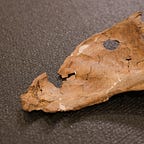
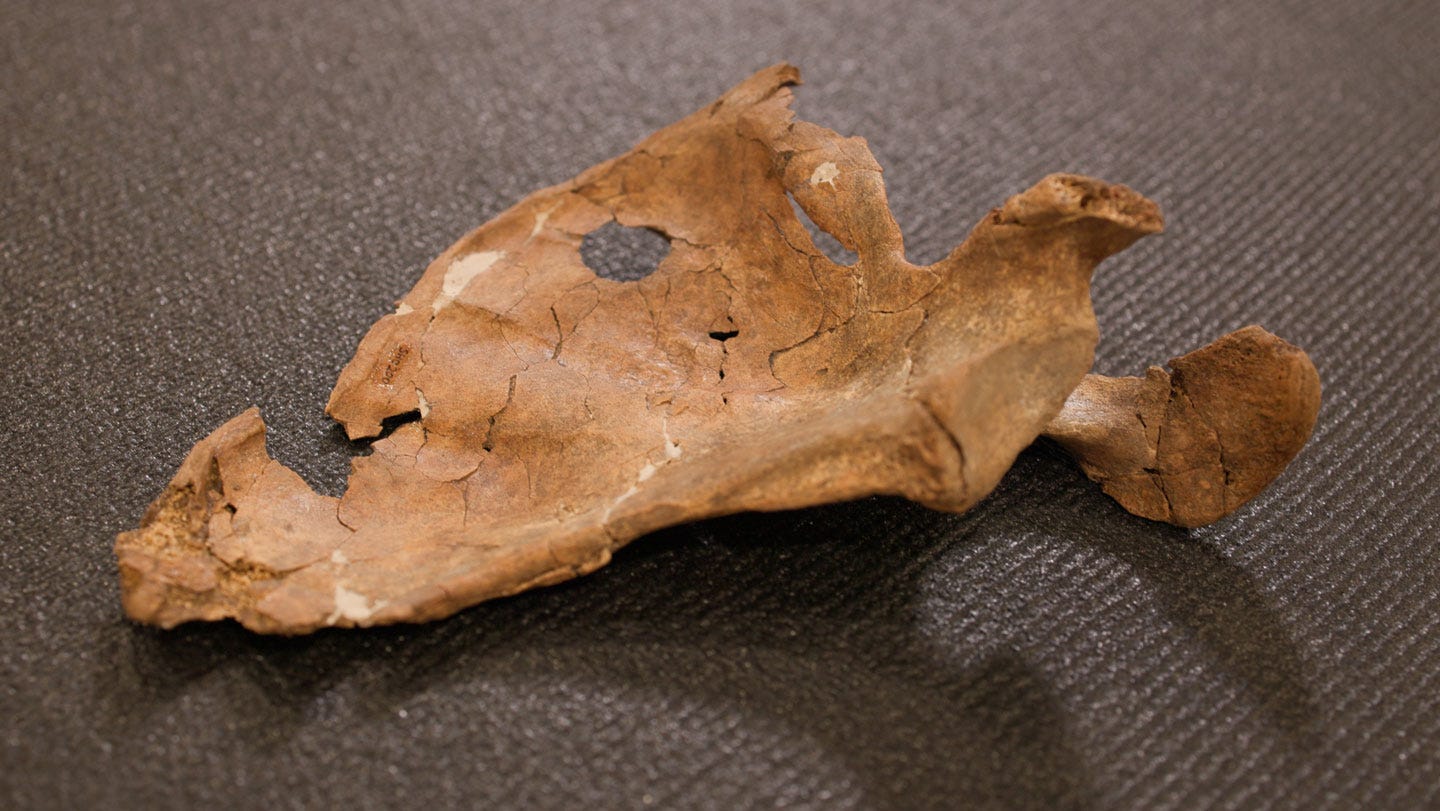
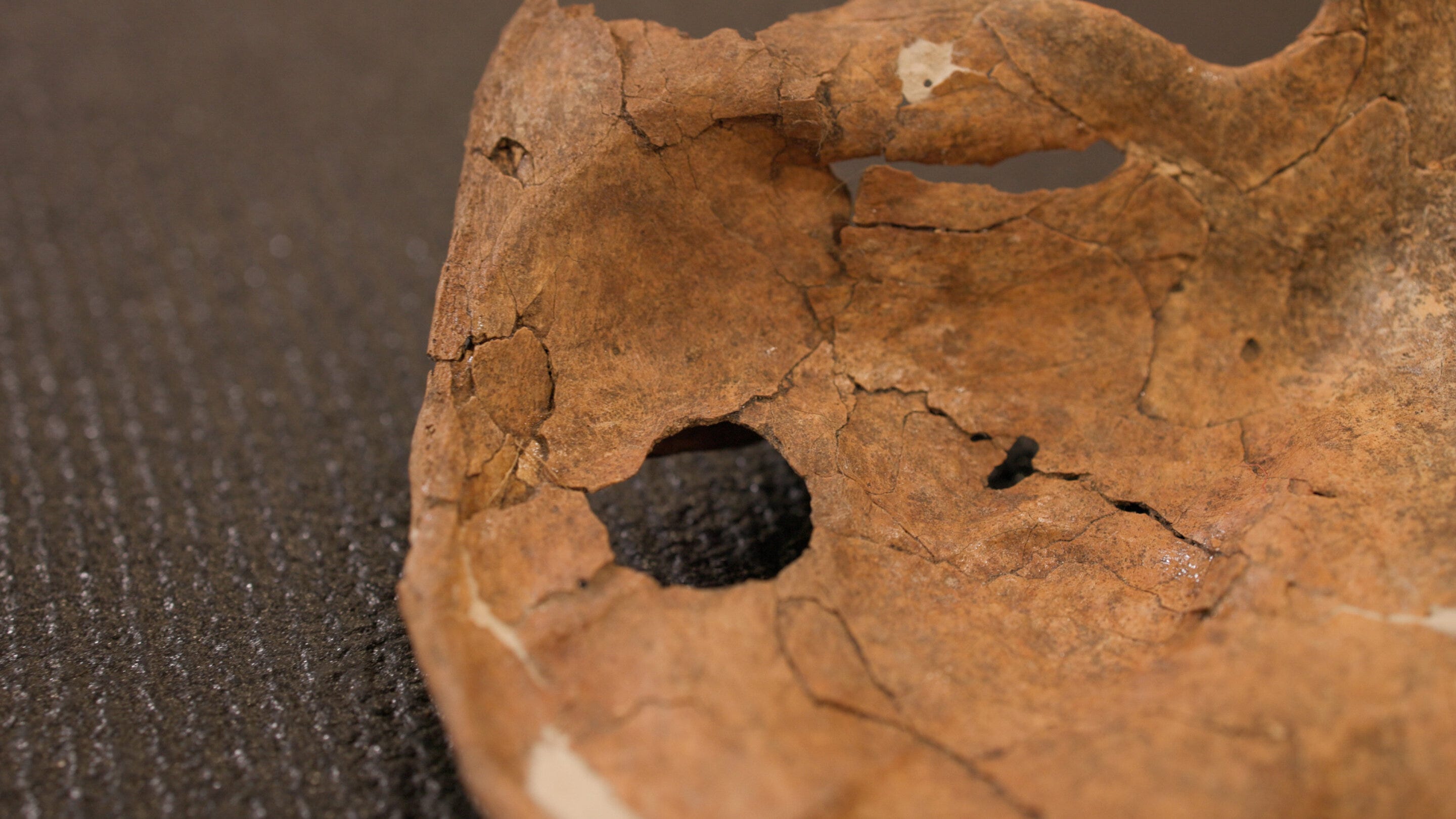
Seven and a half meters down in Shanidar Cave, in the Zagros Mountains of Iraqi Kurdistan, the left shoulder blade, or scapula, of a Neanderthal had lain for some 75,000 years with a hole through it. The bone was too soft to pick up. The excavators soaked it where it lay with an acrylic consolidant, Paraloid B72 dissolved in acetone, backed it with cotton gauze, and cut it out of the ground inside a block of its own sediment; it had come through nearly whole, which is rare for a bone so thin in places that it is almost translucent. The hole sits low on the back of the blade, in the broad hollow anatomists call the infraspinous fossa. It is about 15 millimeters across and very nearly a perfect circle, and at least three hairline cracks run out from its rim.
“It’s so round, it’s like, what is it?”
That was Emma Pomeroy’s first thought, she told Science News.1 Pomeroy, a biological anthropologist at the University of Cambridge, is lead author of a study published October 15 in Scientific Reports2 that describes these bones, dug up in 2019 and 2022, and the person they belonged to, a Neanderthal the team calls Shanidar A. Anyone raised on the phrase Stone Age pictures a killing in this period done with stone, a flake of flint knapped to a point and bound to a shaft. Neanderthals did use weapons like that, but a hafted stone point leaves a different mark. When archaeologists drive replica stone points into carcasses, the wounds come out oval or lozenge-shaped, sometimes a narrow slot, following the flattened section of the blade, whereas a sharpened wooden shaft, round in section, leaves a circle.
Shanidar has encouraged the stone picture before. A man excavated there in the 1950s, known as Shanidar 3, has a narrow puncture in his left ninth rib, and in 2009 Steven Churchill, an evolutionary anthropologist at Duke University, and his colleagues tried to reproduce it by driving replica Mousterian and Levallois points into the chests of pig carcasses, using a calibrated crossbow to control the energy of each strike. They judged the wound most consistent with a light, stone-tipped projectile and, because early modern humans were in western Asia at around that time and may already have had throwing weapons, raised the possibility that one of them threw it. The rib had started to heal, so Shanidar 3, who died roughly 50,000 years ago, some 25,000 years after Shanidar A, seems to have lived for weeks after he was hit. The older bone points to a different weapon. The University of Cambridge’s announcement presents the new hole as possibly the first evidence that sharpened wooden spears were used anywhere in the prehistoric Middle East, and possibly the earliest example in the hominin fossil record of lethal violence between individuals with a wooden spear, a second claim the paper itself stops short of.
On October 7, in Science Advances, Palmira Saladié and colleagues at the Catalan Institute of Human Paleoecology and Social Evolution described 597 pieces of wood from Abric Romaní,3 a rock shelter near Barcelona that Neanderthals used between about 62,000 and 40,000 years ago. Much of that wood survives only as the shape of where it was: water heavy with calcium carbonate wrapped the pieces in travertine as they rotted, and the excavators recorded the molds. Thirteen had been worked or used, among them two spears, the better preserved 2.45 meters long. Josep Vallverdú, an archaeologist at the institute, told Gizmodo4 that the simplest lesson of the site was that the Paleolithic was “not a world made only of stone,” a strange thing to need to say about a period whose name means Old Stone Age. It needs saying because stone is what lasts, so stone is what archaeologists mostly have; wooden shafts, handles and spears turn up only where some accident of chemistry has kept them.
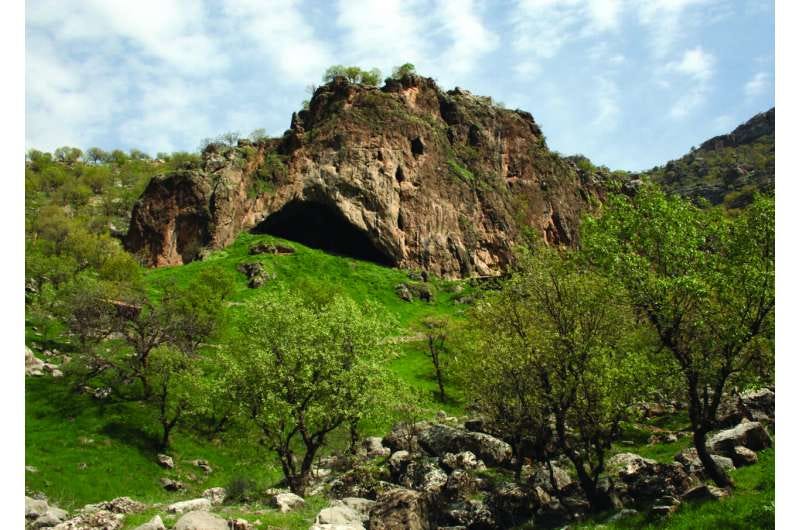
Shanidar has no travertine and no waterlogged mud. Apart from pollen and charred wood, the paper notes, the cave has kept almost nothing organic, so the spear that went through Shanidar A is gone, and the only record of it is the space it took up on its way out of the body. That is why the hole has been worth the trouble the Cambridge team has taken over it. Read closely enough, it is a cast of a weapon nobody will ever hold, and perhaps a little more than that, a record of the direction the weapon came from, which is as close as the evidence gets to whoever was at the other end of it.
A root can bore through buried bone, and so can a burrowing insect or a careless trowel. Because the scapula came out with the sand beneath it still in place, the team could scan the whole block by micro-computed tomography (micro-CT) and look down through the hole into the sediment, where there was no root channel and no burrow of the right width. The rim carries the same crust of manganese oxide as the rest of the bone, so the hole is old, and its edges show no remodeling and none of the disorganized woven bone a living body lays down when it starts to repair a wound. The cracks running from it, the kind that form when fresh bone gives way under a sudden load, put it at the time of death; perimortem, in the paper’s term.
A video of a 3D rendering of the hole in the scapula and fragments embedded in the sediment underneath the scapula in situ prior to conservation. Credit: Dr. Emma Pomeroy
Then the scans showed something better than an absence. In the sand directly under the hole lay at least four slivers of bone, each at least 4 millimeters long. One of them can be fitted back into the edge of the hole with confidence, because a faint ridge on the inner face of the scapula, a linea muscularis, where muscle once anchored, runs from the blade across the break and onto the fragment, the way a road lines up again across the two halves of a torn map. The others probably came from the hole as well, but they are small and brittle, and some broke further during recovery and conservation, so where each belongs in the rim can no longer be worked out. Whatever went through the bone punched them out and carried them a short way into the soft tissue on the back of the shoulder blade, and there they stopped. As the body decayed, the fine sand it lay in probably trickled into the spaces the flesh left behind and held them in place, and when floodwater later tore through and carried off most of the skeleton, the slivers stayed where they were, sheltered by the ridge of the scapular spine, which lay upstream of them.
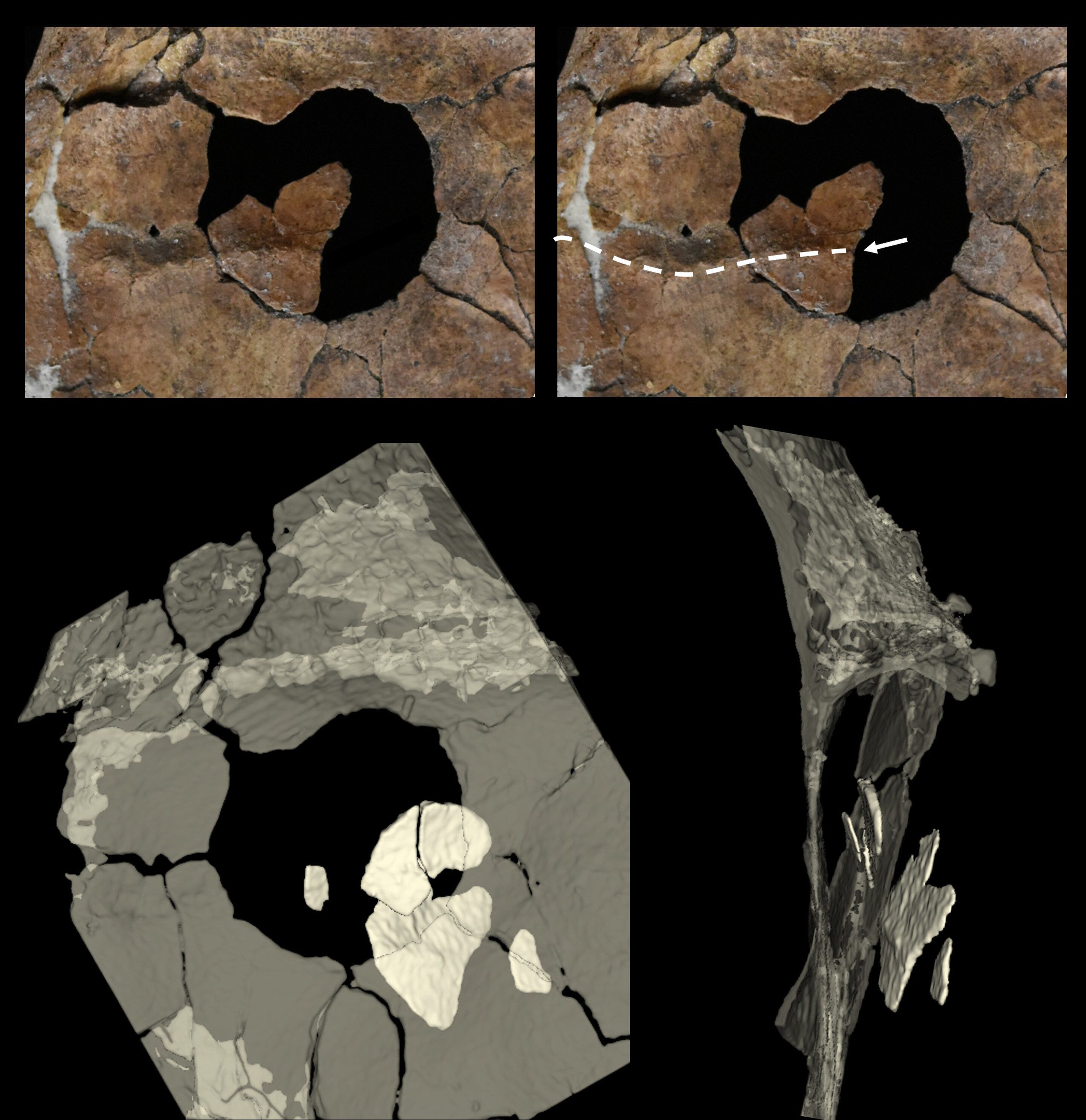
On the back of the blade the rim of the hole flares outward in a shallow bevel. Bone fails rather like glass struck by a pellet, chipping away in a cone on the side the force leaves by, so a bevel marks an exit, and this one says the weapon came through the chest from the front and left through the shoulder blade. The slivers add the angle. They were pushed slightly outward, toward the arm, and slightly down, toward the feet, and they lie tilted away from the center of the hole, from which the authors infer that the weapon entered from above and from nearer the midline of the body, heading down and outward to the left shoulder blade; if it was then pulled back out through the front, that could have dragged them farther. On that path it would have gone through the left lung and perhaps major blood vessels, and death would most likely have come fast.
Holes very like this one turn up fairly often in the shoulder blades of hunted animals, though almost never in human ones. Archaeologists have described round and lozenge-shaped perforations with radiating cracks and an exit bevel in animal scapulae from Paleolithic and Mesolithic sites, among them a red deer shoulder blade from Mesolithic Denmark described in 1974, and the reading that often goes with them is the heart shot, a blow aimed through the shoulder at the organs that bring an animal down fastest. The phrase has followed Shanidar A into the university’s announcement, in which Pomeroy reads the position of the wound, and the force it would take to push a spear clean through a chest, as the marks of a deliberate strike at the heart. The identification of the weapon rests on experiments, among them a 2018 study in which Sabine Gaudzinski-Windheuser of Johannes Gutenberg University Mainz and her colleagues reproduced, with a wooden thrusting spear driven in at low speed, one of the lesions on two extinct fallow deer (Dama dama geiselana) killed about 120,000 years ago at Neumark-Nord, near Halle in Germany. Against that work, and against experiments with stone- and bone-tipped weapons, a 15-millimeter circle fits a sharpened wooden shaft better than a flat point of any material; the first Neanderthal bone spear point to be identified, reported from Abric Romaní in 2024,5 is closer in cross-section to a stone point than to a round shaft.
Bruno Maureille, an anthropologist at the University of Bordeaux who was not involved in the study, told Science News6 he had no doubt that a wooden spear made the wound, though Rebecca Wragg Sykes, an archaeologist and the author of Kindred, a book on Neanderthal life, told Live Science7 she would like to see the hole compared with the damage a wild goat’s horn can do, since wild goat, she noted, was the animal hunted most intensely at Shanidar. Graeme Barker of the University of Cambridge’s McDonald Institute for Archaeological Research, who leads the Shanidar excavations and is the paper’s senior author, put the limits of the evidence to Gizmodo8 in a sentence:
“The science gets us to the point of showing death by spear thrust.”
Past that point, Barker said, all is speculation, and he listed what he could not exclude: someone tripping over a spear, a spearing by a member of the same group or of a neighboring one, a fight with Homo sapiens. Even the word “thrust” runs a little ahead of the paper, whose authors describe experiments still under way to test whether the hole’s features could be produced by a high-energy impact as opposed to a low-energy one, the distinction Churchill’s group used in 2009 to tell a spear driven by hand from a weapon that was thrown. Nor does the paper choose between an accident and a killing. Most injuries on Neanderthal skeletons, the authors note, look like the accidents of hunting big animals at close quarters, and Pomeroy, in the university’s statement, allows that this death could have been one, though the same statement calls violence between Neanderthals the most straightforward interpretation, which is further than the paper goes; it says only that which it was cannot be known, and that either way the spear went into the left side of a person who was facing it.
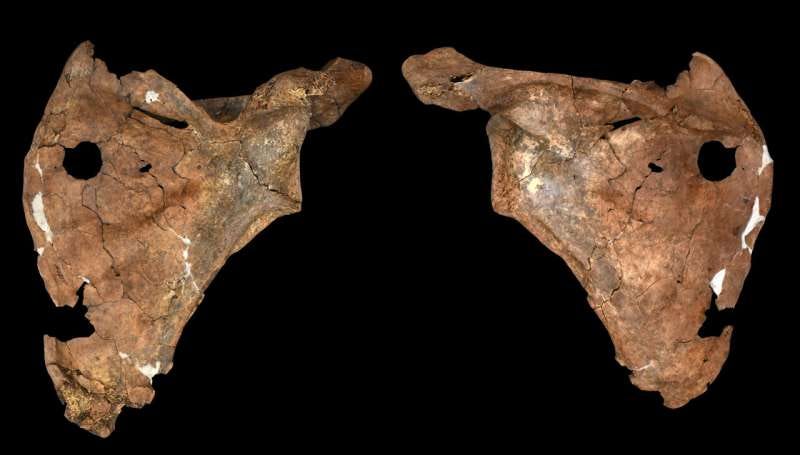
Accident or not, the wound is rare. Libby Cowgill, a biological anthropologist at the University of Missouri, reminded Science News9 that many ways of dying leave no mark on a skeleton at all, which is one reason the list of Paleolithic deaths by violence is so short. The oldest is Cranium 17, a skull about 430,000 years old from the Sima de los Huesos in northern Spain, broken by two blows from the same object; Nohemi Sala, a taphonomist now at Spain’s National Research Center on Human Evolution (CENIEH) in Burgos, described it in 2015,10 and she is one of the Shanidar A authors.
The Schöningen spears, and a monkey tooth beneath them
At Schöningen, an open-cast lignite mine in Lower Saxony some 3,000 kilometers northwest of Shanidar, the wood survived. In the 1990s, excavators led by the archaeologist Hartmut Thieme of Lower Saxony’s state heritage office took about ten spears out of the mud of an ancient lakeshore there, most of them carved from slow-grown spruce and one from pine, some more than two meters long and, the Cambridge statement notes, balanced for throwing like a javelin. They lay among the remains of nearly 50 wild horses. Older still is a sharpened tip of yew that the collector Samuel Hazzledine Warren took from the foreshore at Clacton-on-Sea, on the Essex coast of England, in 1911, now put at roughly 400,000 years old. Both are round in section, and both are the kind of weapon Pomeroy has in mind when she says, in the university’s statement, that replicas of spears from this period leave holes that fit Shanidar A’s very well.
No bone of the people who made the Schöningen spears has ever been found at the site.
On June 6, 2004, in the Lower Berm area of the mine, in a layer cataloged as Schöningen 13 II-3b2 that lies a little below the Spear Horizon, 13 II-4, the excavators recovered a milk tooth 7.47 millimeters long. It is the upper fourth deciduous premolar of a Barbary macaque, or of something close enough that Thijs van Kolfschoten of Leiden University, Ivo Verheijen of the Lower Saxony State Office for Cultural Heritage and Jordi Serangeli of the University of Tübingen, who described it in September in Quaternary Environments and Humans,11 call it Macaca cf. sylvanus, the “cf.” marking caution over the last step of the identification, and it is the first primate the site has produced. Its crown is barely worn, which in a macaque, whose last milk premolar comes in at six or seven months and which is weaned at about a year, puts the animal at around a year old. It is also the only macaque tooth among more than 40,000 vertebrate remains collected at Schöningen since 1992, and at 52.08 degrees north it is the northernmost fossil of its genus on the European mainland; only English finds, at Hoxne in Suffolk and West Runton in Norfolk, lie farther north.
The layer formed in open woodland where birch and pine took turns as the commoner tree, at a time when summers were much like today’s and winters at least a degree Celsius colder, a cold that Barbary macaques, which have been reported to sit out January temperatures as low as minus 22 degrees, could probably bear. The harder limit, the authors suggest, drawing on a 2014 model by Sarah Elton of Durham University and Hannah O’Regan of the University of Nottingham, may have been daylight: at that latitude the short winter days squeeze the hours a macaque has for feeding, foraging, moving, resting and socializing, and the monkeys of northern Germany and Britain may have been living at the edge of what the light allowed.
The monkey paper also dates its layer, on the excavators’ long-standing chronology, to between 310,000 and 315,000 years ago, which takes a side in a dispute over how old the spears above it are. They were called 400,000 years old when they were found, and later about 300,000. In May 2025 a team led by Jarod Hutson of the Smithsonian’s National Museum of Natural History, working with Kirsty Penkman’s amino acid group at the University of York, measured how far the amino acids in the shell lids of freshwater snails of the genus Bithynia, taken from the Spear Horizon itself, had turned from their living form into its mirror image, and with a reassessment of the regional sequence put the spears at about 200,000 years, in the time of the early Neanderthals. Thomas Terberger of the University of Göttingen told the Associated Press he found the arguments “interesting, but not absolutely convincing.” In June, Charles Turner of the University of Cambridge, Brigitte Urban of Leuphana University Lüneburg and van Kolfschoten argued in Quaternary International12 that the fossil mammals support an age of about 300,000 years for the spears, and the monkey paper keeps to that chronology, while the Cambridge paper on Shanidar A, published a month after it, uses 200,000.
Neanderthal burial at Shanidar Cave
Six of Shanidar A’s lower front teeth survived, loosened from a jaw that did not and jammed by moving water against the ribs. They are worn down far enough to put their owner at around 45, old by Neanderthal standards, and in a pattern odd even for Neanderthals; the bones cannot say whether this was a man or a woman. One of the six, the left lateral incisor, had been split lengthwise, and the half nearer the midline is gone. Calculus, the mineral crust better known as tartar, coats the broken faces of what remains down to the tip of the root, so the broken tooth stayed in the mouth long enough for tartar to build up over every surface the break exposed, and a polish from continued wear cuts through the thin calculus on its biting edge, so it was still in use. Micro-CT scans show the calculus in layers. The broken tooth and the central incisor beside it had probably been twisted in their sockets, and the canine pressed against it is worn unusually as a result. A heavy blow to the front of the mouth is the likeliest explanation, the authors write, whether from a fall onto a hard surface or from another person; a sharp edge cannot be ruled out, though nothing on the teeth points to one. Pomeroy estimates, in the university’s statement, that Shanidar A lived with the injury for at least a year.
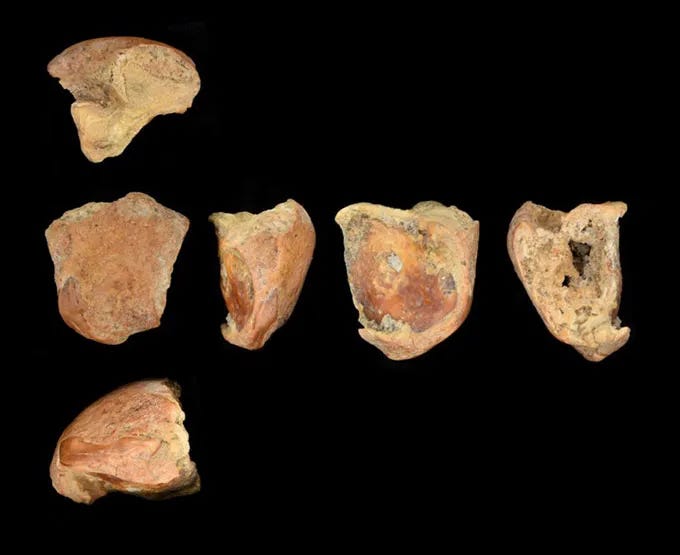
The paper suggests that for some of that time Shanidar A may have needed help from others with eating, with speaking and with the pain, and Pomeroy has floated the idea that they were given soft food; earlier work at the cave by members of the same team found charred plant food that had been soaked and pounded before cooking. Survival is the evidence for the care, and nothing more direct, and the authors concede that how far back such care goes in the human lineage is still argued over.
The body lay at the bottom of a cluster of Neanderthals, all dated to between about 70,000 and 75,000 years ago, packed into a space about 1.5 meters long, a meter wide and a meter deep, directly behind a large boulder that had fallen from a fault in the cave roof and would have stood above the cave floor of the time. In 1960 the American archaeologist Ralph Solecki, whose excavations here between 1951 and 1960 recovered ten Neanderthals in all, removed four individuals from this spot in a single block of earth: the adults Shanidar 4, 6 and 8 and an infant, Shanidar 9. The Cambridge excavations that began in 2015 have found at least three more adults directly beside them, Shanidar Z in 2018, then A and B, and because Shanidar 4, Z, A and B each preserve the same piece of the left shoulder blade, the acromion at the point of the shoulder, the new paper puts the minimum count for the cluster, with the infant, at five. Whether Z, A or B could be parts of the people Solecki called Shanidar 6 and 8 is something the team hopes to check against the 1960 bones, which are in the Iraq Museum in Baghdad. Solecki’s own reading of the spot, that Shanidar 4 had been buried with flowers, has not lasted; in 2023 Chris Hunt of Liverpool John Moores University and colleagues, Pomeroy and Barker among them, argued that at least some of the clumps of pollen found with that skeleton were probably left by solitary bees nesting in the cave floor.
The bodies were not laid there at once, as a group sheltering from the cold behind the rock might have died together. Thin layers of sediment separate them, the later ones disturbed the earlier, and the pollen and sediments point to mild conditions when they were put there. And they came close together in time, since in most cases a new body went in before the last had finished decomposing, which the authors take to mean that the dead were placed within living memory of one another, and they read the choice of so small a space, again and again, as deliberate.
Shanidar A came first. The body lay about 15 centimeters below the chest of Shanidar Z, on its back with the head to the east, as Z’s is, in a shallow channel that water had cut into the cave floor and that was dry when the body was set down; for Z someone had scraped out a hollow, but there is no sign that anyone dug for Shanidar A. The team reads the placing of a body that had just been run through with a spear, in a spot that others would keep returning to, as care of a kind, extended past death. Sand washed over the body soon afterward and partly covered it, and it decayed there. Later, once the flesh was gone and the sediment had dried, the flash flood came through the channel, thick with stones, and carried off most of the skeleton, leaving the ribs, the shoulder blade with its slivers, the teeth caught against the ribs, and the right hand. The hand’s position, south of the left ribs, means the right arm had been lying across the chest, and the hand itself had come to rest against the boulder, bent at the knuckles, with its back to the stone.
There was one more tooth in the sand under the shoulder blade, an upper third molar with the taurodont roots that are more common in Neanderthals than in Homo sapiens, and with so much less wear than the six front teeth that the team thinks it came from someone else. The paper does not say whose.
Further Reading
Hutson, J. M., et al. (2025). Revised age for Schöningen hunting spears indicates intensification of Neanderthal cooperative behavior around 200,000 years ago. Science Advances 11, eadv0752. https://doi.org/10.1126/sciadv.adv0752
Thieme, H. (1997). Lower Palaeolithic hunting spears from Germany. Nature 385, 807-810. https://doi.org/10.1038/385807a0
Allington-Jones, L. (2015). The Clacton spear: The last one hundred years. Archaeological Journal 172, 273-296. https://doi.org/10.1080/00665983.2015.1008839
Churchill, S. E., Franciscus, R. G., McKean-Peraza, H. A., Daniel, J. A., Warren, B. R. (2009). Shanidar 3 Neandertal rib puncture wound and paleolithic weaponry. Journal of Human Evolution 57, 163-178. https://doi.org/10.1016/j.jhevol.2009.05.010
Gaudzinski-Windheuser, S., et al. (2018). Evidence for close-range hunting by last interglacial Neanderthals. Nature Ecology & Evolution 2, 1087-1092. https://doi.org/10.1038/s41559-018-0596-1
Noe-Nygaard, N. (1974). Mesolithic hunting in Denmark illustrated by bone injuries caused by human weapons. Journal of Archaeological Science 1, 217-248. https://doi.org/10.1016/0305-4403(74)90024-7
Pomeroy, E., et al. (2020). New Neanderthal remains associated with the ‘Flower Burial’ at Shanidar Cave, Iraqi Kurdistan. Antiquity 94, 11-26. https://doi.org/10.15184/aqy.2019.207
Hunt, C. O., Pomeroy, E., Reynolds, T., Tilby, E., Barker, G. (2023). Shanidar et ses fleurs? Reflections on the palynology of the Neanderthal ‘Flower Burial’ hypothesis. Journal of Archaeological Science 159, 105822. https://doi.org/10.1016/j.jas.2023.105822
Kabukcu, C., Hunt, C., Hill, E., Pomeroy, E., Reynolds, T., Barker, G., Asouti, E. (2023). Cooking in caves: Palaeolithic carbonised plant food remains from Franchthi and Shanidar. Antiquity 97, 12-28. https://doi.org/10.15184/aqy.2022.143
Elton, S., O’Regan, H. J. (2014). Macaques at the margins: the biogeography and extinction of Macaca sylvanus in Europe. Quaternary Science Reviews 96, 117-130.
University of Cambridge (2026, October 15). Fatal Neanderthal wound may be earliest evidence of a wooden spear attack on a human ancestor. https://www.cam.ac.uk/stories/neanderthal-spear-wound-shanidar-cave
Ramakrishnan, A. (2025, May 9). Ancient wooden spears found in Germany may have been wielded by Neanderthals, a new study suggests. Associated Press.
Science News (2026, October 15). A telling hole in a Neandertal bone hints at a bitter end.
Pomeroy, E., et al. (2026). Evidence for funerary behaviour and lethal trauma in a new Neanderthal individual from Shanidar Cave. Scientific Reports 16, 30042. https://doi.org/10.1038/s41598-026-69193-z
Saladié, P., et al. (2026). Neanderthal woodworking at Abric Romaní: Insights into the role of wood in a Middle Palaeolithic domestic context. Science Advances 12, eaeh2287. https://doi.org/10.1126/sciadv.aeh2287
Lee, G. (2026, October 15). A spear wound likely killed this Neanderthal, but it tells a very human story. Gizmodo. https://gizmodo.com/a-spear-wound-likely-killed-this-neanderthal-but-it-tells-a-very-human-story-2000826369
Mateo-Lomba, P., et al. (2024). First identification of a Neanderthal bone spear point through an interdisciplinary analysis at Abric Romaní (NE Iberian Peninsula). Scientific Reports 14, 19160. https://doi.org/10.1038/s41598-024-67817-w
Science News (2026, October 15). A telling hole in a Neandertal bone hints at a bitter end.
Live Science (2026, October 15). Mysterious hole in Neanderthal shoulder blade may have been a ‘kill shot’ from a wooden spear, according to archaeologists. https://www.livescience.com/archaeology/neanderthals/mysterious-hole-in-neanderthal-shoulder-blade-may-have-been-a-kill-shot-from-a-wooden-spear-according-to-archaeologists
Lee, G. (2026, October 7). A wooden club and other rare finds reveal ‘invisible’ side of Neanderthal life. Gizmodo. https://gizmodo.com/a-wooden-club-and-other-rare-finds-reveal-invisible-side-of-neanderthal-life-2000822875
Science News (2026, October 15). A telling hole in a Neandertal bone hints at a bitter end.
Sala, N., et al. (2015). Lethal interpersonal violence in the Middle Pleistocene. PLOS ONE 10, e0126589. https://doi.org/10.1371/journal.pone.0126589
van Kolfschoten, T., Verheijen, I., Serangeli, J. (2026). The first primate (Macaca cf. sylvanus) from Schöningen (Germany). Quaternary Environments and Humans 4, 100116. https://doi.org/10.1016/j.qeh.2026.100116
Turner, C., Urban, B., van Kolfschoten, T. (2026). A radical reassessment of the stratigraphy, palaeoenvironmental processes and dating of the Middle Pleistocene deposits at Schöningen, northern Germany. Quaternary International 768, 110257. https://doi.org/10.1016/j.quaint.2026.110257


