

Each of the 32 volunteers lay inside a scanner in Los Angeles and said “beat,” “bait,” “pot,” “boat,” and “boot,” twice, while a camera recorded the inside of the mouth at 83.28 frames per second. A vowel lasts about 0.12 seconds, so each one yielded roughly ten frames, and across 32 people the team of Steven Moran (Institute of Biology, University of Neuchâtel) and Tiena Danner (Neuchâtel), with Marcia Ponce de León and Christoph Zollikofer (Department of Informatics, University of Zurich), ended up placing1 95 landmarks on each of 3,210 images. Their subject was vocal tract variation, the ordinary anatomical differences in palate, tongue and jaw that make no two mouths the same, and the question was whether those differences leave a trace in the vowels people produce that is large enough to matter for how languages drift apart.
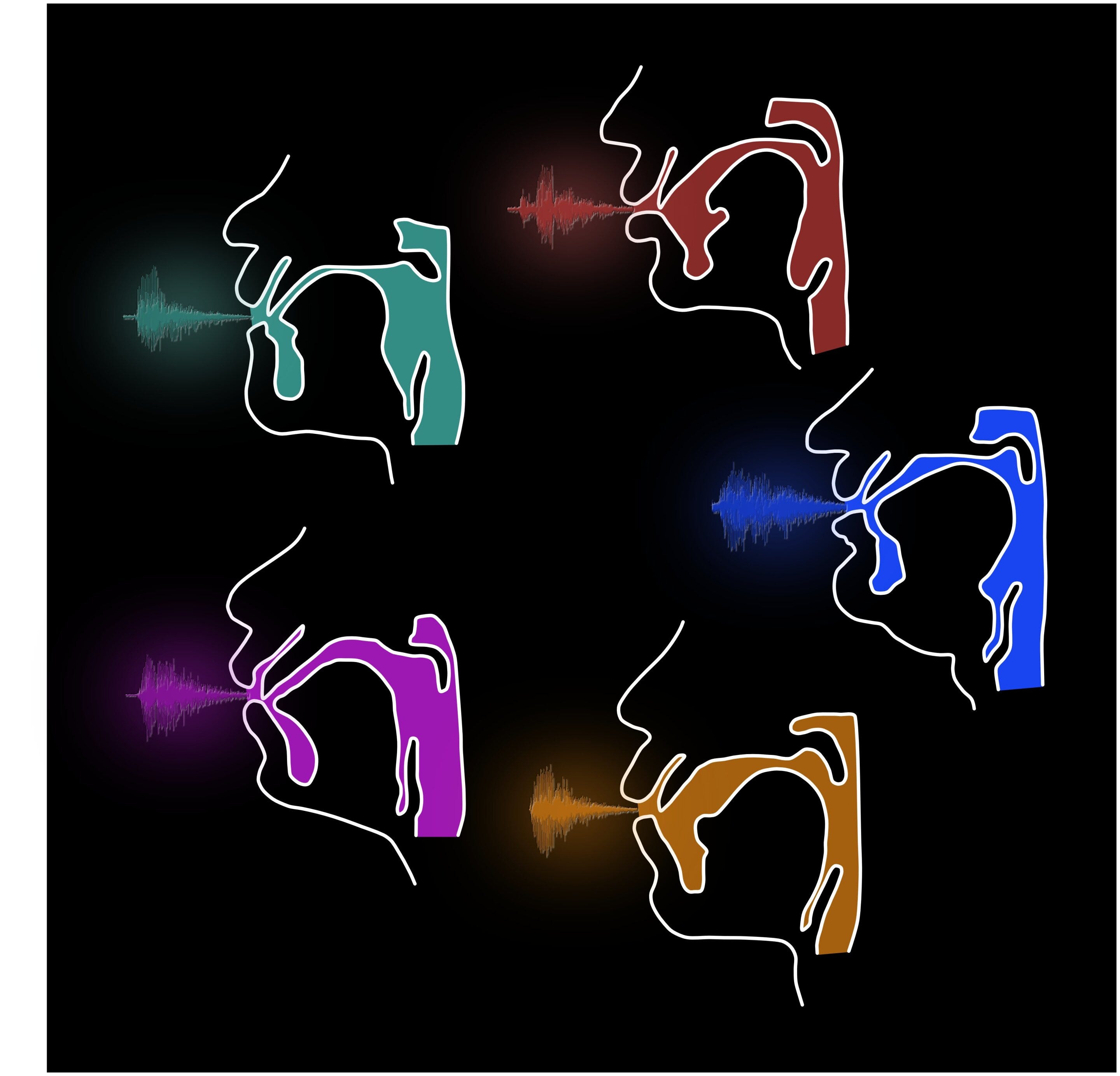
The standard assumption runs the other way. Linguists and speech engineers have long treated the pitch and timbre peculiar to one speaker as noise, something to be normalized out before the real signal of the language is read, and the authors point to the view, expressed in Labov’s Principles of Linguistic Change,2 that biology finished its work when the language faculty arrived and that everything since is cultural transmission. On that account the anatomy of the speaker is a nuisance, and the differences between English and Hindi have nothing to do with the differences between two English speakers’ jaws.
The data do not support so clean a separation, though the study’s reach is narrow, and I will come to its limits.


