

Forty centimeters down in the central precinct at Bosutswe, in the deposits associated with the site’s elite, excavators recovered a rolled sheet of metal that is four fifths lead and one fifth tin. As an alloy it is close to useless. Nobody set out to make it. It is a smelting accident, a lump of the wrong thing that formed when galena got mined along with tin ore and went into the furnace with it.
The furnace was in the Rooiberg valley in what is now South Africa’s Limpopo province, roughly 360 kilometres to the south-southeast. Somebody looked at this piece of industrial waste, decided it was interesting, and carried it that entire distance.
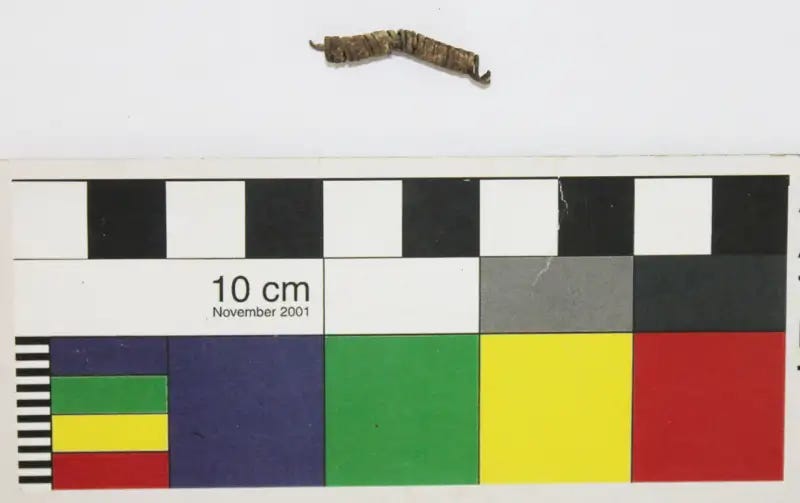
We can say that with some confidence because tin carries a geological signature. The sheet has a tin isotope ratio (δ124Sn of 1.4 per mil) that is distinctively characteristic of Rooiberg cassiterite, and a lead model age of about 2050 million years, matching the Bushveld Large Igneous Province that hosts the Rooiberg deposits. The object is a curiosity in the literal sense. Someone found it curious.
That sheet is one of the odder finds in a new study by Jay Stephens, Carla Klehm, Phillip Segadika and David Killick, published in Azania: Archaeological Research in Africa,1 which works out where the copper and tin at three Iron Age sites in east-central Botswana actually came from. The three sites are Bosutswe, a three-hectare hilltop settlement that began as a cattle post in the seventh century AD and was abandoned by the seventeenth; Khubu la Dintša, a much smaller settlement about 14 kilometres away, occupied roughly cal AD 1220 to 1445; and Lose, a hilltop site about 100 kilometres south, occupied from around AD 900 to 1500. They are the only three sites anywhere that have produced Lose pottery, a locally made ware with incised triangular motifs borrowed from Mapungubwe styles. Lose is therefore a site, a pottery type and a period name (c. AD 1200 to 1650) all at once, which is worth holding in mind for what follows.
Bosutswe was well connected long before any of this. Glass beads from the Indian Ocean trade, cowrie shells from the coast, a single gold spiral, chickens (Gallus gallus) and black rats (Rattus rattus) all turn up in its deposits. What has been much harder to see is what these communities traded with each other, inside the African interior, rather than with the Swahili coast.
Metals are the way in, but only two of them. Iron makes up about 7.1 percent of the earth’s crust, which means fingerprinting all its possible sources is not a research programme, it is a fantasy. Gold is the opposite problem: rare, but scattered across an enormous number of tiny deposits, and endlessly recyclable. Summers counted 1119 pre-colonial gold mines in what is now Zimbabwe and Botswana against 143 copper mines, and that figure excludes alluvial gold. Copper, at 75 parts per million of the crust, and tin, at 2.5 ppm, sit in the sweet spot. They are common in archaeological assemblages and scarce in the ground, and since 2014 the team behind this study has been building a reference database of lead isotope ratios for southern African ore deposits, now over 800 entries.
The Bosutswe metals sort into four groups: 14 unalloyed copper objects, two pieces of “dirty copper” with trace tin, 25 bronzes, and the lead-tin sheet. Nearly all of it is jewellery or the debris of making jewellery. Beads, clips, wound-wire helices, bangles.
The copper in those objects comes from almost everywhere. Cobalt-bearing deposits on the Central African Copperbelt and the Kipushi deposit on the Congo-Kinshasa and Zambia border, more than 950 kilometres away. Copper Queen in northwestern Zimbabwe, over 500 kilometres. Musina and Phalaborwa in South Africa, 380 and 515 kilometres. Rooiberg copper, from small deposits in the same valley as the tin. Selebi Phikwe and Dukwe in Botswana, 150 and 140 kilometres. And an unidentified vein-type deposit somewhere in the Transvaal Supergroup rocks of northern South Africa.
There is no dominant source. That is the finding. Contemporary Mapungubwe, 350 kilometres east, drew its copper almost exclusively from Phalaborwa; Bosutswe has exactly one unambiguous piece of Phalaborwa copper in the whole sample.


