

In tomb M328 at the Mogou cemetery in southeastern Gansu, two people share a grave. One is a boy, roughly six to eleven years old, laid in the side chamber. The other is a woman somewhere between forty-four and sixty, placed in the tomb passage. They are not biologically related. They did not die in the same year or the same generation. The dating puts about two hundred years between them.
That tomb is a small version of a larger problem, and both of them sit inside a new study of 149 ancient genomes from Gansu published in Cell1 on September 3. The work was led by Qiaomei Fu at the Institute of Vertebrate Paleontology and Paleoanthropology in Beijing, with archaeologists from the Institute of Cultural Relics and Archaeology in Gansu Province and collaborators elsewhere. The team generated 186 sequences from 185 samples, obtained 62 direct radiocarbon dates, and after quality filtering ended up with 149 usable individuals from eleven sites, spanning roughly 4,700 to 3,000 years before present. Ninety-five of those individuals come from Mogou alone.
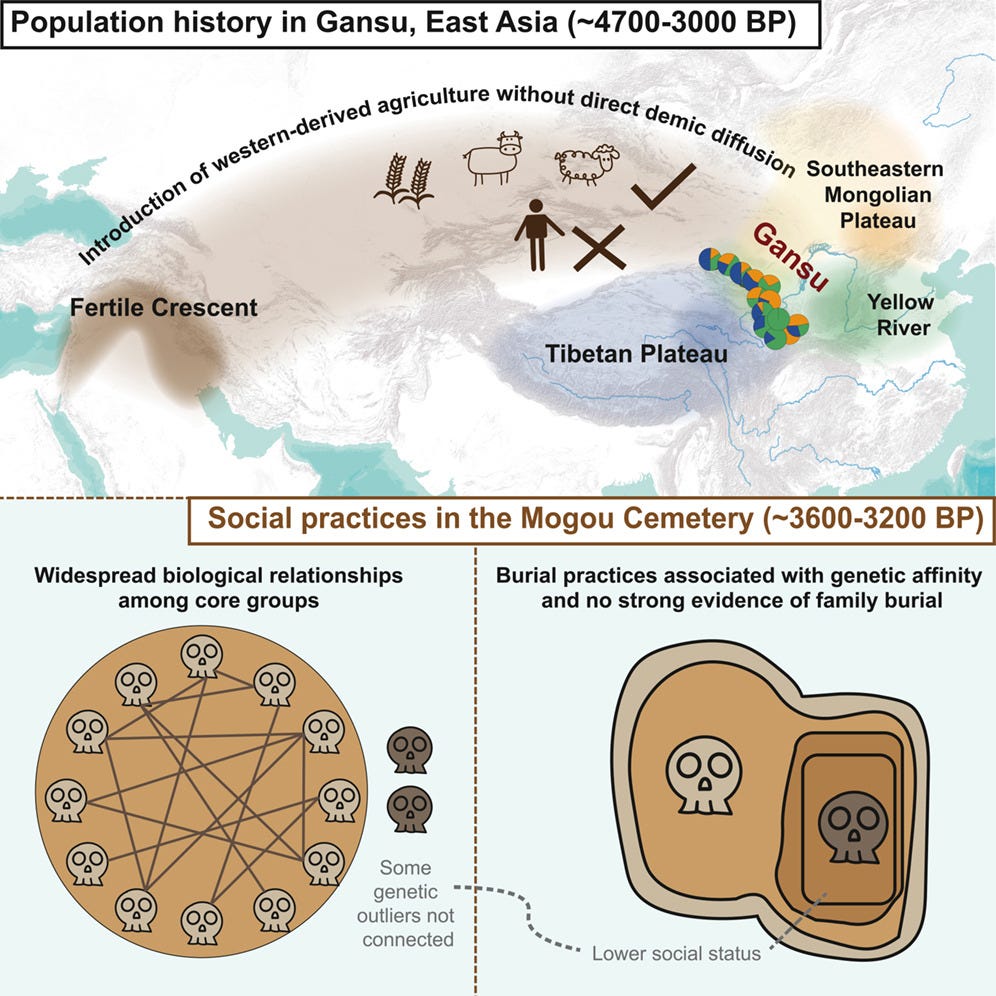
Gansu is the obvious place to ask the question they were asking. The province sits at a junction: the Inner Asian Mountain Corridor to the west, the Loess Plateau to the east, the Mongolian Plateau north, the Tibetan Plateau south. By about 4,000 years ago, crops and animals first domesticated in southwest Asia were showing up there. Wheat. Barley. Cattle. Sheep and goats. Some of the earliest copper and bronze objects recovered anywhere in China turn up in the same region, and a few cultural features at these sites recall the early Bronze Age Andronovo horizon far to the west. Nine of the eleven newly sampled sites show western-derived crops or livestock in use.
So the genomes should show western Eurasian ancestry. They don’t.
Principal component analysis places every one of the newly reported Gansu individuals inside the range of East Asian variation, with no drift toward western Eurasian or Central Asian populations. ADMIXTURE finds no meaningful western component. D-statistics comparing the Gansu groups against four reference ancestries used as western Eurasian anchors, Anatolian Farmer, Iranian Farmer, Eastern Hunter-Gatherer and Caucasus Hunter-Gatherer, return affinities no different from what any other East Asian population produces. Three independent approaches, one answer.
This is not how it went in Europe. There, the arrival of farming came bundled with people: the Neolithic expansion of Anatolian farmers, then the Bronze Age expansion of Yamnaya agropastoralists, both leaving genetic signatures visible thousands of years later. Central Asia shows something similar. Gansu shows the opposite. The domesticates crossed the continent and the people who domesticated them apparently did not, or at least not in numbers that left a trace.
The authors are careful about how far that goes. Absence of evidence at the population level is not proof that no individual with western Eurasian ancestry ever set foot in Gansu. What the data rule out is a demographic event large enough to register. Whoever carried the wheat east, they were not founding populations. The plausible mechanisms are cultural transmission along the Inner Asian Mountain Corridor, or exchange through intermediary groups on the Mongolian Steppe, and the study notes that direct archaeological evidence for a steppe route remains thin.


