

The skull tells you something is wrong before you know what to call it. The right side of the primary palate is incomplete. The alveolar arch has a gap where bone should be. The nasal septum veers sharply to one side. An upper incisor never formed. The face, in life, would have been visibly, unmistakably different.
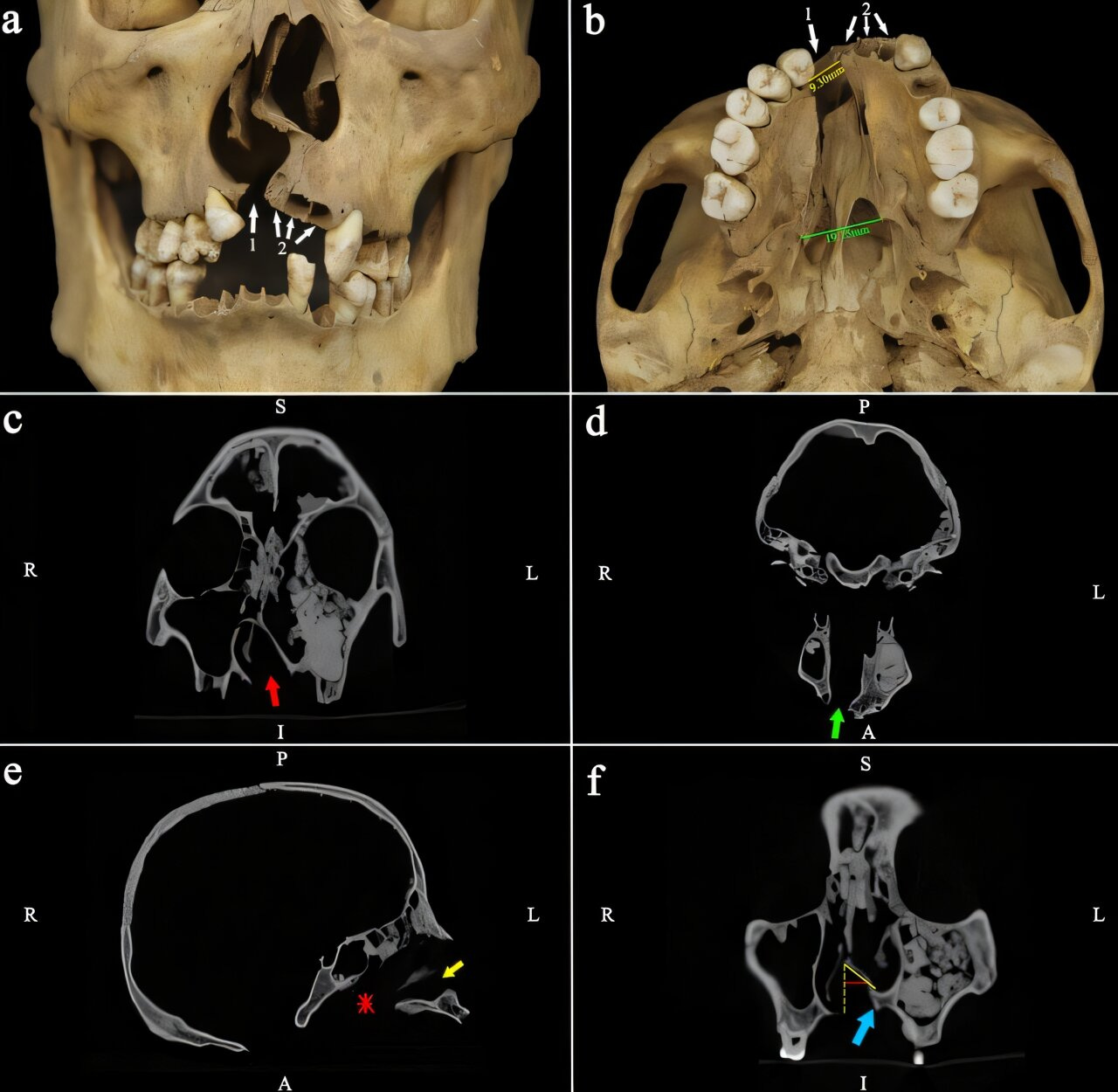
The individual designated M234-2 was between 16 and 18 years old when he died, sometime during the Jiaqing era of the Qing dynasty, between 1796 and 1820 CE. He was buried in a brick-chambered tomb at the Wenchi cemetery in Shanxi Province, northern China, alongside an adult female and a modest collection of grave goods: ceramics, metal objects, coins. The kind of burial that marks a life as ordinary.
That ordinariness is the finding.
Macroscopic examination and CT imaging, carried out by Dr. Xiaofan Sun and colleagues and published in the International Journal of Osteoarchaeology,1 confirmed what the morphology suggested: M234-2 was born with unilateral cleft lip and bilateral cleft palate. The defect arises during fetal development, when the tissues forming the lip and palate fail to fuse properly. It is among the most common congenital craniofacial conditions in humans, but its archaeological record is sparse, and in China it was previously unattested entirely. This is the first identified case.
The condition would have announced itself at birth. Feeding an infant with an orofacial cleft is difficult under any circumstances. The mechanics of nursing depend on the palate creating suction, and with a cleft, that seal is compromised or absent. Without sustained, intensive effort from caregivers, infants with untreated clefts in pre-surgical eras faced a narrow path.
M234-2 made it to adolescence.


