

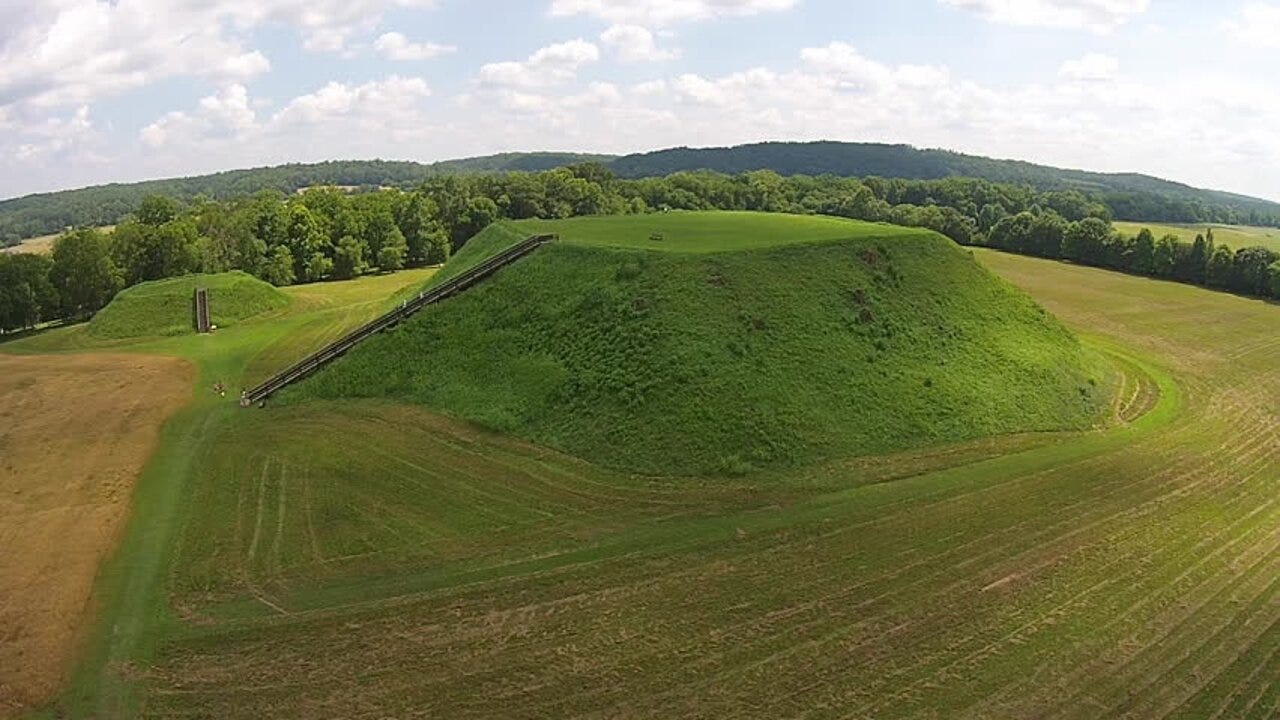
The two sherds at the center of this are small. Both are fragments of flaring rim jars, both carry the curvilinear stamped designs archaeologists file under the type name Etowah Complicated Stamped, and both came out of the same place: a borrow pit between Mounds A and B at the Etowah site in Bartow County, Georgia, excavated by Arthur R. Kelly and a crew of University of Georgia students between 1954 and 1957.1 The pit had been dug for fill and then packed with animal bone, broken pottery, and organic debris, the wreckage of feasting. The people doing the packing were raising Etowah’s first earthen platform mound. The deposit dates to the 11th and 12th centuries CE, which makes the sherds roughly 800 to 900 years old and places them more than a century before Etowah’s 14th-century peak as one of the major centers of the Mississippian world.
The sherds were washed, stored in paper bags, moved to shoeboxes, moved again to plastic bags, and eventually housed at the University of Georgia’s Laboratory of Archaeology. In 2013 someone took a burr to their interior surfaces and scraped off powder. In a Paris clean lab that powder yielded fragments of Theobroma cacao DNA.
Cacao does not grow in Georgia. It does not grow anywhere near Georgia. It is a tropical understory tree, and its presence in an 11th-century deposit in the southern Appalachian piedmont means somebody carried it there, or carried something made from it, across a distance nobody has yet been able to map.


