

Thirty meters inside Wonderwerk Cave, in a layer of sediment that accumulated somewhere between 1.07 and 1.79 million years ago, a team of researchers found bones that glow red in the dark.
Not metaphorically. When illuminated with a narrow-band blue light at 455 nanometers and viewed through a long-pass red filter, fossil bones that were exposed to fire emit a faint but distinct luminescence. Bones that were never heated do not. The physics is straightforward: thermal alteration changes the crystallographic structure of bone mineral, and those changes shift the wavelength at which the material re-emits absorbed light. The archaeological implication, if the method holds up, is less straightforward. It suggests that Homo erectus populations were bringing fire into the deepest accessible part of a South African cave nearly two million years ago.
The new study, published in PLOS One1 by Marin-Monfort and colleagues, does two things simultaneously: it extends Wonderwerk Cave’s already remarkable fire record further back in time, and it introduces a fast, non-destructive detection method that could reshape how paleoanthropologists search for burning evidence at other sites.
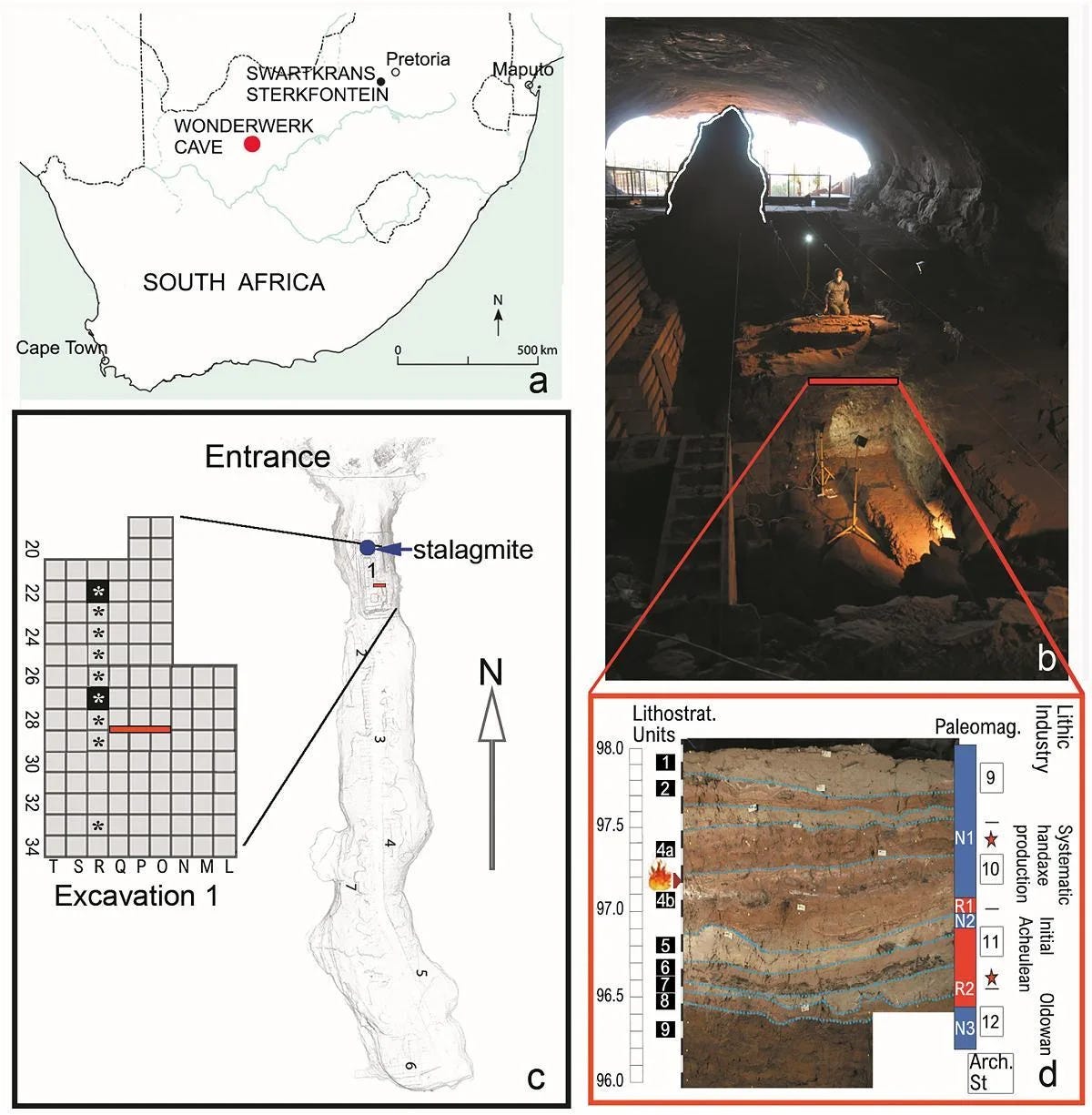
Wonderwerk has attracted attention for decades precisely because it is the kind of site that makes claims about early fire use hard to dismiss. Unlike open-air localities across Africa where burned sediment or lithics could plausibly be the work of seasonal wildfires, Wonderwerk is a cave. A deep one. By the time of the Early Acheulean deposits analyzed here, the excavation area would have sat roughly 30 meters from the cave entrance. Natural grassfires do not penetrate that far. Whatever was burning inside Wonderwerk, something carried it in.
The team’s earlier benchmark was Stratum 10, dated to around one million years ago, where micromorphological analysis by Berna and colleagues had previously documented wood ash, burned large mammal bone, scorched sediment, and heat-fractured stone tools all in association. That was the evidentiary package that established Wonderwerk as one of the world’s most credible early fire sites. The new study digs deeper, literally, into Stratum 11, the layer below, where rough early handaxes signal the onset of the Acheulean. The paleomagnetic signature of Stratum 11 places it within a reversed polarity zone between the Jaramillo and Olduvai subchrons, which gives the broad age range of 1.07 to 1.79 million years. The cosmogenic dating and the faunal biochronology both point toward the older end of that range.


