
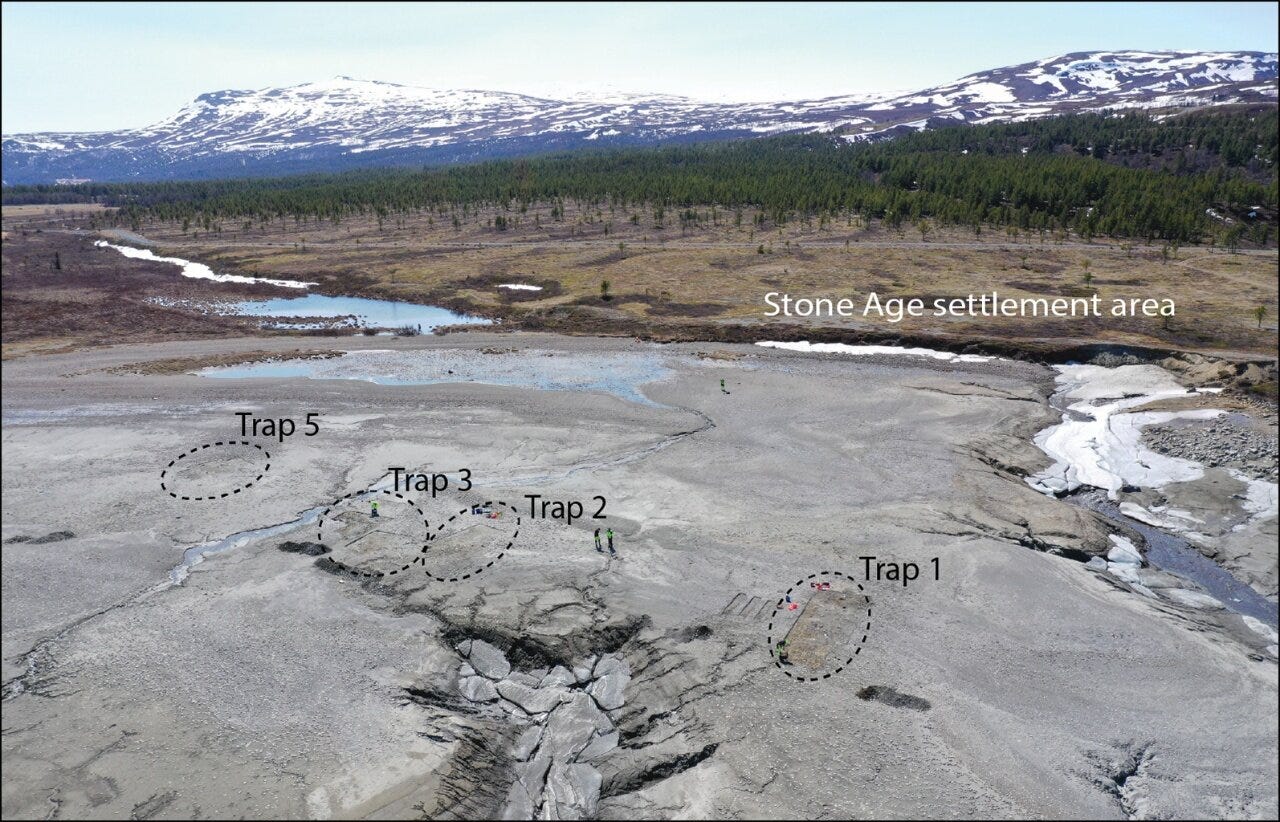
A drained lakebed in the mountains of Jotunheimen doesn’t look like much: gray silt, exposed stone, the odd meltwater channel cutting through it. But in 2022, when the water level at Lake Tesse dropped for its usual spring maintenance, someone walking the exposed mud spotted wood poking out of the ground. Not driftwood. Poles. Dozens of them, still standing upright where they’d been driven into the lakebed, arranged in a tight circular chamber with a fence of angled supports leading into it. A fish trap.
That alone wouldn’t be remarkable. People have been building lattice-wall fish traps in Scandinavia for millennia, and the type is well documented from wetland sites across northwestern Europe going back to around 4000 BC. What made this one strange was the radiocarbon date.
The trap was closer to 4950 BC. And it sat in a lake that, by every reconstruction of the region’s glacial and hydrological history, should not have had fish in it at all.
A landscape with a locked door
Lake Tesse sits at 854 meters above sea level in the central Norwegian mountains, fed and drained by a river system that eventually reaches the Oslofjord. The ice sheet that covered this terrain for most of the last glacial period didn’t finish retreating from the area until around 8400 BC. Once it did, the landscape opened up fast, both to colonizing plants and animals and to the hunter-fisher-gatherer groups moving in from the coasts. Fish followed too, but only where they could. In the lowlands, trout, pike, and a couple dozen other species swam upstream from the sea and from the shrinking freshwater and brackish remnants of the Baltic as relative sea levels dropped through the Early Holocene.
Above a certain elevation, that migration hit a wall. Literally: waterfalls and steep gradients along the Tessa River made it physically impossible for fish to swim up into Lake Tesse from the watercourses below. Historically, the lower stretches of that same river system supported around twenty-five species. The upper stretches, cut off by the falls, supported exactly one: brown trout. Not because brown trout were better adapted to alpine conditions than everything else. Because brown trout were the only species that ever got up there, and they didn’t get up there on their own.
That’s the setup the new paper, published in Antiquity 1by Axel Mjærum and colleagues at the University of Oslo, is working with. If fish couldn’t climb the falls, and Lake Tesse had fish anyway, something else put them there. The obvious candidate, in a lake that’s been renowned since the twentieth century as one of Norway’s most productive trout fisheries (it once yielded close to nine tonnes of fish a year before it was dammed for hydro-power in the 1940s), is people. The trap dating just pushes back how far that “something else” goes. Considerably.
What the poles actually show
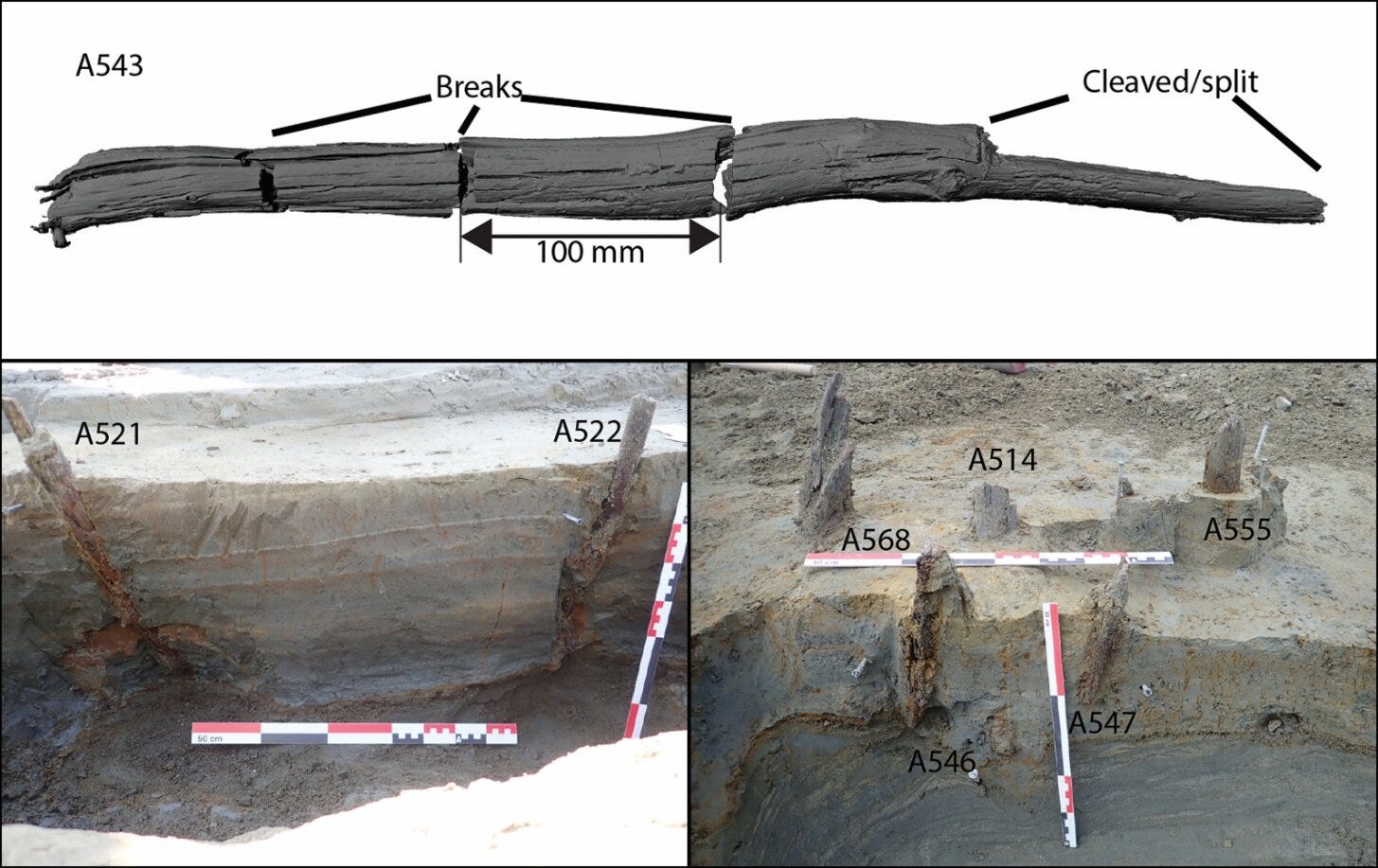
The excavation recovered four traps in total, with 73 individual poles subjected to dendrological and radiocarbon analysis. The construction itself is unglamorous and entirely functional: small stems of Scots pine, with some birch and willow mixed in, averaging about 37 millimeters in diameter, driven vertically into the lakebed to form a circular chamber roughly 3.5 meters across, braced by poles set at 30 to 45 degree angles. Cut marks and traces of lashing show the wood was deliberately worked, not just accumulated debris. It’s the kind of trap ethnographically documented across the Nordic countries well into the twentieth century, built in spring, fished through summer, sometimes maintained and rebuilt over years.
The dating is where it gets interesting. Trap 5 comes back at roughly 4950 BC via radiocarbon on its outer tree rings, placing it squarely in the Late Mesolithic. Trap 2 dates to around 5000 BC as well. Trap 1, dated both by radiocarbon and by cross-matching against a regional pine tree-ring chronology from Jämtland, Sweden, comes out at 3850 BC, with two of its posts felled about twelve years apart, suggesting the structure was periodically rebuilt rather than used once and abandoned. Trap 3 is later still, around 2700 BC. Altogether, the traps at Tesse span more than two thousand years of use, starting in the Mesolithic and continuing well into the Neolithic, long after farming had arrived in southern Scandinavia but before it had displaced hunting, fishing, and gathering as the dominant subsistence base in this particular region.
The Tesse traps aren’t isolated evidence, either. Burned fish bone from nine other sites across the Jotunheimen and Hardangervidda mountains has produced radiocarbon dates that predate 1700 BC, five of them clustering in the fifth millennium BC, roughly contemporary with the earliest Tesse traps. Where the bones have been identified to species, they’re brown trout, and only brown trout. Given that lowland fishing assemblages from the same period are far more taxonomically diverse, that pattern is hard to explain as fish being caught elsewhere and hauled up into the mountains as preserved food. It looks instead like the same species being deliberately introduced, over and over, at multiple lakes.
Ruling out the alternative explanation matters here, because there is one on the table: birds. Waterfowl are known to carry fish eggs on their feet or feathers over short distances, and it’s been proposed as a mechanism for colonizing isolated water bodies. But the case against it in the Norwegian mountains is fairly clean. If birds were doing the work, you’d expect a scatter of species turning up unpredictably across different lakes, not the same single species appearing again and again with what looks like reasonable synchrony across a two-thousand-year window. Genetic work on modern mountain trout populations backs this up too: their population structure points to repeated, stepwise upstream translocations within river systems rather than one-off natural colonization events.
None of this is unprecedented for later periods. Fishing rights over mountain lakes show up in European texts from the fourteenth century onward, already assuming fish had been introduced. A twelfth-century Norwegian runestone references the practice explicitly. Sedimentary ancient DNA from a Spanish Pyrenean lake recently pushed the confirmed record of human fish introduction back to the seventh century AD. What the Tesse dates do is detonate that timeline. Not centuries. Millennia. And crucially, they place the origin of the practice not with farmers, but with people who had no farming at all.
Why bother moving fish into the mountains
There’s an economic logic buried in this that’s worth sitting with, because it isn’t really about fishing for its own sake. Norwegian Mesolithic hunter-fisher-gatherers, judging from rock art, faunal assemblages dominated by ungulates, and sites clustered along known elk and reindeer migration corridors, put serious cultural weight on big-game hunting. The Langfonne ice patch, just eleven kilometers from Lake Tesse, has produced evidence of reindeer hunting going back to at least the fifth millennium BC. But big-game hunting in mountain terrain is unpredictable and risky. Success rates are low, and a bad trip into the high country can mean a long stretch with nothing to show for it.
Introducing a stable population of brown trout into a mountain lake changes that calculation. Trout are calorically dense, comparatively easy to catch relative to elk or reindeer, and once established, they don’t run away or migrate elsewhere. A fish population effectively domesticates the risk profile of the mountains, turning them into something closer to the resource-rich lowland environments these groups already knew how to exploit. That, in turn, makes it feasible to stay in the mountains longer, which opens up access to other resources worth having up there: furs, lithic raw material, whatever else the terrain offers.
But getting fish into a lake that fish can’t reach on their own isn’t trivial. Someone had to catch live fish somewhere downstream, keep them alive during transport (the paper raises hide waterskins as a plausible method, given how prominent hide-processing evidence is in the Mesolithic Norwegian archaeological record), carry them upstream past the barriers that were keeping every other fish out, and release them into a lake that wouldn’t produce a harvestable population for years, possibly decades. That’s not an opportunistic act. It requires understanding fish reproduction and population growth well enough to make an investment with no immediate payoff, on the expectation that it would pay off eventually, for someone. Maybe not even the person who did the carrying.
That’s the part that quietly undoes a fairly old assumption in archaeology: that this kind of deferred, planned environmental manipulation is a hallmark of agricultural thinking, something that shows up once people start planting seeds and expecting a harvest months later. The Tesse evidence says foragers were doing versions of the same thing already, with fish, at least fifteen hundred years before farming shows up anywhere in this part of Scandinavia. Indications of contact with continental farmers appear around 5500 BC in southern Scandinavia, and actual cereal cultivation not until roughly 4200 BC. In the central Scandinavian region where Lake Tesse sits, there’s no clear evidence of interaction with farming groups during the Mesolithic at all, and hunting, gathering, and fishing remained the primary subsistence strategy until around 2200 BC.
The Tesse trout aren’t an isolated curiosity either. Mountain hares were introduced to the Baltic island of Gotland around 7000 BC, apparently to improve hunting prospects, and reintroduced again after a local extinction around 2800 BC. Hazel trees spread across post-glacial Europe partly through human agency, their nuts becoming a dietary staple while their stems went into exactly the kind of wickerwork used to build fish weirs. None of these are farming. They’re all forms of people reaching into an ecosystem and adjusting it, deliberately, for future benefit, well before anyone in the region was planting a field.
What’s easy to miss in the Tesse case is just how long the intervention lasted. The traps span from the Mesolithic into the Neolithic, rebuilt and maintained across more than two thousand years. And the population those first translocated trout founded is, by all indications, still there. Sport fishers on Lake Tesse today are catching the descendants of fish someone carried past a waterfall seven thousand years ago, for reasons that had nothing to do with agriculture and everything to do with knowing a lake, a river system, and a fish well enough to bet on a return that wouldn’t come for years.
Further Reading
Ahlgren, H. et al. 2016. Multiple prehistoric introductions of the mountain hare (Lepus timidus) on a remote island, as revealed by ancient DNA. Journal of Biogeography 43: 1786–96. https://doi.org/10.1111/jbi.12759
Fagín, E. et al. 2025. Parasite sedimentary DNA reveals fish introduction into a European high-mountain lake by the seventh century. Nature Communications 16. https://doi.org/10.1038/s41467-025-57801-x
Hesthagen, T. & Sandlund, O.T. 2004. Fish distribution in a mountain area in south-eastern Norway: human introductions overrule natural immigration. Hydrobiologia 521: 49–59. https://doi.org/10.1023/B:HYDR.0000026350.93171.ba
Pilø, L. et al. 2018. The chronology of reindeer hunting on Norway’s highest ice patches. Royal Society Open Science 5. https://doi.org/10.1098/rsos.171738
Mjærum, A., Friis, E.K., Hesthagen, T. & Kirchhefer, A.J. 2026. The introduction of fish to the Scandinavian mountains by hunter-fisher-gatherers 5000 BC. Antiquity 100. https://doi.org/10.15184/aqy.2026.10392


