

Seventy-one jaws, some more than five million years old, sit in drawers at the Ditsong Museum of Natural History and the University of the Witwatersrand’s School of Anatomy. Ugo Ripamonti and his colleagues Laura Roden and Jakobus Hoffman pulled them out, scanned them with electron microscopy and microfocus X-ray tomography, and measured something1 that rarely gets attention in stories about human origins: how far the bone anchoring each tooth had receded from the enamel-dentine junction.
That distance turns out to track a fault line in hominin evolution.
In Australopithecus africanus and A. robustus, the two species showed no meaningful difference in alveolar bone loss. The bone supporting their teeth had worn down in the ordinary way biological tissue does, evenly, without much drama. In Homo habilis and Homo erectus, the picture changed. The bone loss became statistically significant compared to the australopithecines, and it took on a different shape entirely: a vertical pattern, with crateriform lesions gouged around individual teeth and furcation defects at the roots. This is not general wear. It is the fossilized signature of periodontal disease, the same category of illness that, in a modern patient, would send them to a periodontist rather than a dentist for a filling.
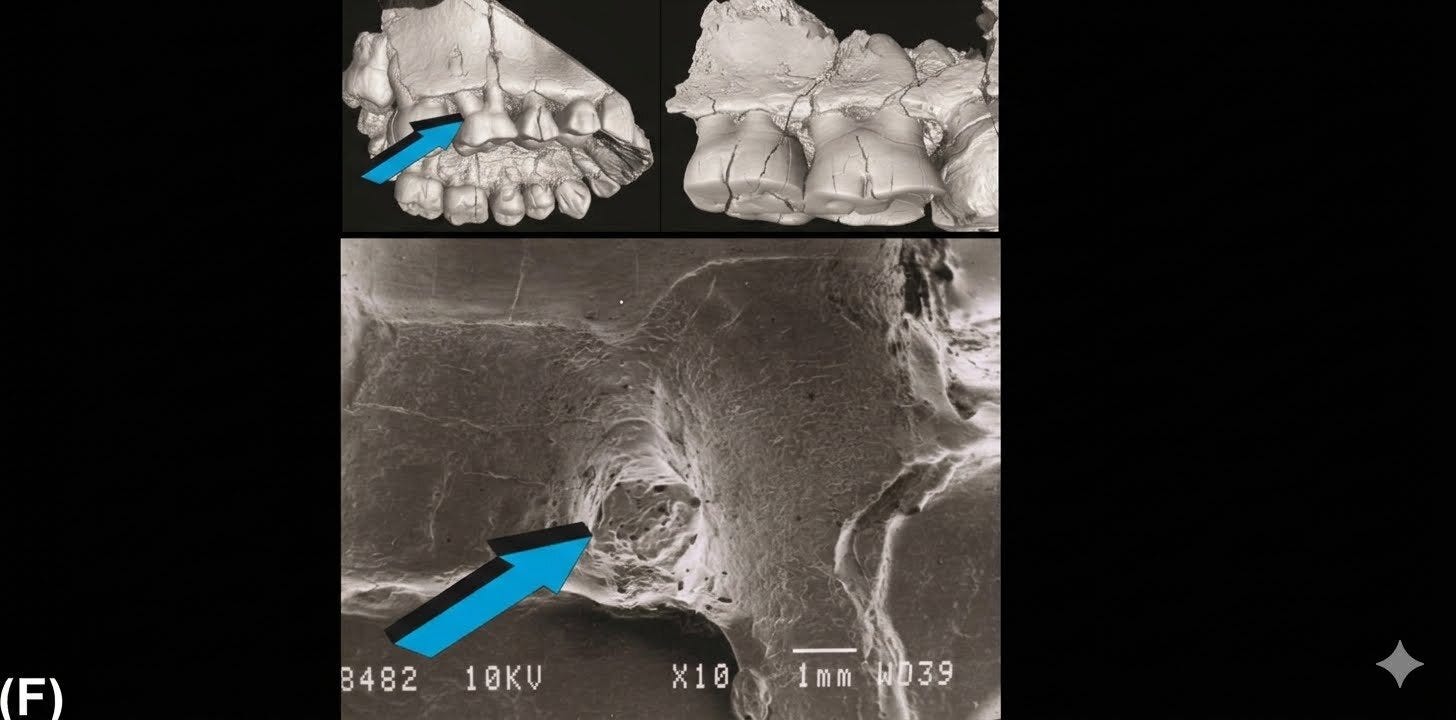
Periodontal disease is caused by bacteria colonizing the space between tooth and gum, triggering an immune response that, left unchecked, eats away at the bone holding the tooth in place. It is one of the oldest diseases we can actually see in the fossil record, because unlike soft tissue infections, it leaves a permanent mark on bone. What Ripamonti’s team found is that this mark shows up in Homo in a way it does not in the australopithecines that preceded it, right around the Plio-Pleistocene boundary, the stretch of time when the genus Homo was taking its first distinct shape.
The obvious question is why disease would concentrate more heavily in one lineage than another, and the paper’s answer runs through the size of the teeth.


