

There is a story about hunter-gatherers that has been told so many times it has almost calcified into myth. They share everything. They resist hierarchy instinctively. They are, in some deep evolutionary sense, wired for fairness. The Hadza of Tanzania are often cast in this role: egalitarian foragers living near Lake Eyasi, hunting and gathering much of their food, distributing it widely across camp. They are cited in behavioral economics papers as evidence that humans evolved with strong, other-regarding preferences for equality. Look, the argument goes — even in the absence of markets and institutions, people share generously with strangers. That must mean something fundamental about our nature.
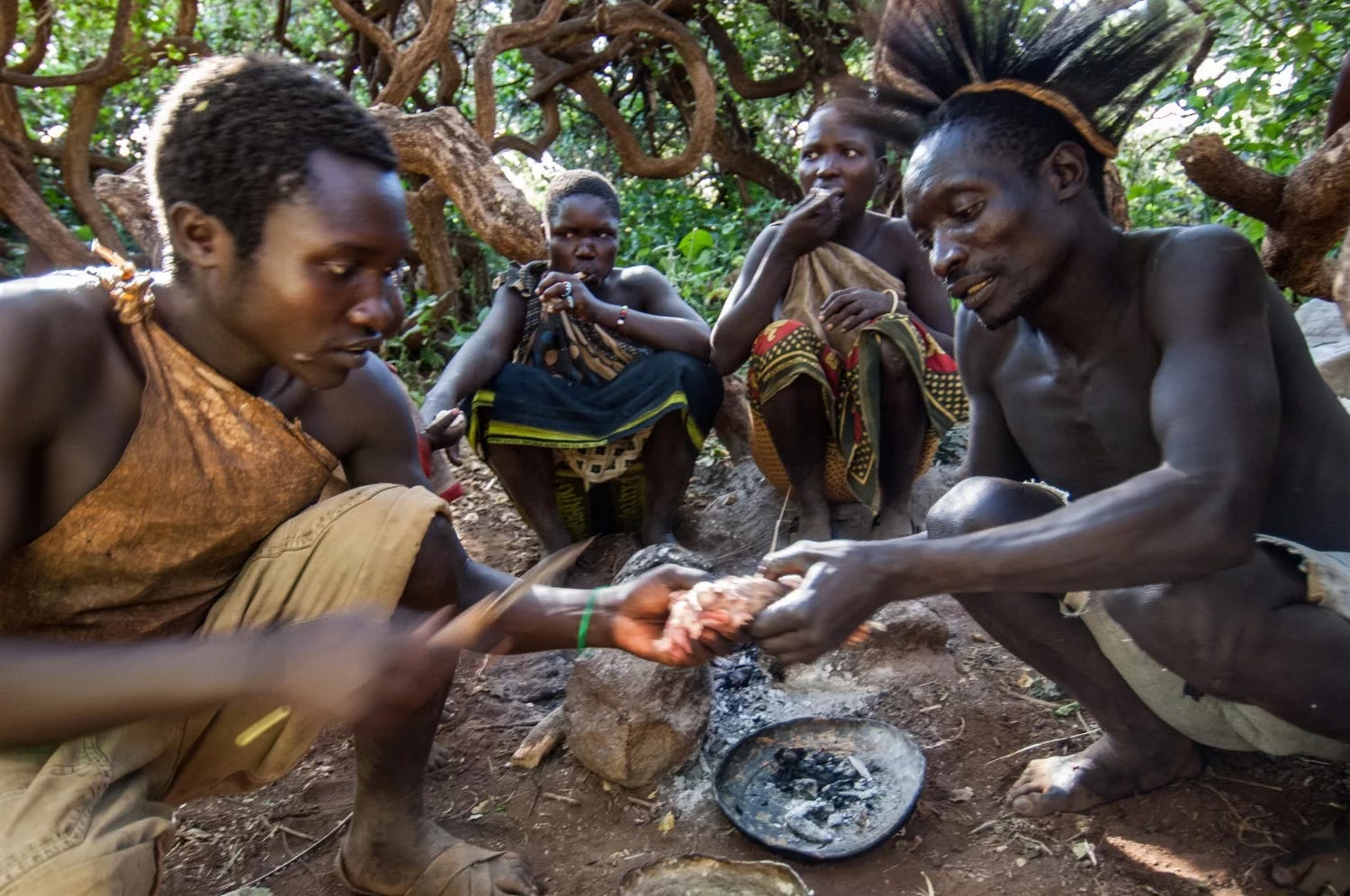
A new study published in PNAS Nexus1 complicates this story in a way that is harder to dismiss than the usual methodological quibbles. Researchers led by Kristopher Smith and Duncan Stibbard-Hawkes ran a carefully designed economic game with 117 Hadza adults across nine camps. The game looked simple: two people receive unequal amounts of a food resource, and one person decides how to redistribute it. But the design contained a twist that most previous experiments had omitted. Participants could not only give tokens to the other person. They could also take.
That one change — adding the option to take — produced results that looked, for the first time, like real Hadza food-sharing. Not because people became more generous. But because people who started with less grabbed what they felt they were owed.
The resource was dried banana chips, chosen in consultation with a Hadza research assistant because they are calorie-dense, universally valued, and not easily spent in markets far from camp. Each token represented one chip. The split was unequal by design: either 8 tokens for the participant and 4 for an anonymous campmate, or 4 for the participant and 8 for the campmate. Photographs of real camp members were placed face-up and face-down in front of participants, making it clear that the other player was not an abstraction but a neighbor. Decisions were made privately, away from camp.
The results were not subtle. Across both conditions, participants took from the other player more often than they gave — 43 percent of decisions involved taking, while only 31 percent involved giving. The most common single outcome was for the participant to leave nothing at all for the other player: one in five participants took everything.
When participants started with the advantage, only about 41 percent chose to give anything away. Nearly a third of those in the advantaged position actually took even more, widening a gap that was already in their favor. Equality was rarely achieved when people had more than their campmate to begin with.
The picture shifted sharply when participants started behind. Among those in the disadvantaged position, nearly 59 percent took tokens from the other player. And when they did, the resulting distributions came close to equal, matching — for the first time in any experimental study of the Hadza — the kind of food-sharing patterns observed in everyday camp life. Under the disadvantaged condition, the median number of tokens left for the other player was roughly six out of twelve: close to a 50/50 split. Under the advantaged condition, it was about four. The difference tells the story.
Stibbard-Hawkes has put it plainly in describing the research: egalitarianism among the Hadza is real, and outcomes are genuinely equitable. But the mechanism behind it is not what the “noble generosity” framing implies. People secure a fair share for themselves. They do not especially seek to deliver one to others.


