

The bones came out of the cave in pieces. Over more than two decades, paleoanthropologist Ronald Clarke and his colleagues excavated, cleaned, and reassembled the skeleton of StW 573 from the breccia of Sterkfontein Caves, about 50 kilometers northwest of Johannesburg. By 2016, they had what is probably the most complete Australopithecus skeleton ever found. They called it Little Foot.
The skull, though, was a problem.
Post-depositional damage had done what millions of years of sediment weight will do. The lower face had been shoved upward into the frontal and left zygomatic bones. The frontal squama had been pushed downward. Bone fragments in the supraglabellar region had buckled and cracked. The face of one of the oldest hominins ever found in southern Africa was, in an important sense, not yet visible.
That has changed. A new study published in March 2026 in Comptes Rendus Palevol 1presents the first synchrotron-based digital reconstruction of the StW 573 face, produced by a team led by Amélie Beaudet of CNRS and the University of Poitiers. The result is preliminary, the researchers are careful to say. But what they found is genuinely strange, and it opens a line of questions that paleoanthropologists are only beginning to ask.
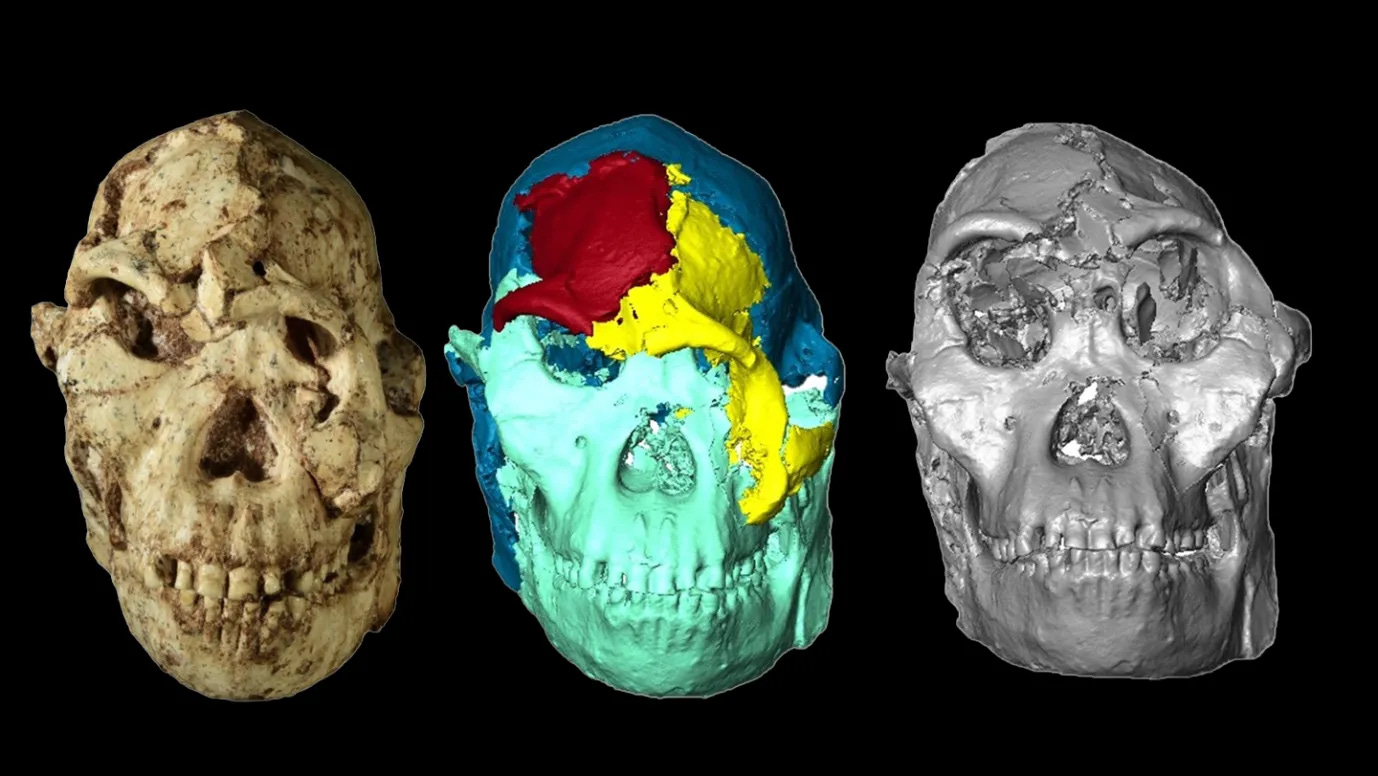
The skull was scanned in 2019 at the I12 beamline of Diamond Light Source, a synchrotron facility in Oxfordshire, England, using propagation phase-contrast X-ray micro-computed tomography at a voxel resolution of 21.23 micrometers. That’s fine enough to distinguish individual bone fragments from the matrix they’re embedded in. The team then used semi-automated segmentation software to isolate those fragments digitally, a process that required manually segmenting 115 out of 9,138 total image slices, with machine learning filling in the rest. Once the bones were separated from stone, the team identified five major displaced blocks and reassembled them through a combination of digital translations and rotations, aligning them according to anatomical correspondences.
The lower face was considered relatively intact and served as an anchor. The rest was fit around it. Where the left maxilla had been destroyed, they mirrored the intact right side to fill the gap.
What emerged was a face.


