

Among the burial goods recovered from the elite tombs at El Caño and Sitio Contè on Panama’s Pacific coast, there are fossilized megalodon teeth. There are pyrite mirrors. There is gold worked into the shapes of animals. And there are small green stones that, for as long as archaeologists had reason to suspect, were emeralds.
Suspicion is not confirmation. The stones sat in that ambiguous category for decades — visually consistent with emeralds, plausibly traded down from South America, but never subjected to the kind of analysis that could say, with precision, what they actually were or where they actually came from. That confirmation has now arrived, and it carries implications that go well beyond mineralogy.
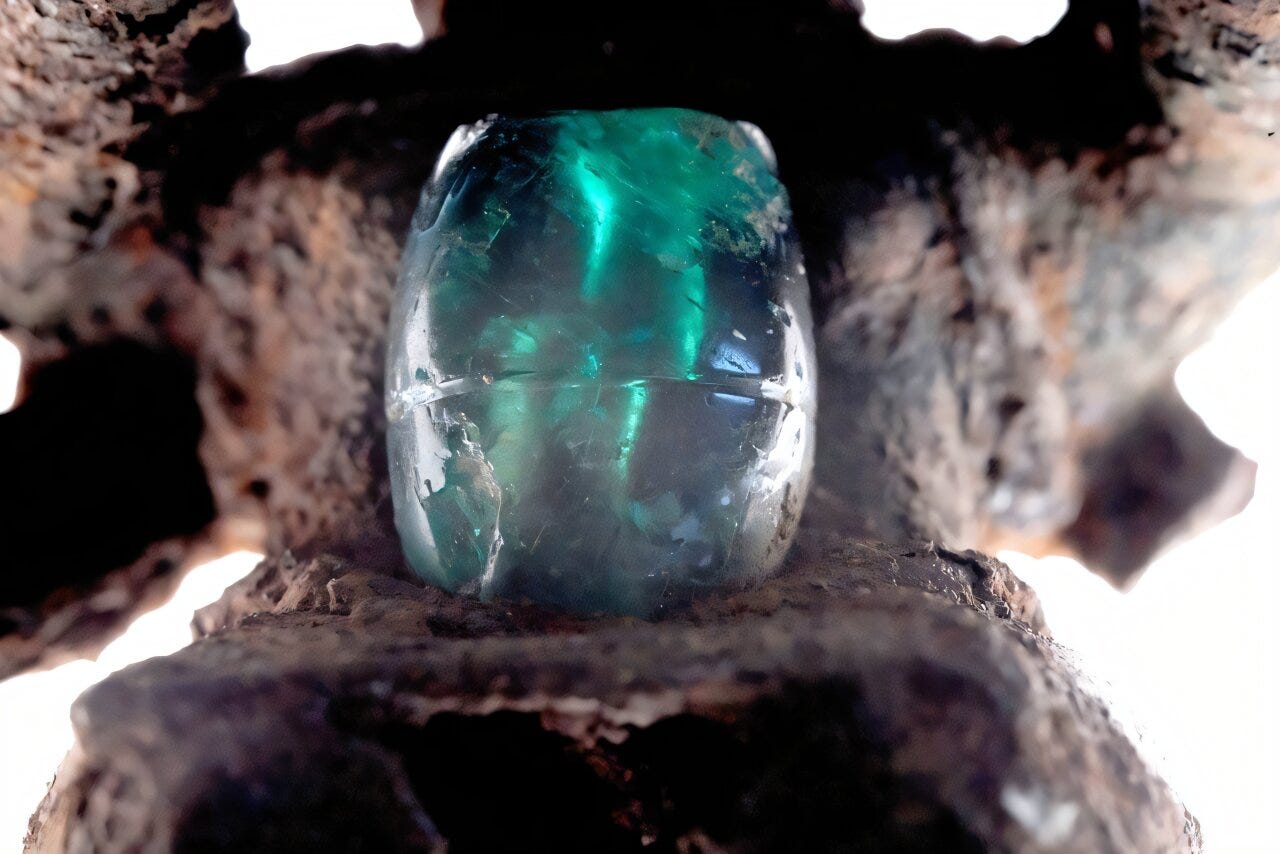
A team led by Carlos Mayo Torné, an archaeologist at the Technological University of Panama, applied1 a battery of non-destructive techniques — portable X-ray fluorescence, infrared spectroscopy, photoluminescence — to five green stones from El Caño and Sitio Contè. The results were unambiguous. All five were emeralds. And their geochemical signatures pointed not to any nearby source, but to Colombia: specifically, to the Western Emerald Belt near Muzo and the Eastern Emerald Belt near Chivor, both of which would become famous centuries later under Spanish colonial extraction. The emeralds had traveled more than 700 kilometers before ending up in someone’s grave.
These sites, dated to roughly AD 800–1000, sit within the Gran Coclé region, a culture zone defined in part by the richness of its elite burial practices. Only eight emerald-like stones have ever been documented from this region, appearing in specific and deliberate contexts — mounted on a copper spider pendant, worked into a golden feline, set into a copper pendant in the form of a woman. The numbers are small. The settings are not incidental. Whatever these objects meant to the people who buried them, they were not decorative filler.


