

For two million years, the skull of the genus Homo did two things at once. The braincase swelled. The face retreated. Both trends look, at a glance, like textbook adaptation: smarter hominins outcompeting duller ones, generation after generation, until the vault ballooned to hold the extra tissue. It’s a satisfying story. Mark Hubbe and Katerina Harvati just ran the numbers on it, and the numbers don’t cooperate.
Their study, published in Nature Communications,1 took 3D landmark data from 87 skulls spanning early Homo through recent Homo sapiens, including Homo erectus, Homo heidelbergensis, and Homo neanderthalensis, and asked a narrower question than “did brains get bigger.” It asked: which of six mathematical models of evolutionary change best explains how they got bigger. A model where natural selection pushed steadily in one direction. A model where change is just noise, an unbiased random walk with no destination. Three flavors of stasis, where a trait gets pinned near some optimum and stays there. And punctuated equilibrium, long quiet stretches broken by short bursts.
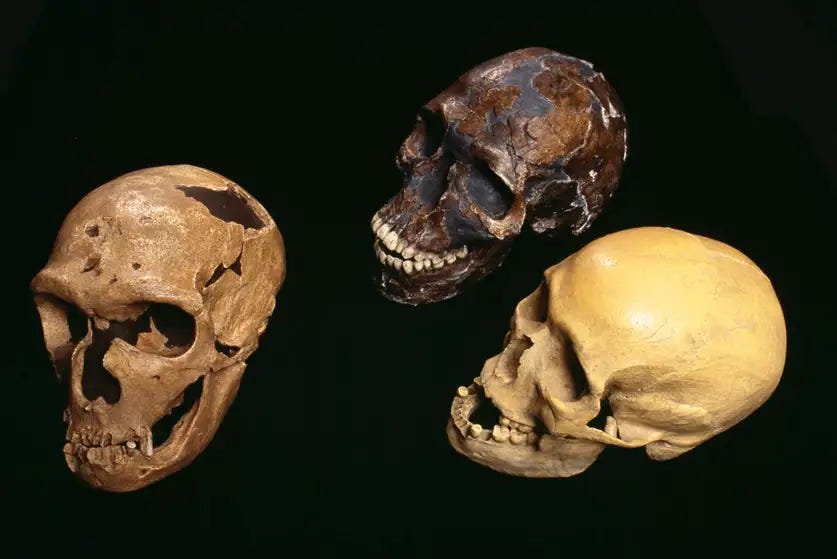
The result, run separately for the sapiens and neanderthalensis lineages, favored randomness and stasis almost everywhere. Neurocranial shape and size were best explained by an unbiased random walk or by evolutionary stasis. Directional selection, the steady-pressure model that would vindicate the “smarter brains win” story, came in a distant also-ran in nearly every comparison. Facial reduction told the same story with an even stronger lean toward stasis, particularly the strict version, where a trait is essentially locked in place and any variation is just noise around a fixed mean.
This isn’t a claim that brains didn’t grow, or that faces didn’t flatten. Both things clearly happened, and the paper’s own principal component analyses trace the changes in detail: increasing cranial height and breadth, a rounding of the vault in the sapiens line, a steady loss of jaw projection and dental arcade length. What the analysis rules out is a specific mechanism for that change, the one anthropologists have leaned on for a century. If a trait were under constant selective pressure to increase, you’d expect the statistical signature of a biased walk, a Ornstein-Uhlenbeck climb toward higher and higher optima. Instead the signature looks like a cranium wandering within a fence, occasionally finding the fence moved.


