

Stratum H at Jebel Katefeh-1 is a band of silty sand no more thrilling to look at than the dune material above and below it. What makes it interesting is its position. Beneath it lies wind-blown sand, the signature of a dry Nefud. Above it lie lake sediments. The artefacts sit exactly at the hinge, in the moment when a desert basin in northern Saudi Arabia began filling with water again. Someone was knapping quartzite on that shoreline as it formed.
Jebel Katefeh-1 (JKF-1 hereafter) is an open-air site in the Jubbah basin of the Nefud Desert, excavated in the past two decades and holding one of the largest published Middle Palaeolithic assemblages from northern Arabia. Its problem has always been chronology. Earlier dating placed the occupation somewhere between roughly 90 and 50 thousand years ago (ka), a window so wide it was almost useless. Southwest Asia at 90 ka and Southwest Asia at 50 ka were occupied by different hominins. A date that spans both tells you nothing about who left the tools.
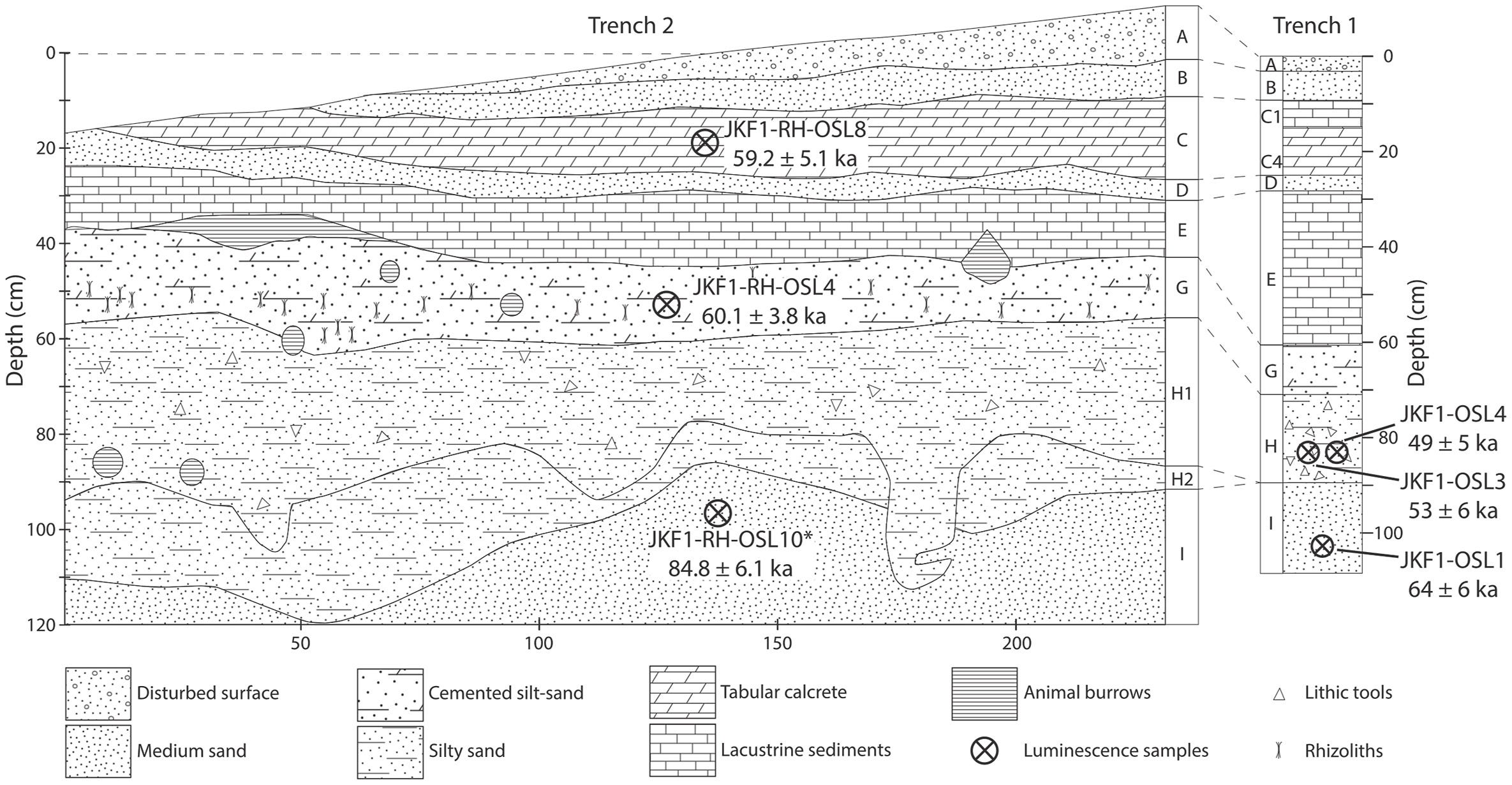
So a team1 led by James Blinkhorn and Huw Groucutt went back and dug a second trench five metres from the first, in the same stratigraphic context, and ran new optically stimulated luminescence samples. The measurements were messier than ideal. Overdispersion in the equivalent dose values ran from 33 to 69 percent, well above the roughly 28 percent you would expect from laboratory and microdosimetry effects alone, and the site is riddled with fox burrows. Animals had been stirring the sediment. Rather than average through the mixing, the team used a finite mixture model to pull apart the dose components in each sample and dated the dominant one.
The result: aeolian sand deposited between 85 ± 6 and 64 ± 6 ka, lake sediments at 60 ± 5 and 59 ± 5 ka, and the artefact layer wedged between them. Combined with two direct ages of 53 ± 6 and 49 ± 5 ka on the same stratum from the original trench, the occupation lands at roughly 60 to 50 ka. Call it 55.
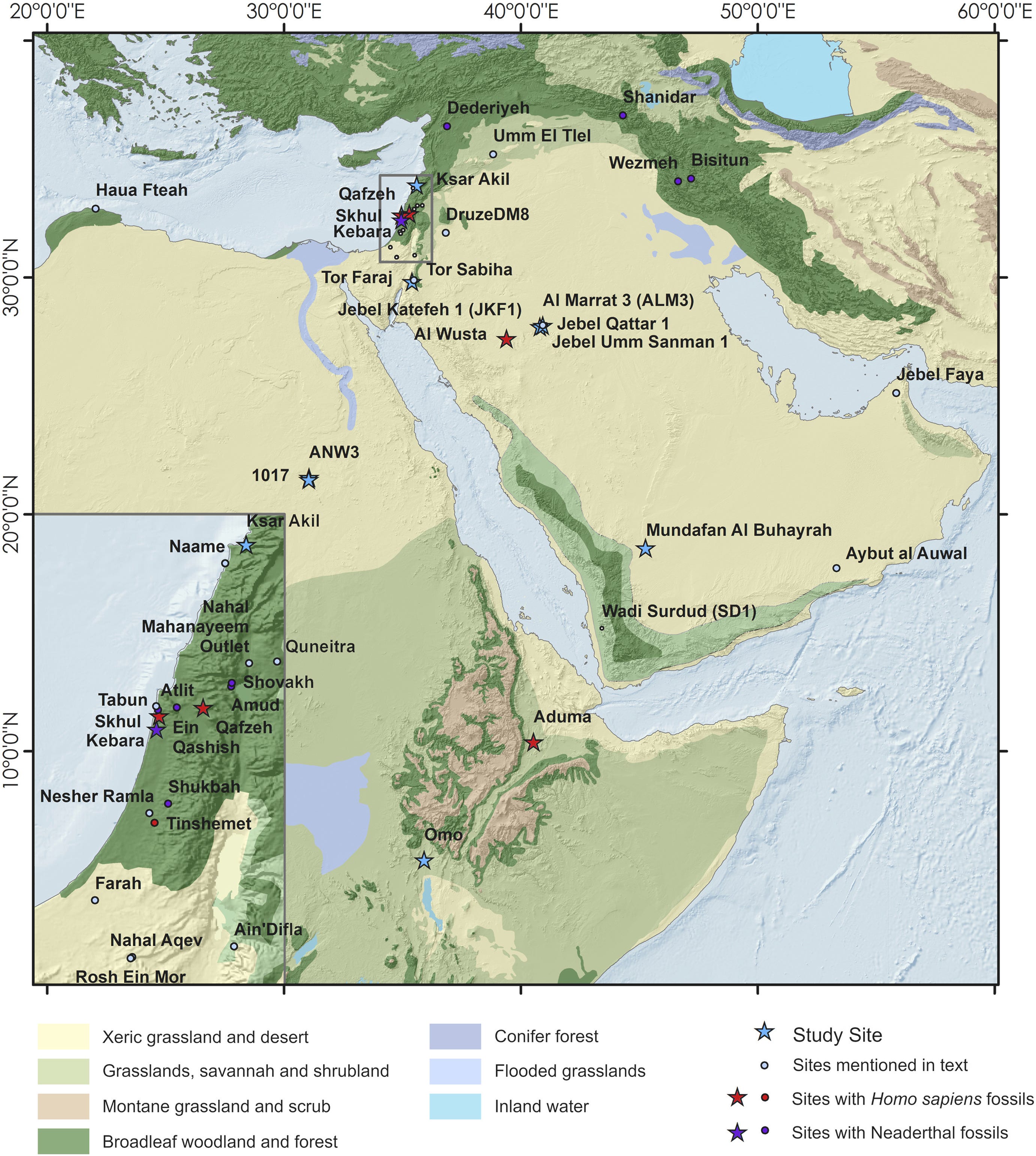
That number does a lot of work. In the Levant and the Zagros, the hominins securely dated to that window are Neanderthals, and there are many of them: Kebara, Amud, Dederiyeh, Shovakh, ‘Ein Qashish and Shukbah to the west, Shanidar, Bisitun and Wezmeh to the northeast. The Homo sapiens fossils of the region are all older. Skhul falls around 130 to 100 ka, Qafzeh around 110 to 90 ka, and al-Wusta, the one H. sapiens finger bone from Arabia itself, dates to 90 to 85 ka. Nobody has ever found a Neanderthal bone in Arabia. But at 55 ka, the nearest people we can name were Neanderthals, several hundred kilometres north.


