

The list of jobs a Hizen Ogame could hold is short and unglamorous. Water. Soy sauce. Fertilizer, meaning collected human excrement. Human remains. These were big stoneware vessels, roughly 60 to 100 cm tall with rims that occasionally exceeded 80 cm across, built by stacking coils of clay and beating them thin with a wooden paddle against an interior block, then fired in multi-chambered climbing kilns (noborigama) that sometimes ran more than 40 m up a hillside. The two paddle-and-anvil tools, shurē and tokyā, carry Korean names, a trace of the artisans relocated to Kyushu after the Imjin War of 1592 to 1598 whose descendants seeded Japan’s porcelain industry at Arita.
Ogame are the opposite of Arita porcelain in almost every way that matters to a collector. Nobody exported them. Nobody wrote about them in Europe. In rural western Kyushu they were the affordable coffin: a jar burial, kamekan, for commoners who could not afford anything else. In Edo, where transport costs made them expensive, they show up mostly with high-status individuals, which is a nice inversion of how status usually attaches to objects.
Two Japanese archaeologists, Higashinakagawa in 1987 and Shimomura in 1994, both argued that Ogame became more standardized over the course of the Edo period (1603 to 1868), tied to the same forces that reorganized Hizen porcelain production: domain-level regulation under the Nabeshima authorities, the Qing sea ban of 1647 to 1684 that briefly pulled Chinese porcelain off the world market, and the kiln expansion that followed. Shimomura noticed that thickened inner rims turn up more often in 18th-century contexts. Nobody had measured any of it.
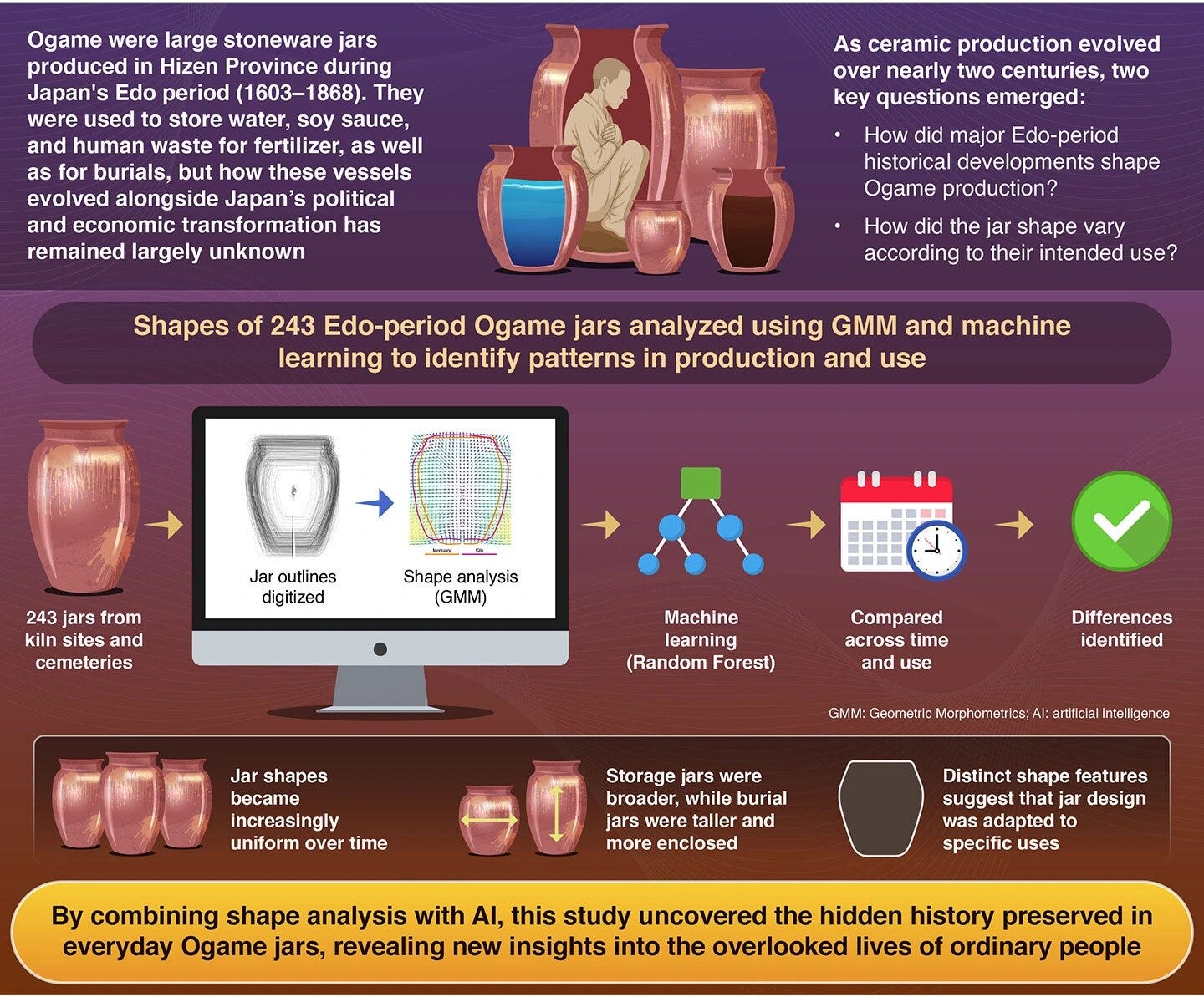
James Frances Loftus, of Institute of Science Tokyo, has now measured it. His study, published in Open Archaeology,1 digitized the profile outlines of 243 Ogame from 11 sites across Hizen and Chikuzen Provinces (present-day Saga and Fukuoka prefectures): two kiln assemblages, Kameya and Furukameyashimo, contributing 137 vessels, and nine mortuary sites contributing 106. Each outline was decomposed using Elliptical Fourier Analysis into ten harmonics, which converts a closed silhouette into a set of coefficients that describe global proportions at low harmonic rank and progressively finer curvature at higher ranks. Principal Component Analysis then compressed that coefficient space into interpretable axes. PC1, which captures 60.9 percent of shape variance, tracks horizontal breadth across the shoulder and upper body. PC2, at 16.2 percent, tracks vertical elongation and the neck-to-body relationship. Together they account for 77.1 percent of the variation.


