

In 1974, an iron ore pellet plant near Dampier in Western Australia installed equipment to strip sulfur dioxide out of its exhaust. The stated reason, recorded in the Hamersley News, the company’s own paper, was to protect the people working there. Nobody was thinking about the engravings on the rocks a few kilometres away.
That clipping now appears in the reference list of a scientific paper about those engravings. It is one of the few surviving traces of how much sulfur the Dampier industrial area was putting into the air half a century ago, and it turns out to matter quite a lot.
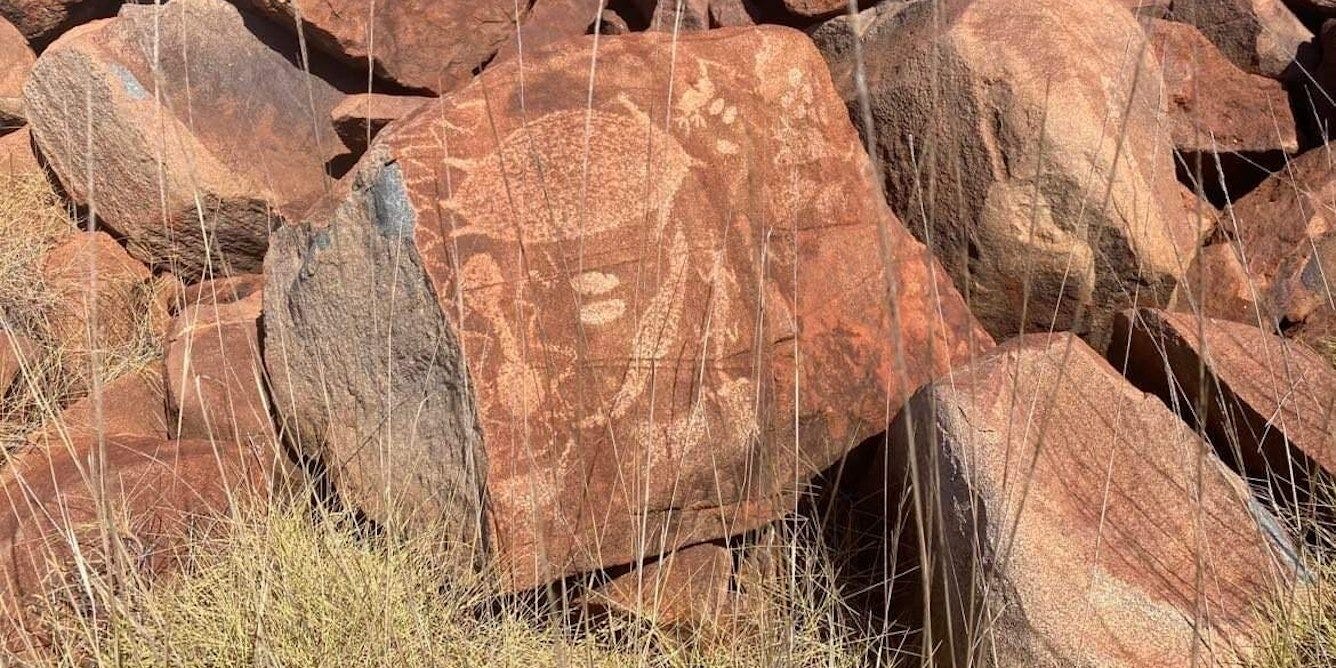
Murujuga, the cultural landscape spanning the Burrup Peninsula and the Dampier Archipelago, holds something between one and two million petroglyphs. The engravings record the relationship between Ngarda-Ngarli Traditional Owners and this land and sea Country across a span of at least 50,000 years, including images of animals that no longer exist in the region. In July 2025 it was inscribed on the UNESCO World Heritage List, one of Australia’s first Indigenous-led nominations. It is also, and has been since the 1960s, the site of liquefied natural gas processing, fertiliser production, salt works, and a major iron ore port.
For more than two decades the dominant explanation for observed changes to the rock surfaces has been acid deposition. The logic was clean. Industry emits nitrogen and sulfur oxides. Those gases form nitric and sulfuric acid. The engravings are visible only because of a dark surface layer, a few tens to a few hundred microns thick, coloured by iron and manganese oxides, which contrasts against the paler clay-bearing layer underneath. Iron and manganese oxides dissolve more readily as pH falls. And when researchers put a probe to those rock surfaces, they got readings between about 4.5 and 6. Acidic. Case closed, or close enough that it shaped two decades of argument about industrial approvals.
A team led by K.A. Evans at Curtin University, working with the Murujuga Aboriginal Corporation as part of the government-funded Murujuga Rock Art Monitoring Program, has now published an analysis that takes that chain of reasoning apart link by link. The paper appeared as a preprint in February 2026 and in Scientific Reports1 the following month. Its central claim is not that the rock art is fine. It is that the field has been reading the wrong instrument.


