

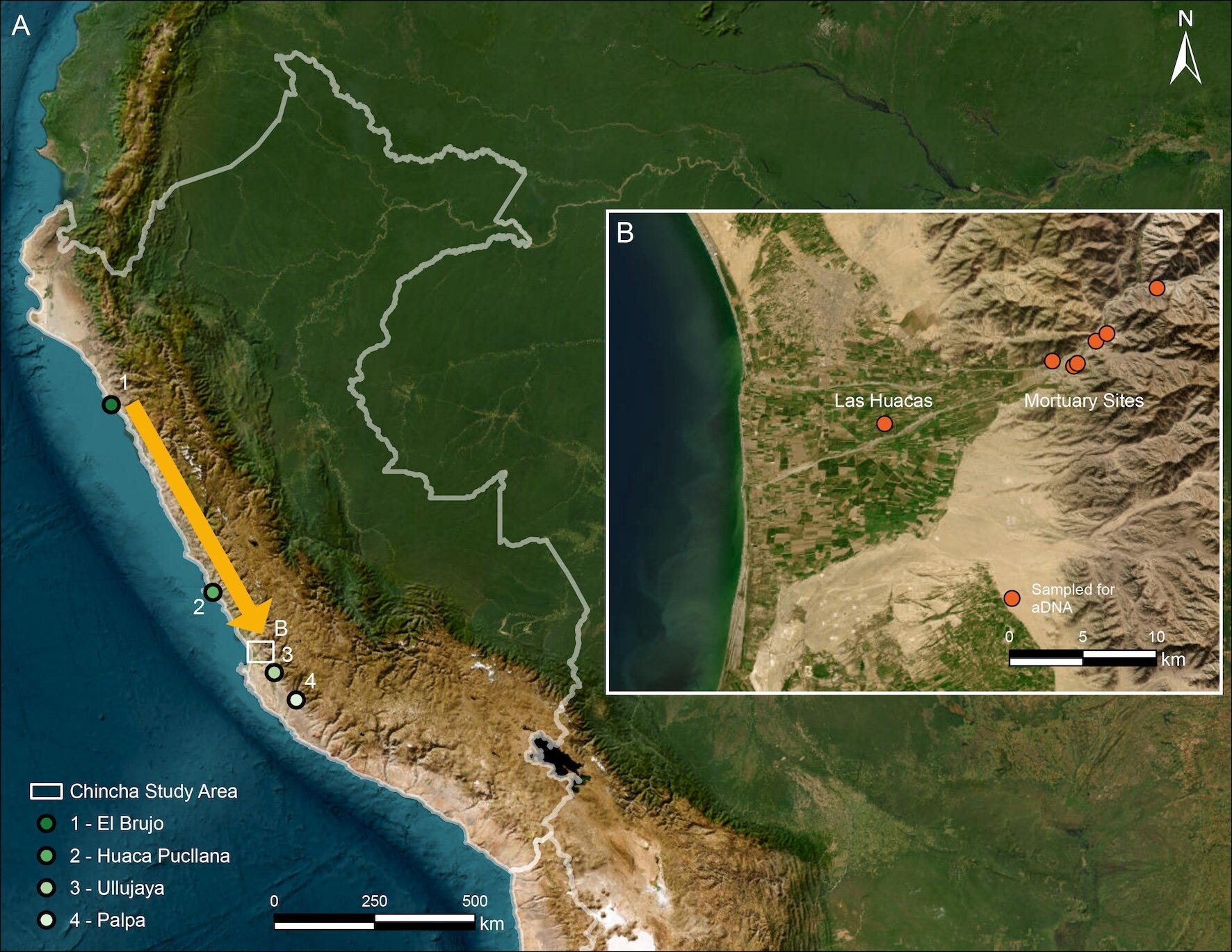
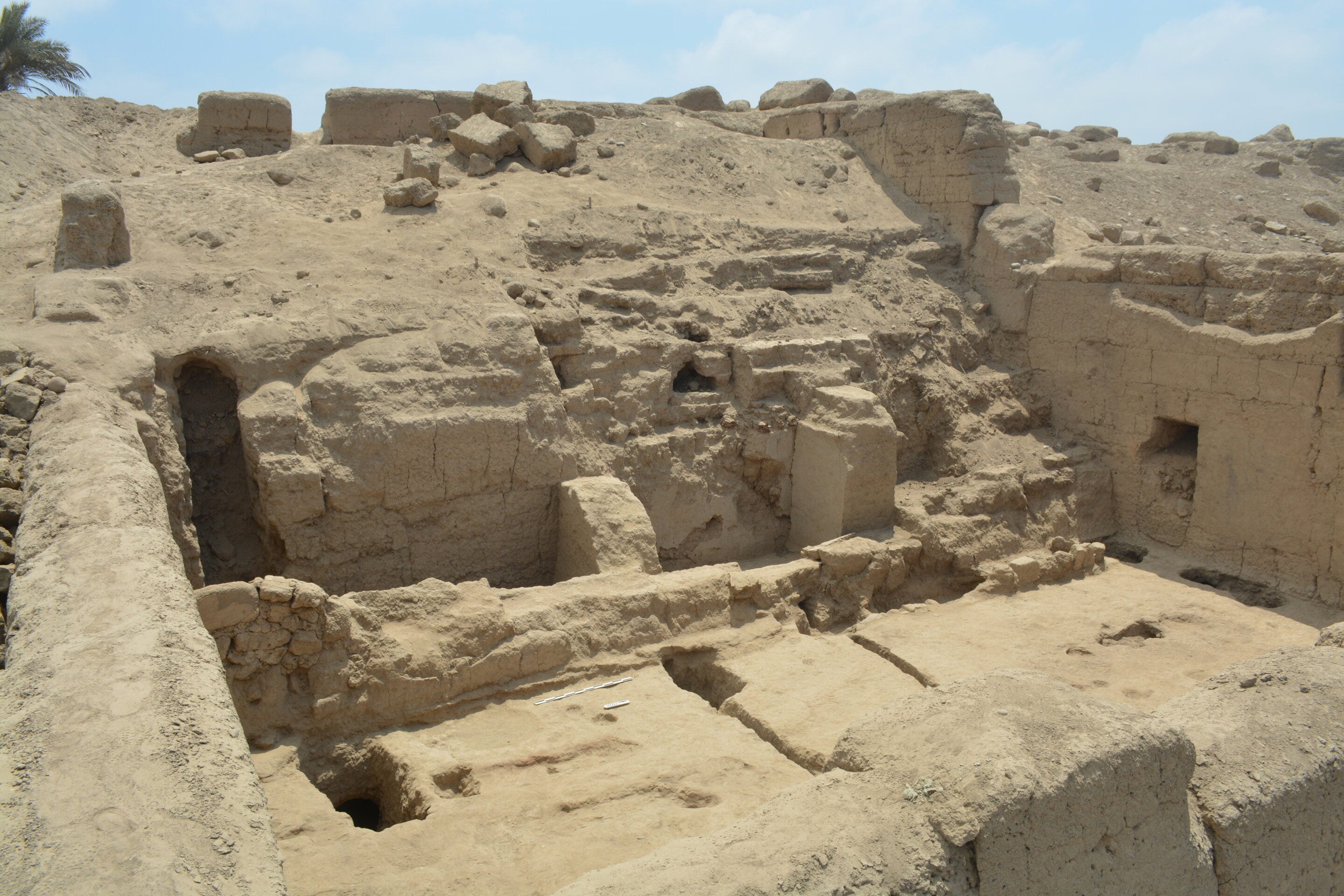
Sometime around AD 1280, a woman was born on Peru’s north coast. We don’t know her name. We don’t know exactly where she came from, though the genetic evidence points somewhere in the vicinity of the Chicama Valley, roughly 700 kilometers north of where her descendants would eventually be buried. At some point, she or her children made that journey south, settled in the Chincha Valley, and started a family. Her grandson would be born around 1320. Her granddaughter around 1340. They were laid to rest together, with their skulls painted red, in a communal ossuary at a site called Las Huacas.
That family is now the subject of a genome-wide ancient DNA study published in Nature Communications1 by Jacob Bongers, Jordan Dalton, Lars Fehren-Schmitz, and colleagues. The paper reconstructs kinship, ancestry, and movement in the Chincha Valley between roughly the thirteenth and sixteenth centuries AD, before, during, and just after Inca incorporation of the region. What it finds complicates the standard story of pre-Inca coastal Peru as a patchwork of isolated, static communities.
These people were moving. And they had been doing so long before the Inca gave them any reason to.
The Chincha Valley sits on Peru’s south-central coast, a fertile strip running from the Pacific inland toward the Andean foothills. By the fifteenth century, it was home to a major regional polity called the Chincha Kingdom, with a total population that may have exceeded 100,000. Sixteenth-century colonial sources describe a finely stratified economy: at least 10,000 fisherfolk, 12,000 farmers, and 6,000 artisans and merchants, each occupying distinct sectors of the valley. Chincha merchants traveled by balsa raft along the coast and by llama caravan into the highlands, trading silver, gold, emeralds, and other prestige goods with elites across the Andes. At the pivotal Cajamarca confrontation between Inca forces and the Spanish, the Chincha lord reportedly sat beside the Inca Emperor himself. This was not a marginal valley people.
When the Inca incorporated Chincha in the early AD 1400s, they did so through what current scholarship describes as a negotiated arrangement, rather than straightforward conquest. The Chincha, it seems, agreed to become a seafaring client state in exchange for privileged access to the prized Spondylus trade, which had previously been dominated by the Chimú on the north coast. The relationship was unusual. And new DNA evidence suggests it may have been built on connections that already ran deep.
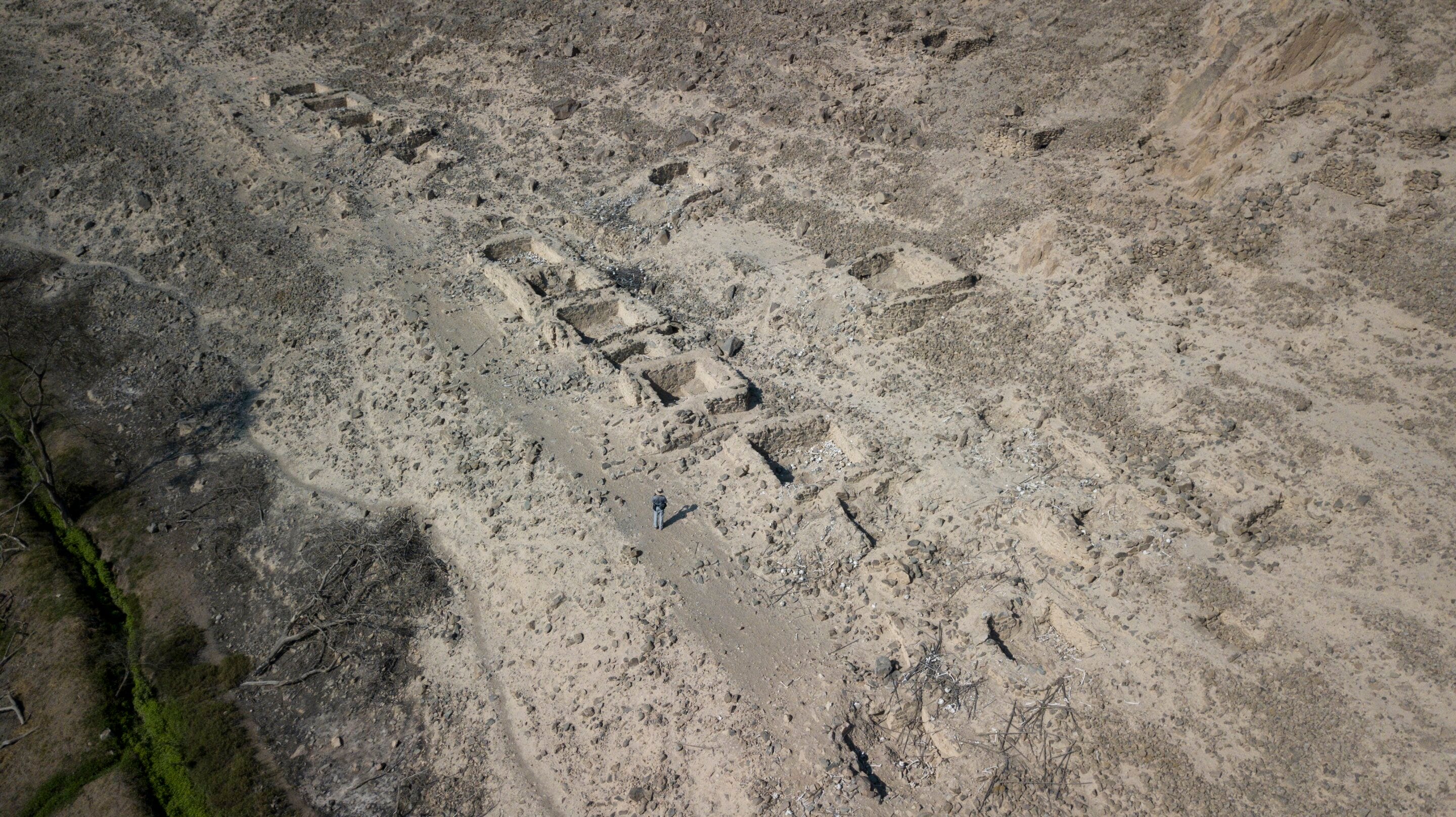
The research team extracted genome-wide data from 21 individuals buried at two locations in the valley: Las Huacas, a 100-hectare site on the alluvial plain, and a series of cemeteries scattered across the middle valley. The middle valley is what Andean scholars call a chaupiyunga, a transitional ecological zone between the coast and the highland valleys, suitable for growing coca and maize. Over 500 graves cluster into 44 mortuary sites there, falling into two basic types: subterranean cists holding individuals in extended positions, and larger accessible mausolea called chullpas, where the dead were painted with red hematite and cinnabar pigments and had their vertebrae threaded onto reed sticks.
The earliest individuals from the cist graves, two people with median modeled death dates around AD 1290, carry unadmixed north coast ancestry. Their genomes cluster not with southern coastal populations, as geography would suggest, but with individuals from the Chicama Valley and other north coast sites more than 700 kilometers away. The team’s analysis used outgroup-f3 statistics and qpADM admixture modeling to establish this. The result is unambiguous enough that the paper frames it as “strongly supported” by independent historical, ceramic, and textile evidence as well. North coast ceramics and textiles have been documented throughout Chincha, and a sixteenth-century chronicle by Pedro Cieza de León describes the earliest Chincha people as a group led by a captain who came from afar to conquer the valley.
The radiocarbon modeling here is itself a significant methodological achievement. Calibrating dates from coastal Peru is notoriously difficult, because the marine reservoir effect, the offset between atmospheric and marine radiocarbon, varies substantially along the Peruvian coast due to strong deepwater upwelling and seasonal El Niño activity. The standard approach of using modern shell data to estimate this offset produces wildly inconsistent results; for this region, the six relevant shells from the early twentieth century yield ΔR estimates ranging from -181 to +219 years, a range so wide it renders precise dating essentially meaningless.
The team addressed this by letting the marine reservoir offset float as a free parameter in a Bayesian model, constrained by stratigraphic relationships and generational intervals derived from the aDNA family tree. The result was a ΔR estimate of -314 ± 52 years, far more negative than the shell-based approaches suggest, and consistent with two earlier estimates from AD 500 contexts in coastal Peru. They also built individual mixed calibration curves for each person based on their specific marine diet proportions, derived from stable isotope analysis, using a custom script they call Mix-Cal-Lot. The practical upshot is a generational-scale chronology that can actually track who lived when, with enough precision to say things like: this grandmother was born around 1280, this grandson around 1320.


