

The points are smaller than a thumbnail. Some weigh less than two grams. They are unretouched — meaning nobody shaped their edges — and most of them are broken. For decades, researchers sorting through the lithic debris from a rock shelter in the hills of northeastern Uzbekistan passed right over them. They were too small, too plain, too easy to mistake for knapping accidents or random flake debris.
That was the wrong call.
A team led by traceologist Hugues Plisson of the Université de Bordeaux has now identified1 these fragments for what they appear to be: projectile armatures. Weapon tips. And based on their dimensions, the only type of shaft that could have carried them is one the size of an arrow.
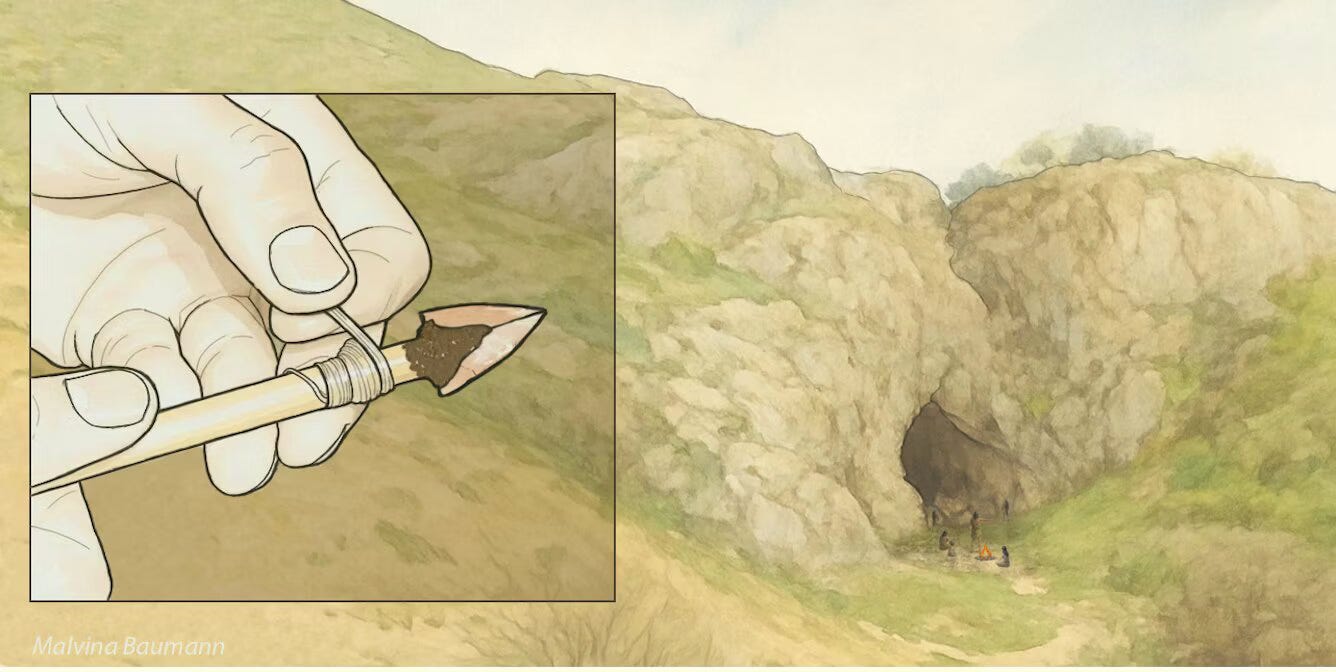
The site is called Obi-Rakhmat, a limestone rock shelter carved into the Tien Shan foothills at 1,250 meters above sea level, about 100 kilometers from Tashkent. Excavated since the 1960s and more recently led by Andrei Krivoshapkin, it contains ten meters of Pleistocene deposits spanning roughly 40,000 years of occupation, from approximately 90,000 to 40,000 years ago. The stone tool assemblage is remarkably consistent across that span: blades, bladelets, and points made from local silicified limestone, rooted in a tradition that traces back to the Levantine Early Middle Paleolithic.
The oldest layers — levels 20 and 21 — date to around 80,000 years ago. That is where Plisson’s team found the micropoints.


