

At the Kimmswick site in eastern Missouri, archaeologists have found Mastodon remains alongside Clovis points for decades. It’s one of the better-preserved faunal assemblages from the earliest Paleoindian period in North America, and even there, in a site with unusually good conditions for recovering small bones, less than a quarter of one percent of the edible meat represented in the deposit comes from anything smaller than a bison. Rabbits, rodents, birds: they’re barely there. Mammoths and mastodons are.
That pattern repeats itself with almost eerie consistency across a new study in Science Advances,1 led by Ben Potter of the University of Alaska Fairbanks and James Chatters of McMaster University, along with collaborators from the US, Canada, and Argentina. The team pulled together zooarchaeological data from 50 sites spanning three of the earliest widespread cultural groups in the Americas: Eastern Beringians in Alaska and the Yukon, Clovis people across North America, and Fishtail Projectile Point users in South America. Across all three groups, on all three landmasses, 83 to 88 percent of the calculated food supply came from animals weighing over a thousand kilograms. Mammoths. Gomphotheres. Giant ground sloths.
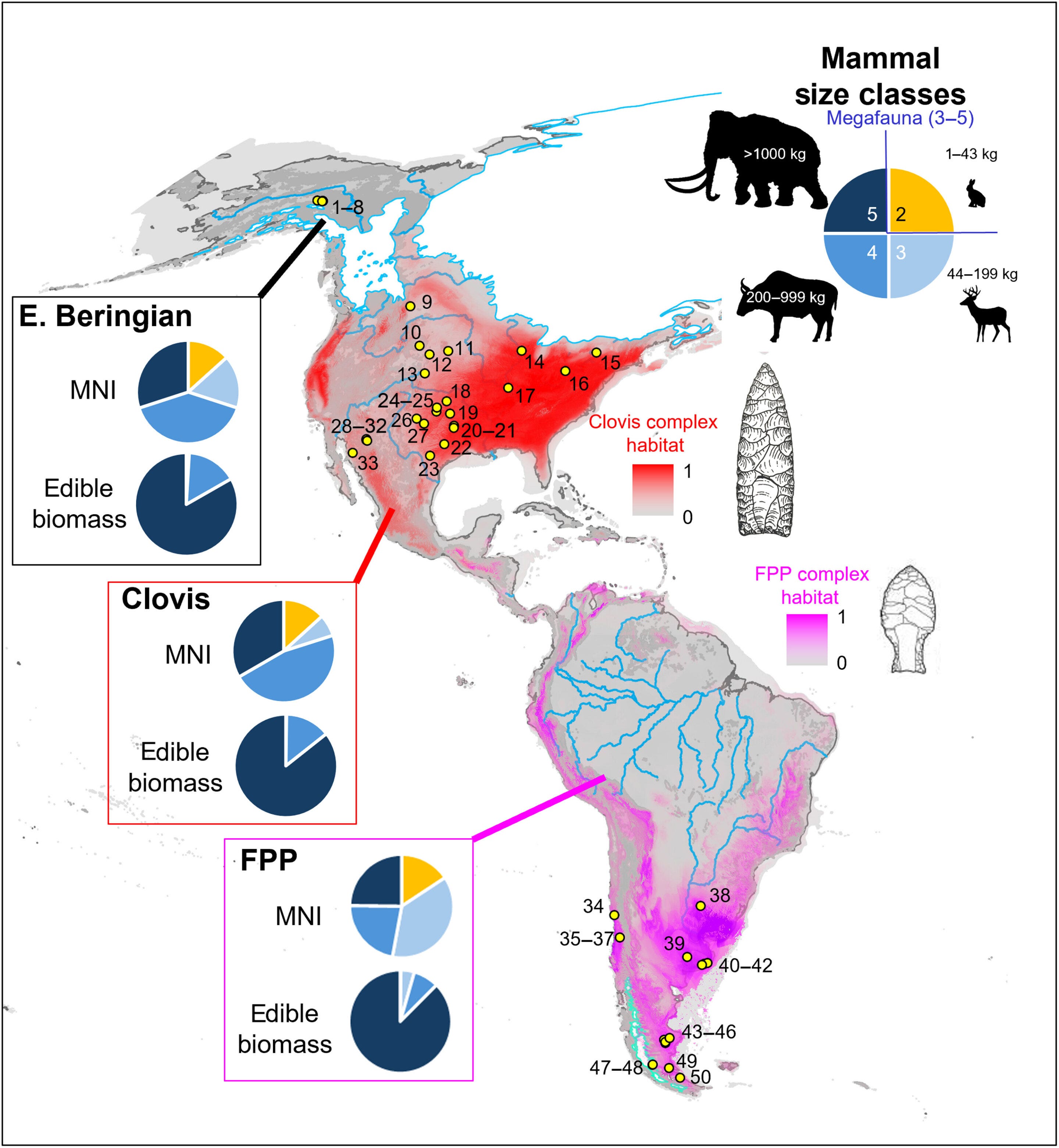
This is not a new question in Paleoindian archaeology. Whether the first Americans were specialists chasing megafauna or generalists eating whatever the local landscape offered has been argued for decades, and for much of the last ten years the field had been drifting toward the generalist camp. What makes this study different is scale and method. Instead of counting how many bones of a given species turn up at a site, which tends to favor whichever animal happens to preserve well or get noticed first, the team weighted each species by its edible biomass and then compared that against how common each animal actually was on the surrounding landscape.
That second step is the interesting one. If early Americans were opportunistic generalists, you’d expect their kill sites to roughly mirror what was out there. Common animals should show up often in the archaeological record; rare ones, rarely. Instead the data run backward. The animals dominating these assemblages, mammoths above all, were some of the least numerous creatures on the Pleistocene landscape. Meanwhile rabbits, ground squirrels, and other genuinely abundant small mammals are nearly invisible in the bone record. People were not eating what was around. They were seeking out what was rare, huge, and calorically enormous.


