

A flake of red paint from a wooden coffin fragment in Stockholm went into a mass spectrometer and came back carrying 2S albumin from Moringa oleifera. Twenty-one matching peptides, 220 spectral matches. In the same sample sat four isoforms of 11S globulin from Sesamum indicum, sesame, backed by 37 peptides.
Those are seed storage proteins. They are what a seed packs away to feed an embryo before it can photosynthesize. They have no obvious business being in a paint layer on a coffin, and as far as the authors can tell, nobody has found them in one before.
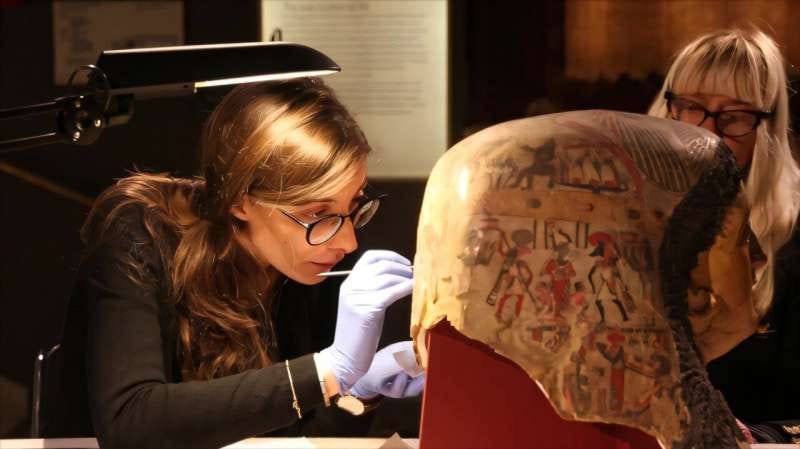
The coffin fragment is catalogued MM 13944 at the Medelhavsmuseet in Stockholm, and it dates loosely to the Greco-Roman period, somewhere between 332 BCE and 395 CE. It is one of fourteen painted objects that Clara Granzotto and colleagues sampled for a study published in Science Advances.1 Twenty-eight microsamples in total, drawn from the Egyptian collections of the Medelhavsmuseet, the British Museum in London, and the Ny Carlsberg Glyptotek in Copenhagen. The objects span roughly eighteen centuries, from 1425 BCE to 400 CE, and include painted wooden coffins, wall painting fragments on mud and plaster, cartonnage and a plaster mummy bust, and painted limestone architectural pieces.
The reason nobody found sesame in Egyptian paint before is partly a matter of what the older methods were built to look for.
Chemists have been characterizing Egyptian binding media for decades, mostly with gas chromatography coupled to mass spectrometry, or with high-performance liquid chromatography. These techniques work by hydrolyzing a sample down to its constituent amino acids and reconstructing what was probably there from the relative proportions, plus a few diagnostic markers such as hydroxyproline for collagen. That approach is very good at answering a specific question: is this animal glue, egg, or casein? It is much worse at answering the open version of the question, which is simply what proteins are in here. If the answer is something that was never in the reference set, the method returns a shrug. Fourier transform infrared spectroscopy has the same limitation from the other direction. It will tell you confidently that a protein is present and tell you nothing about which one.
Untargeted proteomics does not start with a list. Peptides are sequenced and then matched against databases, and if the match is a plant seed protein rather than collagen, that is what comes out. Granzotto and colleagues searched their spectra first against a curated set of the usual artistic proteins, then against the full SwissProt database, and then, once plant sequences began appearing, against a database restricted to land plants. The searches got narrower as the answers got stranger.
Dr. Clara Granzotto describes the research goals and impact of the study of paint binders in artworks from ancient Egypt by proteomics. The video shows Dr. Clara Granzotto and conservator Inger Jonsson carefully examining the objects’ surface to select the best area for sampling. Micro-samples are taken by using surgical blades and needles. Credit: Museum of Mediterranean and Near Eastern Antiquities, Stockholm. Photographer Johan Jeppsson


