

The newest face for Jebel Irhoud, the Moroccan site that holds the oldest fossils attributed to Homo sapiens, was built on a skull captured from a press video. In June 2017 the Max Planck Institute for Evolutionary Anthropology in Leipzig released footage of its digital reconstruction of the Jebel Irhoud skull, credited to Philipp Gunz, a paleoanthropologist at the institute, under a Creative Commons license that permits derivative work. In 2024 a group led by Cicero Moraes, a Brazilian specialist in digital facial approximation affiliated with Ortogonline, a training and consulting company in Sinop, cut that footage into a sequence of still images and fed them to photogrammetry software, which stitched the frames back into a three-dimensional object; the video carried no scale markers, so the model was sized against a measured image elsewhere in the same release. The face that Moraes and five co-authors built on that object was published in the journal Heritage1 on September 13, 2026.
The colored version of the face shows a man with brown skin, a heavy brow, a full dark beard and hair to his shoulders, and most people who see it will take it for an estimate of how one individual looked some 315,000 years ago, although no single individual lies under it. The Leipzig skull is a composite, and the new paper lists its parts: the braincase and upper face of Irhoud 1, the fossil a mine worker turned up at the site in 1961; the lower jaw of Irhoud 11, a different adult; the upper tooth row, possibly, from a specimen catalogued as Irhoud 10; and two dental fragments, Irhoud 21 and Irhoud 22. By the paper’s account all of them come from one deposit, Layer 7, which fire-heated flint tools date to about 315,000 years ago, give or take 34,000.
Irhoud 1 was first identified as an African variant of the Neanderthals, about 40,000 years old, and its estimated age climbed for decades, to between 100,000 and 200,000 years in 1991 and about 160,000 in 2007, until two papers in Nature in June 2017 reclassified the Jebel Irhoud fossils as Homo sapiens and put them at roughly 315,000 years. One, led by Jean-Jacques Hublin, then director of the Leipzig institute’s Department of Human Evolution, described the fossils; the other, led by Daniel Richter, a geochronologist also at the institute, supplied the flint dates along with a recalculated age of about 286,000 years for a tooth from Irhoud 3, a juvenile’s jaw that is not part of the composite.
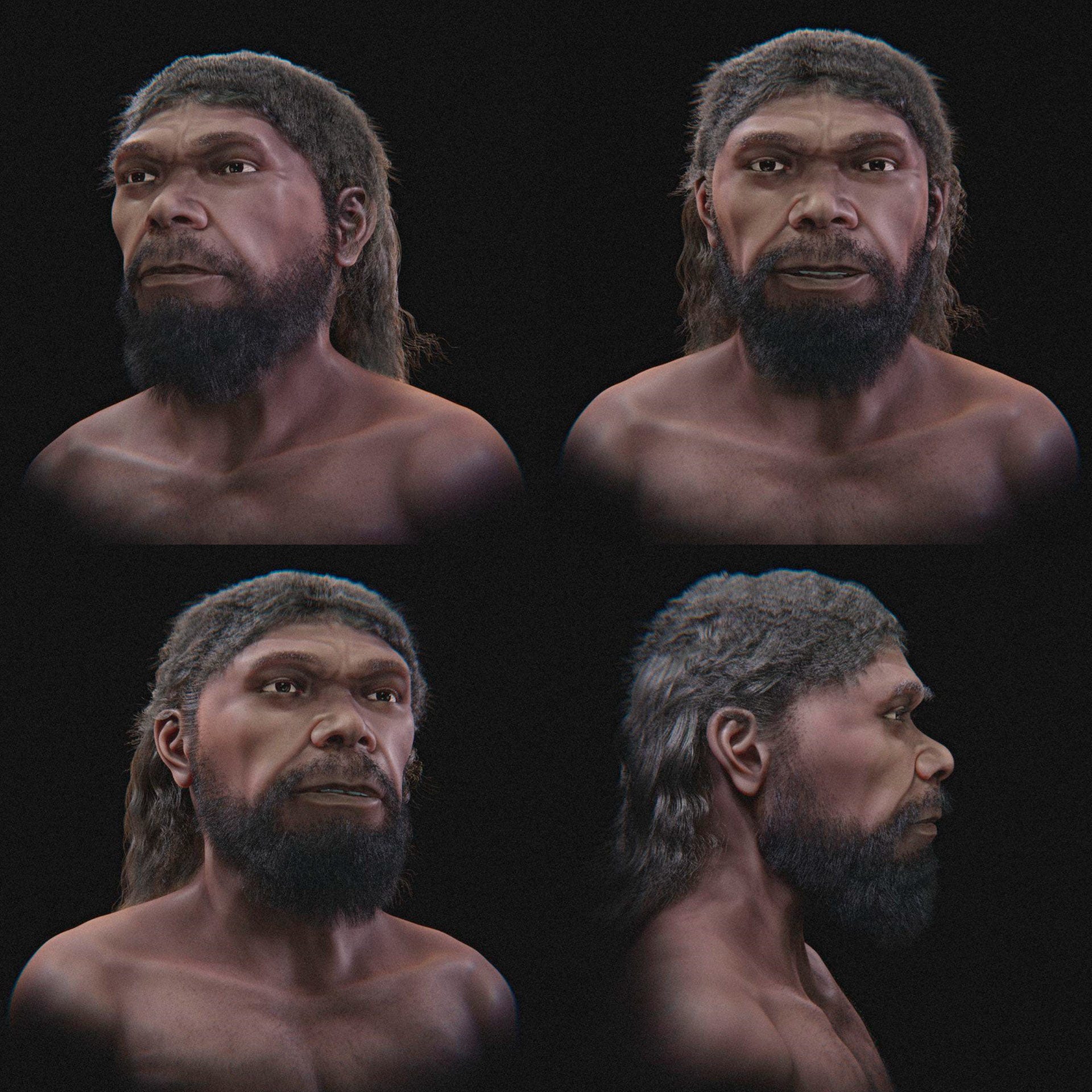
Facial approximation of this kind begins with somebody else’s head. The team took a CT scan of an anonymous modern adult, collected, the paper notes, with the donor’s written consent, and deformed that skull in the free 3D program Blender until its outer surface and its inner cavity matched the Jebel Irhoud composite, carrying the donor’s soft tissue along with the bone. Soft-tissue thickness values came from reference data on modern people of African ancestry, compiled in the forensic artist Karen T. Taylor’s 2000 textbook Forensic Art and Illustration and chosen, the authors write, for their geographic and evolutionary closeness to the site. Skin color, lighting and hair are, by the authors’ own description, artistic conventions without grounding in the fossil. A second set of renderings, in grayscale and without hair, strips those away and leaves only the relation of face to bone.
Hublin’s team had described the Jebel Irhoud fossils as a mosaic. The face, jaw and teeth fell in line with modern humans while the braincase and the shape of the brain cavity stayed more primitive, and those modern features were the core of the case for placing a 315,000-year-old population in our species, a placement the 2017 paper framed with some care, as documenting early stages of the Homo sapiens clade. A reconstruction lays flesh over exactly that part of the head, and the flesh has no direct evidence behind it, because no soft tissue of any kind is known from hominins of the Middle Pleistocene (roughly 774,000 to 129,000 years ago) and every millimeter of skin on this model is borrowed from people alive today. The result in the new paper that holds up best against outside measurement concerns a part of the head that no one looking at the portrait will ever see, the empty space where the brain was.


