

The oldest atlatl ever directly dated and recovered in western North America comes from the Yukon. It’s about 9,300 years old. Nine more like it, all clustered between roughly 9,300 and 6,100 years ago, make up the entire founding population of evidence for this weapon system on the continent. Two specimens turn up in Texas and Coahuila. The rest sit up north, near the ice.
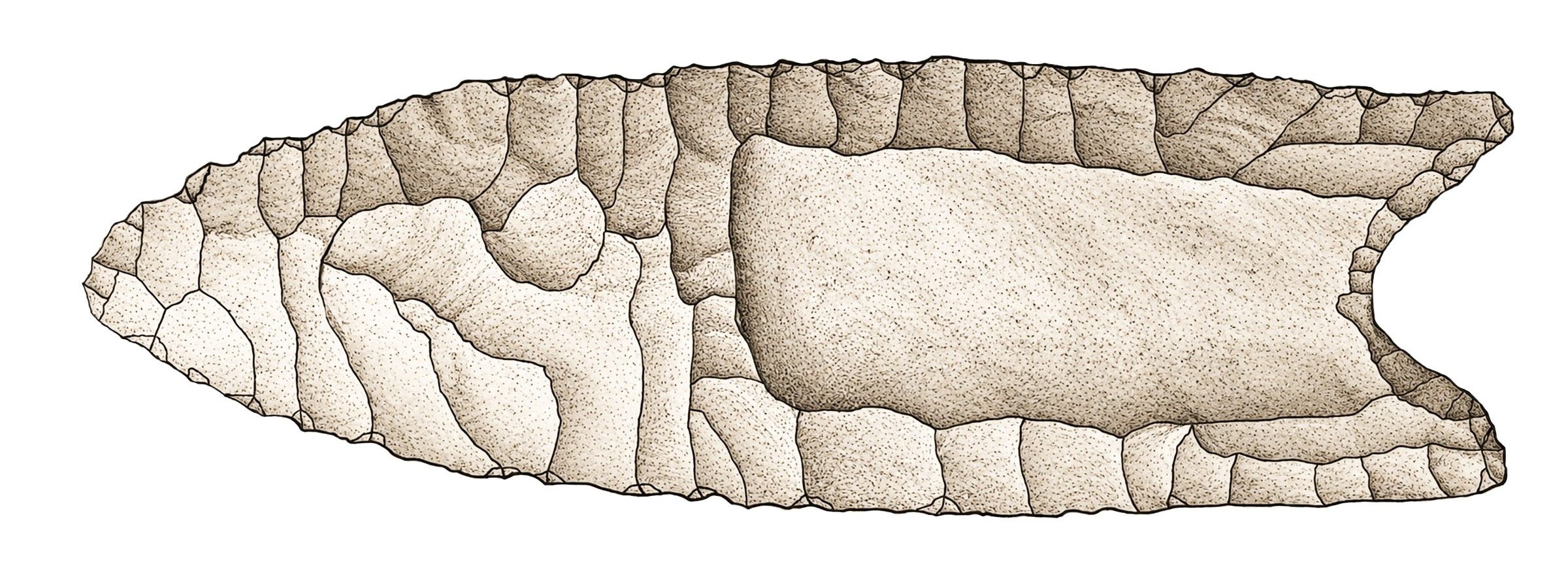
Compare that to Clovis, the toolkit-culture whose fluted points show up alongside mammoth and mastodon bones across North America between about 13,340 and 12,710 years ago. For decades, the working assumption in Paleoindian archaeology has been that Clovis hunters took down that megafauna with atlatls, the handheld spear-throwers that use leverage to launch a dart at speeds and ranges a thrown spear can’t match. It’s a reasonable assumption on its face. Atlatls existed in Upper Paleolithic Europe twenty to thirty thousand years ago, and the people who became Clovis foragers descended, ultimately, from populations that crossed from the Old World. The logic writes itself: they had the technology before they got here, so they probably still had it when they arrived.
The problem is that nobody has ever found one.
A new study in PNAS,1 led by Metin Eren and colleagues at Kent State, the University of Missouri, Southern Methodist University, and the University of Tulsa, makes that absence explicit and then does something more interesting with it. They don’t just point out a gap. They model it.


