

At Santo Adrião, on a granite outcrop overlooking the mouth of the Âncora river in northern Portugal, there is a boat with a raised horn at the bow, an animal head at one end, and a line sloping down and out from the stern at just the angle you’d expect if someone were showing you a steering oar. Nobody carved anything like it anywhere else in Iberia. But go looking through the Swedish Rock Art Research Archives, through the tens of thousands of ship images pecked into the stone of Bohuslän, and you’ll find its cousins immediately. Same horn. Same animal-head prow. Same steering-oar slant. The researchers who scanned it in 2021 called the resemblance, cautiously, “suggestive of direct parallels.” Read the underlying data and the caution starts to feel like understatement.
This is the strange part of a new study out of Durham University and the University of Gothenburg: boats carved into rock on the Atlantic edge of Iberia are turning out to be, in a real technical sense, the same boats being carved eleven hundred miles away in Scandinavia during the same centuries. Not similar in a vague, cross-cultural, humans-like-drawing-boats way. Similar in the specific, arbitrary details that only get shared through contact — the mushroom-shaped symbol at midships, the s-curled end-ships, the “keel-to-keel” paired composition that shows up on both Iberian panels and Scandinavian bronze neck rings dated to 700–500 BCE.
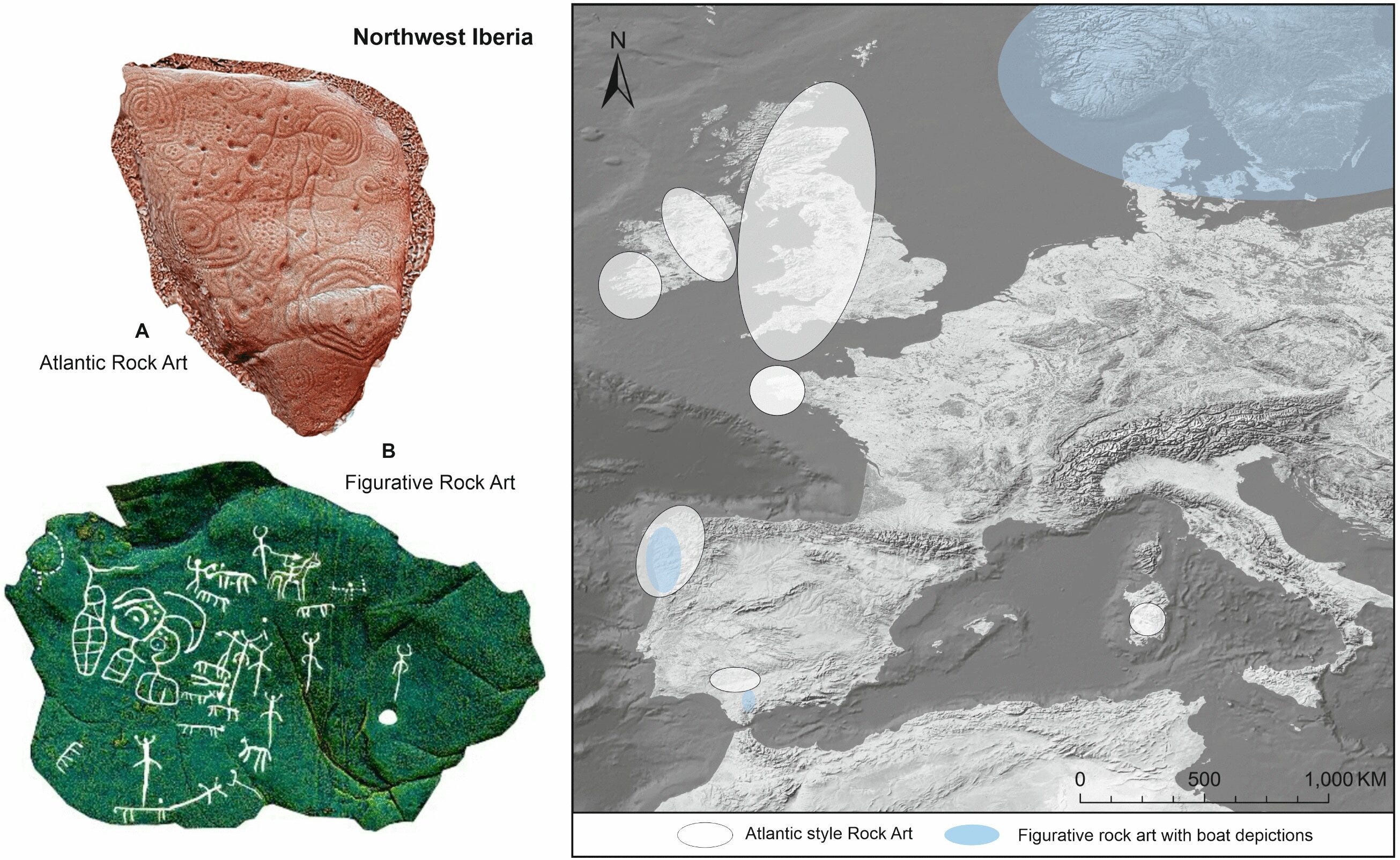
Nautical imagery is rare in Iberian rock art generally. So finding two dense clusters of it, one in the northwest and one in the southwest, both sitting at exactly the points where Atlantic and Mediterranean sea lanes would have met, was already a signal that something organized was happening along this coast. What the new study1 adds is precision. Using laser scanning capturing 480,000 points per second, structure-from-motion photogrammetry, and reflectance transformation imaging that lets researchers “relight” a carved surface and catch marks invisible to the naked eye, the team re-recorded six sites and re-examined others, then set the results next to Scandinavia’s securely dated boat chronology — a sequence anchored by objects like the Rørby sword and the c. 1550 BCE boat image carved into a still-living tree trunk at Vendsyssel, Denmark.


