
Homo floresiensis weighed roughly the same as a ten-year-old child. That fact has been used for years to argue that body size in human evolution was more complicated than a simple upward march. Now, a new study published in PNAS1 gives that argument its most rigorous statistical treatment yet and finds that the outliers were real, the general trend was real, and both things were true at once.
The study, led by Jacob D. Gardner at the University of Reading with colleagues from Oxford and University College London, compiled body mass estimates from 386 specimens across 21 hominin taxa. That’s a larger and more systematically assembled dataset than most previous analyses, and the team used Bayesian phylogenetic generalized linear mixed models to work through it: a method that accounts for the fact that closely related species share evolutionary history and therefore can’t be treated as independent data points.
This might sound like a methodological footnote. It isn’t. Much of the confusion in the literature about whether hominin body size increased over time comes precisely from studies that didn’t account for phylogenetic relatedness, used different body mass proxies, or focused on different slices of the family tree. Some researchers found a general trend. Others found no trend at all. A few argued the increase was confined to Homo. The new analysis asks: what if you test all of these hypotheses simultaneously, in one framework, while accounting for multiple sources of uncertainty?
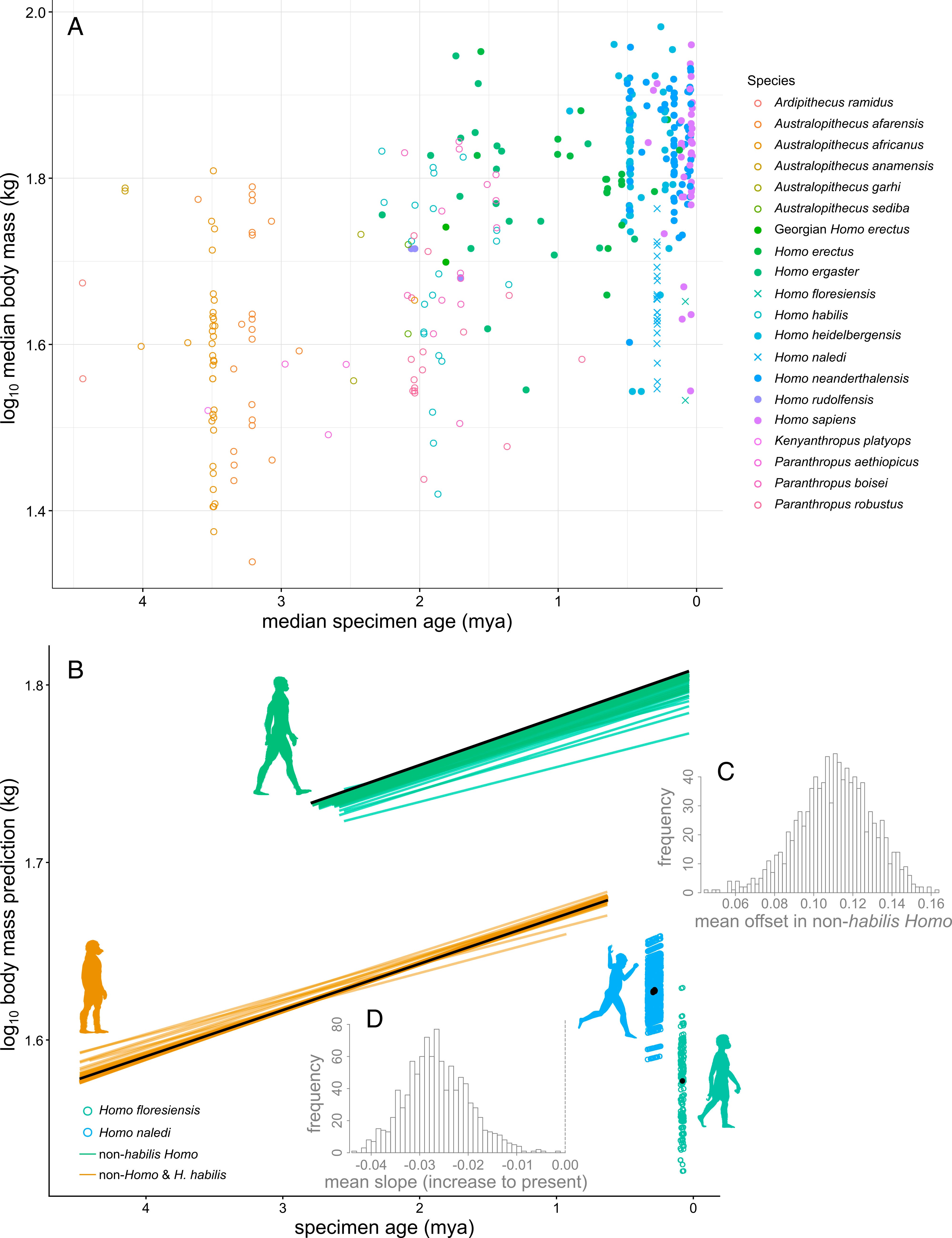
The answer turns out to be that all of them are partly right.


