
Every so often a paper shows up that makes you recalculate what “human” has meant, genetically, for the last million years. This is one of them.
The basic problem researchers have wrestled with for over a decade is this: you can only find archaic DNA in living people if you have something to compare it to. Neanderthal ancestry was detectable because scientists sequenced actual Neanderthal genomes, pulled from actual Neanderthal bones. Same for Denisovans, though there we’ve only ever had one high-quality genome, from a finger bone in a Siberian cave. Without a reference genome sitting there for comparison, an unknown ancestor’s genetic contribution is essentially invisible. It just looks like ordinary human variation.
That’s a real limitation, because the fossil record and the genetic record have been quietly disagreeing with each other for years. Geneticists studying African populations kept noticing haplotypes, stretches of DNA inherited as a block, that didn’t fit any known demographic story. They looked old. Too old. But with no archaic African genome to check them against (the oldest African genome we have is under 20,000 years, and DNA doesn’t survive well outside permafrost), there was no way to confirm what these signals actually were.
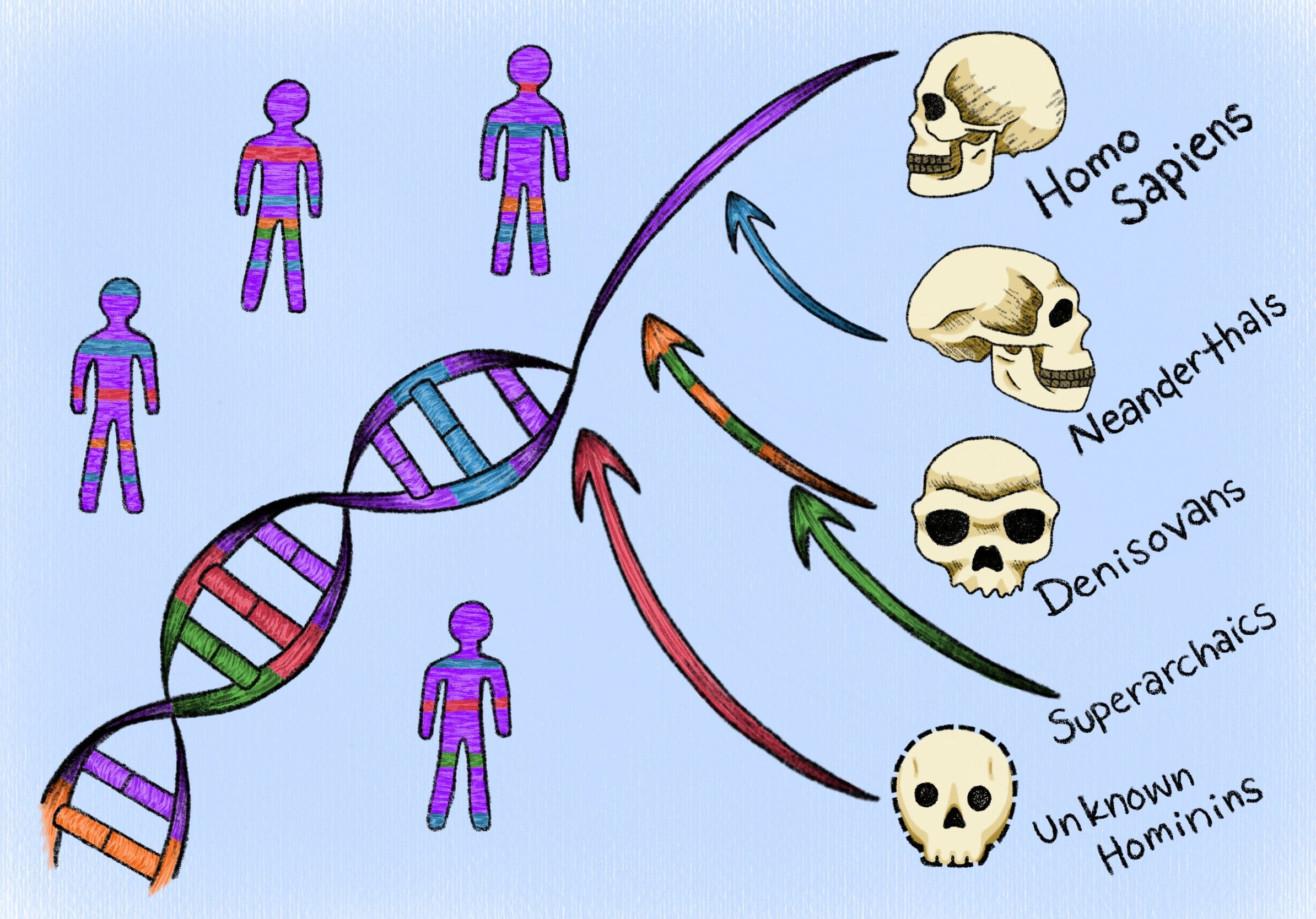
A team at UC Berkeley, led by Priya Moorjani along with graduate student Yulin Zhang and Johns Hopkins postdoc Arjun Biddanda, built a workaround.1 Instead of needing an ancient genome to compare against, their method, called TRACE, reconstructs the genealogical relationships buried inside modern genomes themselves. It reads what’s known as an ancestral recombination graph, essentially a map of how every stretch of DNA in a population traces back through shared ancestors over time. When a segment of DNA came from a deeply diverged, long-extinct lineage, it leaves a specific signature in that graph: branches that reach unusually far back in time, and haplotypes that stayed intact for longer than you’d expect from ordinary population history.
Applying TRACE to whole genomes from the 1000 Genomes Project, the team found two lineages nobody had a name for.


