
A tibia fragment from a Belgian cave had been sitting in a museum collection, confidently refitted to a particular leg bone, for years. Then researchers sequenced its DNA. It didn’t match. The fragment belonged to a different individual entirely — and only by redoing the refitting and pulling a new sample from the correct bone did the picture come clear. This is the kind of thing ancient DNA analysis does now: not just fill in population histories, but correct the physical reconstruction of bodies that died forty thousand years ago.
That correction is one small moment in a much larger study, published today in Nature,1 that represents the most genetically detailed look yet at the final Homo neanderthalensis populations of northwestern Europe. Researchers from the Max Planck Institute for Evolutionary Anthropology and collaborating institutions recovered genetic data from 27 individuals who lived less than approximately 52,500 years ago, drawn from ten archaeological sites in Belgium and France. The findings speak directly to some of the most contested questions in Neanderthal research: how connected were these populations, how much did they interbreed with close relatives, and did genetic deterioration contribute to their extinction?
The short answers, as far as this dataset allows: more connected than previously suspected, less inbred than their eastern counterparts, and probably not dying from a genomic death spiral.
A region, not a scattered handful
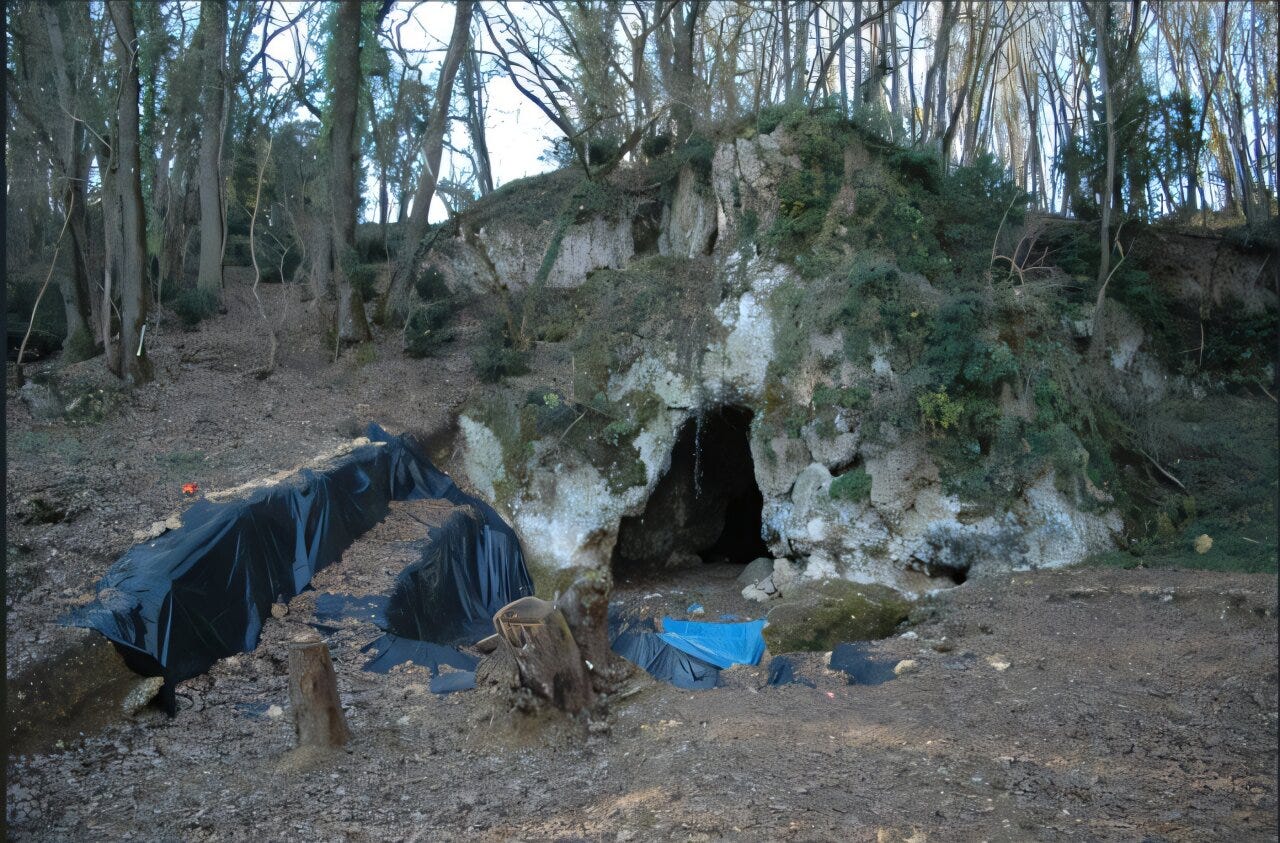
Most of the sampled sites cluster in the Meuse Basin of Belgium — Goyet, Spy, Couvin, Trou Magrite, Fonds-de-Forêt, Engis, Walou — with two French sites, Saint-Césaire and Arcy-sur-Cure. The density of Middle Palaeolithic sites in this region is unusual, and that density is precisely what makes it possible to study something approaching a regional population rather than isolated individuals from distant locations.
The team generated a high-coverage genome (22.4-fold) from a Goyet individual designated GN1 — only the fifth high-coverage H. neanderthalensis genome sequenced to date. For specimens with poorer DNA preservation, they used a new hybridization capture panel called ArchaicPlus, designed to target around 2.3 million SNPs informative for Neanderthal and Denisovan variation. Combined, this approach yielded nuclear data from 19 skeletal remains across six sites.
The genetic picture that emerged is of a loosely knit regional population. Most of the Belgian and French individuals are more closely related to each other than to other contemporaneous late Neanderthals, including Vindija 33.19 from Croatia and the Mezmaiskaya individuals from the Caucasus. Their estimated population split from the Vindija lineage falls around 54,000 years ago — roughly 10,000 years before these individuals actually lived. A relatively shallow separation. Distinct, but not isolated.
What is perhaps more telling is what the genomes do not show. The H. neanderthalensis individuals from Chagyrskaya Cave in Siberia, studied a few years ago, displayed unmistakable signatures of close-relative mating: long homozygous-by-descent tracts in the genome, indicative of repeated inbreeding within a small and probably bounded group. The GN1 individual from Goyet shows nothing of the sort. Her proportion of genome contained in homozygous tracts is comparable to Vindija 33.19, not to the Chagyrskaya or Denisova 5 individuals. No excess of long tracts. No evidence of recent inbreeding. Whatever social dynamics shaped the Altai groups, they were not universal to the species.
The Goyet assemblage is worth pausing on. The remains recovered there — eventually assigned to at least six individuals — are highly fragmented, and many bear cut marks and percussion damage. An analysis published in 2016 interpreted these as evidence of cannibalism: defleshing, marrow extraction, bone use as tools. The individuals were processed like prey.
The new genetic data adds a strange dimension to this. Among the nine Goyet specimens sequenced, the researchers identified two clusters of genetically identical fragments, three bones each, representing two individuals (GN1 and GN2). One cluster had been wrongly refitted across two different tibias in the original skeletal analysis; only DNA comparison revealed the error. Beyond those within-individual matches, however, none of the Goyet Neanderthals appear to be close relatives of each other. No parent-offspring pairs. No siblings. A neonate is present among them, but his mother is not represented among the sampled females.
Whether the Goyet assemblage represents a single community or accumulated over time is genuinely unclear, and the researchers are appropriately cautious about inferring group structure from it. But the absence of close kin is notable. Isotopic evidence adds another layer: sulfur isotope values suggest local foraging at Spy but non-local origins at Goyet. Whoever those individuals were to each other, they were not a family, and at least some of them came from somewhere else.
Contrast that with Spy Cave, roughly thirty kilometers away, where the anatomical articulation of some skeletal elements has been interpreted as evidence of deliberate burial — though that reading remains contested. Genetically, the Spy individual, whose upper molar and femur turned out to belong to the same adult male (confirmed through nuclear DNA comparison), belongs to the same broad regional population as the Goyet individuals. Two sites, similar genetics, radically different treatment of the dead.
A ghost in the mitochondrial tree
The simplest story about late H. neanderthalensis in western Europe is that they formed a single, broadly connected population in their final millennia. The new data largely support that story, but with notable exceptions.
A molar recovered from Couvin, Belgium carries a mitochondrial genome that falls not within the main late Neanderthal clade but in a deeply divergent lineage shared with a Neanderthal called “Thorin” from Grotte Mandrin in the Rhône Valley of France. The divergence between this lineage and the mainstream late Neanderthal mtDNA is estimated tens of thousands of years deeper than the splits within the main clade. This is a lineage that predates the main radiation of late Neanderthals and apparently persisted alongside them in western Europe — possibly including other individuals known from Gibraltar and Poland.
The radiocarbon dating for Couvin places the individual at roughly 49,000 to 44,000 years ago, and the molecular dating shifts accordingly when anchored to those dates. But when the molecular clock runs unconstrained, it pushes the estimate past 100,000 years — a discrepancy similar to what has been reported for Thorin. The archaeological context argues against the Couvin tooth being an intrusion from an older deposit, and the researchers consider this unlikely. What seems more plausible is that a divergent maternal lineage, ancient in origin, was more widespread in western Europe than previously recognized and coexisted with other late Neanderthal lineages until close to the end.
The Arcy-sur-Cure individual (AR-30) from northeastern France adds a separate complication. Her nuclear genome suggests a population split from Vindija 33.19 around 131,000 years ago — much earlier than the other Belgian and French individuals, whose splits cluster around 54,000 years. The team explored possible explanations: faunal contamination (ruled out by metagenomic screening), modern human contamination (too low to account for the signal), or gene flow from a deeper Neanderthal lineage into AR-30’s ancestry. No firm conclusion is possible from the current data. More sequence coverage would help.
No accumulation of genetic damage
One influential hypothesis for H. neanderthalensis extinction holds that small, isolated populations were gradually worn down by the accumulation of mildly deleterious mutations — genetic load accumulation, a process documented in woolly mammoths and eastern gorillas. If Neanderthals were dying by genomic attrition, you would expect to see increasing proportions of harmful variants in later individuals compared with earlier ones.
The new data do not show that. Comparing early and late Neanderthals using three separate measures of genetic load — the ratio of missense to synonymous variants, a measure of functional constraint using polyPhen2, and a conservation score called phyloP — the team finds no significant difference across time. Neanderthals as a whole carry a depletion of non-synonymous variants relative to neutral expectation, meaning purifying selection was operating, but there is no trend toward deterioration. Homozygosity is not increasing. Heterozygosity is not decreasing.
This does not rule out other contributors to extinction. The Meuse Basin Neanderthals lived contemporaneously, at least by some estimates, with early Homo sapiens who were present in central Europe by around 47,000 years ago. Despite that temporal overlap, none of the 16 late Neanderthal genomes analyzed to date — including all those in this study — show any evidence of recent modern human ancestry. Putative modern human DNA segments identified in a handful of individuals are all short and lack the fixed diagnostic differences expected from recent introgression. They are consistent with much older gene flow or simply incomplete lineage sorting.
The asymmetry is striking. Every ancient H. sapiens genome from Eurasia predating 40,000 years ago that has been sequenced carries Neanderthal ancestry. Four of those individuals have Neanderthal ancestors only 4 to 10 generations back. The Neanderthal-to-modern-human flow happened, clearly and repeatedly. The modern-human-to-Neanderthal flow, if it occurred at all in these western European populations, left no detectable trace. The team suggests this asymmetry may reflect the demographics of expansion: when modern humans moved into Eurasia, they encountered Neanderthal groups and introgressed, and their descendants carried that ancestry everywhere. Neanderthal populations, more geographically stable and more widespread at the time of contact, would have absorbed any admixture only locally — and in a declining population, that signal can disappear.
What the genetics suggest about the cause of H. neanderthalensis disappearance is, ultimately, something like the absence of evidence rather than evidence of absence. The western European groups were not collapsing inward. They were not accumulating damage. They were a functioning, connected, genetically diverse regional population — right up until they weren’t.
Further Reading
Skov, L. et al. Genetic insights into the social organization of Neanderthals. Nature 610, 519–525 (2022).
Slimak, L. et al. Long genetic and social isolation in Neanderthals before their extinction. Cell Genomics 4, 100593 (2024).
Prüfer, K. et al. A high-coverage Neandertal genome from Vindija Cave in Croatia. Science 358, 655–658 (2017).
Rougier, H. et al. Neandertal cannibalism and Neandertal bones used as tools in Northern Europe. Scientific Reports 6, 29005 (2016).
Wißing, C. et al. Stable isotopes reveal patterns of diet and mobility in the last Neandertals and first modern humans in Europe. Scientific Reports 9, 4433 (2019).
Fu, Q. et al. An early modern human from Romania with a recent Neanderthal ancestor. Nature 524, 216–219 (2015).
Hajdinjak, M. et al. Initial Upper Palaeolithic humans in Europe had recent Neanderthal ancestry. Nature 592, 253–257 (2021).
Bossoms Mesa, A. et al. Genetic diversity of late Neanderthals in northwestern Europe. Nature (2026). https://doi.org/10.1038/s41586-026-10625-1


