

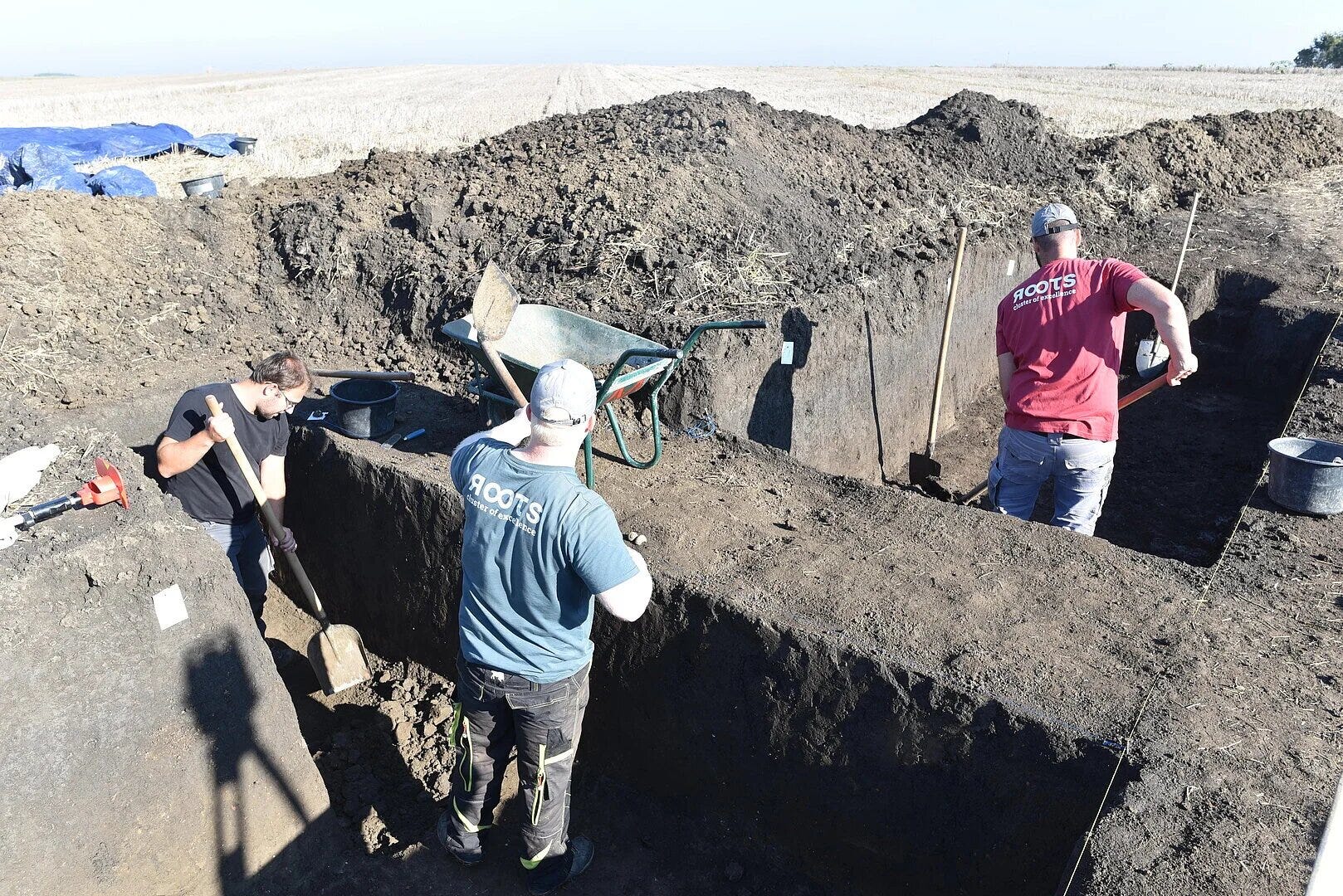
The trench at Opovo gave out at about three meters. A team from Kiel University and two Serbian museums had cut it in the autumn of 2024 across the southwestern entrance of a Late Neolithic Vinča culture settlement called Opovo Ugar-Bajbuk, on a low loess hill two kilometers east of the modern village of Opovo in the Serbian Banat, and for two weeks they took the ditch fill down twenty centimeters at a time: broken pottery and small animal bones near the top, then, at 1.2 meters, larger bones, a goat horn, and an unburned lump of clay daub shaped like an animal, and below that soil so full of charcoal it was nearly black. Four human bones came out near the ditch’s outer edge. Then groundwater rose and the trench walls stopped being safe, and a hand auger had to find the rest, bringing up grayish layers of charcoal, daub, and bone for roughly another two meters before it struck the yellow loess of the natural subsoil at about 4.5 meters. At that entrance the ditch was around eleven meters wide.
At Oreškovica-Selište, a fortified Vinča settlement elsewhere in Serbia, the enclosing ditch measured seven meters across and 3.6 deep. Faced with one half again as wide and nearly a meter deeper, most of us would assume a chain of command behind it, someone with the standing to put a few hundred people to work, and we tend to assume more broadly that a village which grows past a couple of hundred people starts sorting itself into ranks. The archaeologist Gregory Johnson gave that intuition a mechanism in 1982, arguing that decision-making comes under what he called scalar stress as groups grow, and that hierarchy is one of the usual ways the strain gets relieved. A new study of Opovo, published this year in Archaeologia Austriaca,1 describes a village far larger than anyone had thought, enclosed by five ditches, whose houses show little sign that any household rose far above the rest.
The earlier picture came mostly out of one trench, sixteen meters by twenty, dug between 1983 and 1989 by teams from the universities of Novi Sad and Berkeley and the National Museum in Pančevo, on a site that a local priest and amateur archaeologist named Andreas Majer had found in 1965. Ruth Tringham, the University of California, Berkeley, archaeologist who led that project, put the settlement at about five hectares with no more than ten households standing at any one time, and in 1992 called it a “small hamlet.” The population estimate that went with that picture was about 200. It was an odd hamlet. Between 62 and 71 percent of the animal bones from the old excavation came from wild animals, red deer above all, a higher share than at other Vinča sites and closer to the pattern at sites of the Tisza culture, its Late Neolithic neighbor on the Great Hungarian Plain, and the hill stood in marsh ringed by old loops of the Timiș River, ground Tringham later called agriculturally marginal. One early idea had Opovo as a seasonal camp for hunting and gathering expeditions, until Nerissa Russell, working through the bones for her 1993 doctoral dissertation at Berkeley, ruled out seasonal use and made it a permanent village with a mixed economy that leaned hard on wild animals.
Tringham is the last of eleven authors on the new paper, whose lead author, Fynn Wilkes, is a postdoctoral researcher in the ROOTS Cluster of Excellence at Kiel University, and it takes her hamlet apart with her name on the byline. The new team could not even say exactly where her trench lay; of two blank patches near the middle of their magnetic map, which they read as possible open plazas, one may be the old excavation.
Opovo matters to people who will never visit the Banat because the Vinča culture belongs to the centuries when people in southeastern Europe first lived in large settlements for generations at a stretch, and whether inequality came bundled with that way of living is an old argument that has not been settled. The village sits near the start of the Eurasian story that Timothy Kohler of Washington State University and his colleagues told in a 2017 paper in Nature, which compared house sizes from sites on several continents and found that wealth disparities after the Neolithic grew larger in Eurasia than in North America or Mesoamerica.


