

What enamel records, it records briefly. Dental microwear — the microscopic scratches and pits that food leaves on the surfaces of teeth — captures something like the last few weeks of an animal’s life. Not the long arc of evolutionary adaptation, not the selective pressures that shaped jaw morphology over millions of years, but the actual mechanical events of recent feeding. What you chewed last month is still written on your enamel. In principle, if you can read it, you can reconstruct not just broad dietary categories but near-term ecological behavior.
The challenge has always been reading it accurately. For decades, researchers worked primarily with 2D images and a handful of variables — pitting versus scratching, roughness measures that could be plotted on a bivariate graph and compared across taxa. This approach produced real results, including influential work on fossil hominins like Australopithecus anamensis and Paranthropus boisei that revealed discrepancies between what teeth are built to do and what they were actually doing. But 2D analysis has limits, and the transition to 3D confocal microscopy over the past two decades has opened up a different kind of problem.
Three-dimensional surface texture data is extraordinarily information-rich. A single 3D scan can generate dozens of parameters describing surface complexity, roughness, anisotropy, volume, and spatial frequency. ISO 25178, the international standard for surface texture analysis, yields 45 or more variables per scan. Scale-Sensitive Fractal Analysis (SSFA), the method developed specifically for dental applications, adds another 20. The two frameworks measure the same physical surface but describe it differently — one standardized and broadly applicable, the other tailored to the multiscale nature of tooth-food interaction.
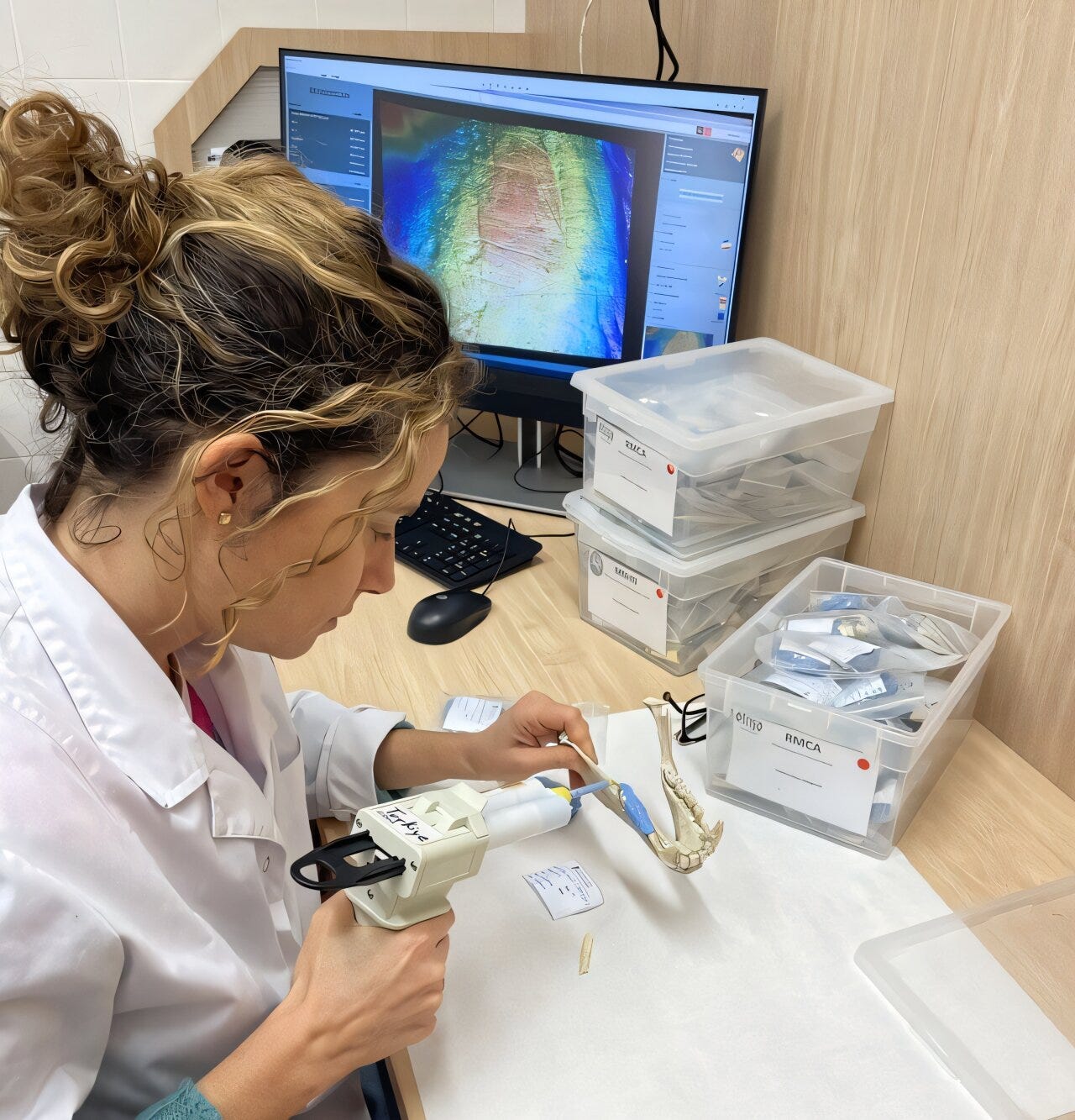
What this proliferation of variables creates is what researchers in the field have called, without affection, a “jungle of parameters.” The variables within each framework are often heavily intercorrelated. Add both ISO and SSFA together and you get severe multicollinearity — noise that can swamp genuine dietary signal. Conventional statistical tools, particularly the discriminant analysis methods that have been the field’s default, are ill-equipped to navigate this dimensionality. The question a team led by Laura M. Martínez at the University of Barcelona set out to answer1 was whether machine learning could do better.


