

Geosmin is the compound responsible for petrichor, the smell of rain on dry earth. Most people recognize it immediately, even if they don’t know its name. Whether that recognition does anything useful for a person commuting to an office is genuinely unclear. Whether it does something useful for a Negrito hunter-gatherer navigating the rainforests of Peninsular Malaysia is a different question entirely.
Geosmin is also detectable by a receptor encoded by a gene called OR12D2. And in the Bateq and Mendriq Negritos, the ancestral haplotype at OR12D2 has been swept to near-fixation. A hundred percent of Mendriq individuals carry it. Ninety-five percent of Bateq. In South and East Asian populations more broadly, that ancestral frequency has been declining for roughly ten thousand years, a decline that tracks almost perfectly with the spread of agriculture. The populations that kept it are the ones who kept foraging.
That is the kind of finding that makes you stop and think about what we mean when we say a sense has “deteriorated.”
The standard account of human olfaction is that it represents a sensory system in decline. Compared to most other mammals, we have lost a striking proportion of our olfactory receptor genes to pseudogenization — roughly sixty percent of the repertoire has accumulated mutations that likely disable function. The assumption has been that as vision became more central to primate ecology, smell became less important, and the genetic pressure to maintain the machinery relaxed. In that story, olfaction is a relic, something we carry but don’t particularly depend on.
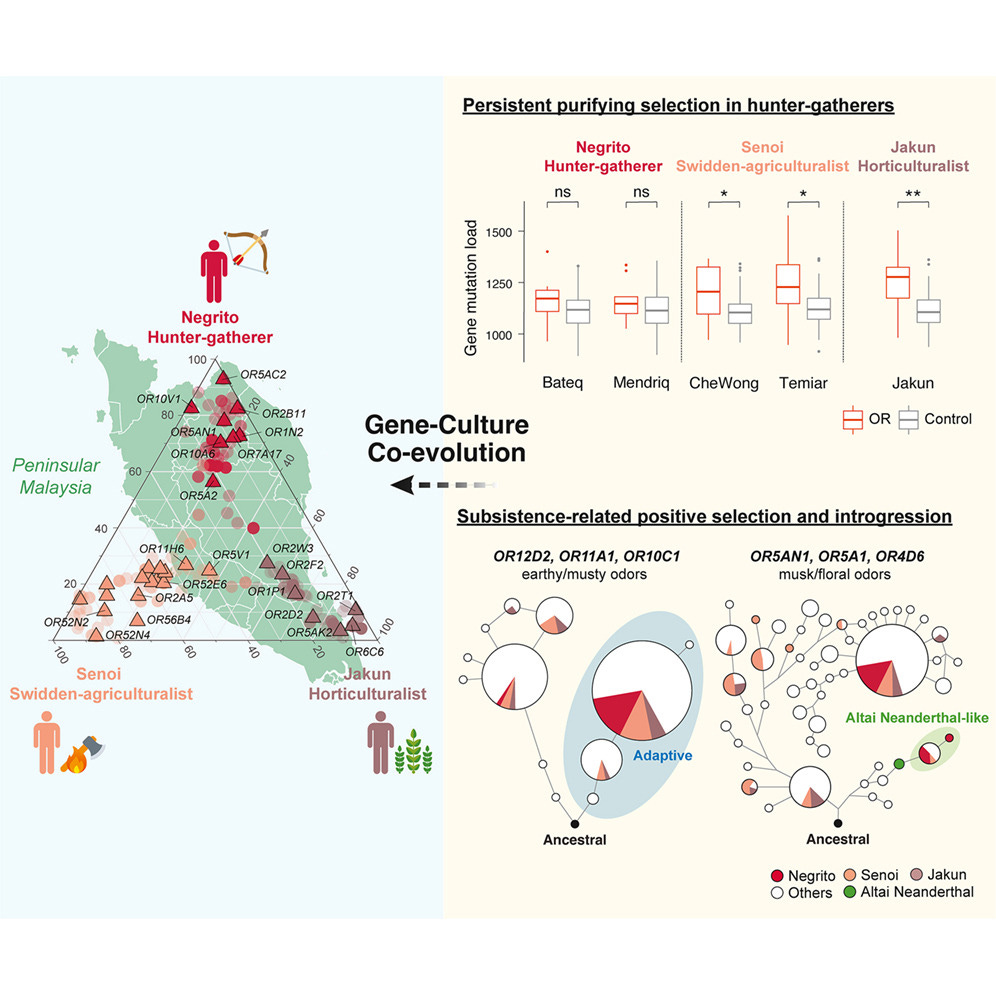
A study published this year in Cell Reports1 by Yueyang Ma, Boon-Peng Hoh, Shuhua Xu, and Lian Deng at Fudan University complicates that story in some interesting ways. The researchers examined olfactory receptor gene variation across fifty individuals from three Orang Asli populations in Peninsular Malaysia, alongside genomic data from more than 2,800 people drawn from sixty-five populations worldwide. What they found suggests the narrative of universal decline misses something important: not all populations are losing these genes at the same rate, and what predicts the difference is how people live.


