
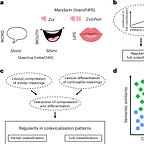
In Quechua, the word shimi means both “mouth” and “word.” In Spanish, lengua is the tongue in your mouth and the language on your lips. These are not accidents or etymological curiosities. They are instances of a pattern that appears, again and again, across the world’s languages: related meanings getting packed into the same form.
Linguists call this colexification. The logic behind it is not hard to grasp. Languages are always under pressure to stay efficient. Smaller vocabularies are easier to learn. Shorter, more reusable forms lighten the cognitive load. When two meanings are closely related in human memory, there is genuine utility in giving them the same word. The two meanings can usually be separated by context anyway, so the ambiguity is tolerable.
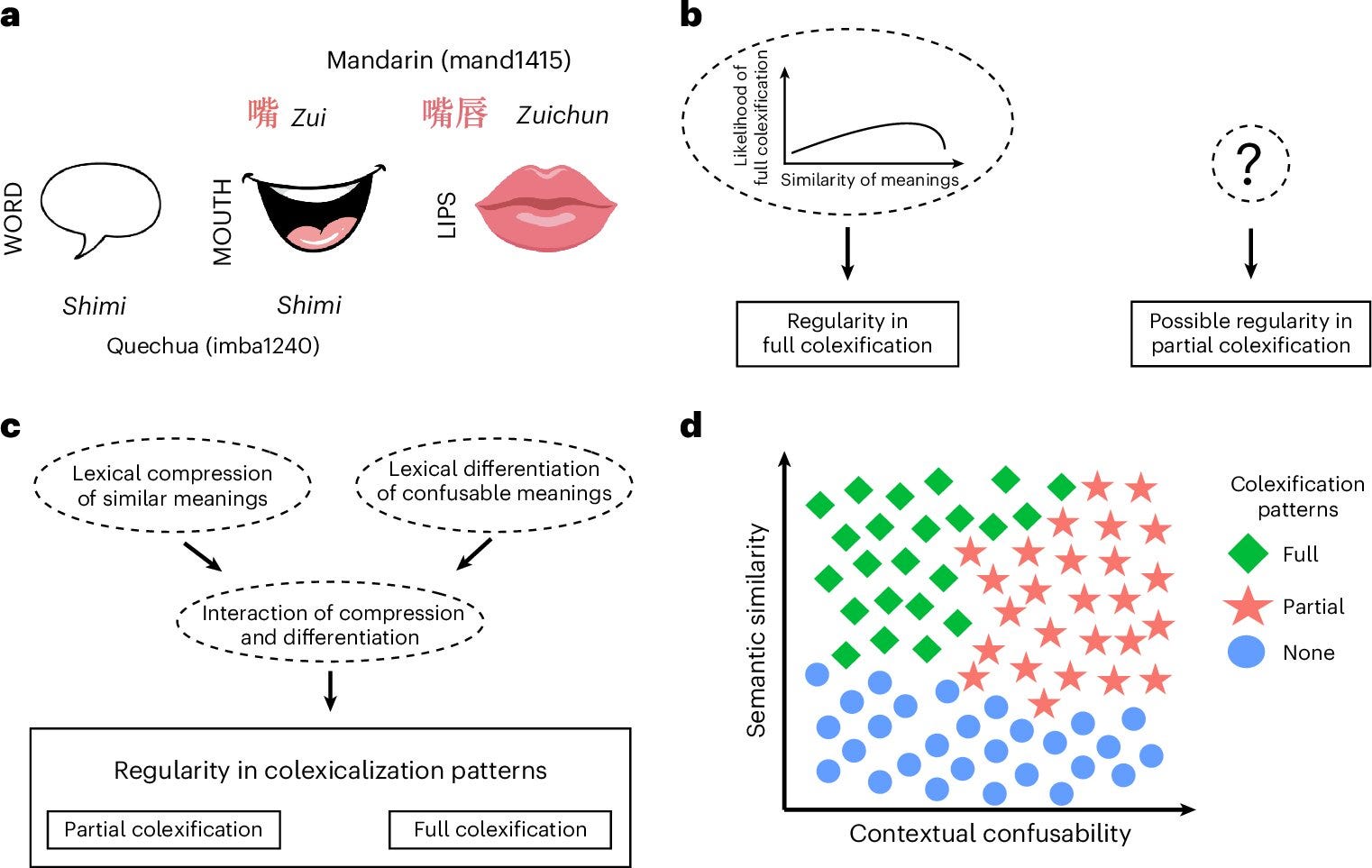
But full word reuse is only part of the story. Languages also recycle fragments. English shares the prefix grand across grandfather, grandmother, grand-aunt, and even improvised forms like grand-supervisor. Mandarin Chinese, which has comparatively little internal morphology, uses zui (嘴) for “mouth” and zuichún (嘴唇) for “lips” — the mouth word folded into the lips word, distinguishable but clearly related. This is partial colexification, and until recently, almost nothing was known about whether it follows any systematic principles at all, or whether it is just linguistic noise.
A study published in Nature Human Behaviour1 changes that picture considerably. Thomas Brochhagen and colleagues analyzed data from nearly 2,000 languages drawn from 192 language families, pulling from the Lexibank database, a standardized collection of wordlists with computed phonological and lexical features. Their question was whether the same underlying logic that explains full colexification could also explain why languages reuse word parts when they do not reuse entire words.
It can. The same logic applies. The details of how are what make this interesting.


