

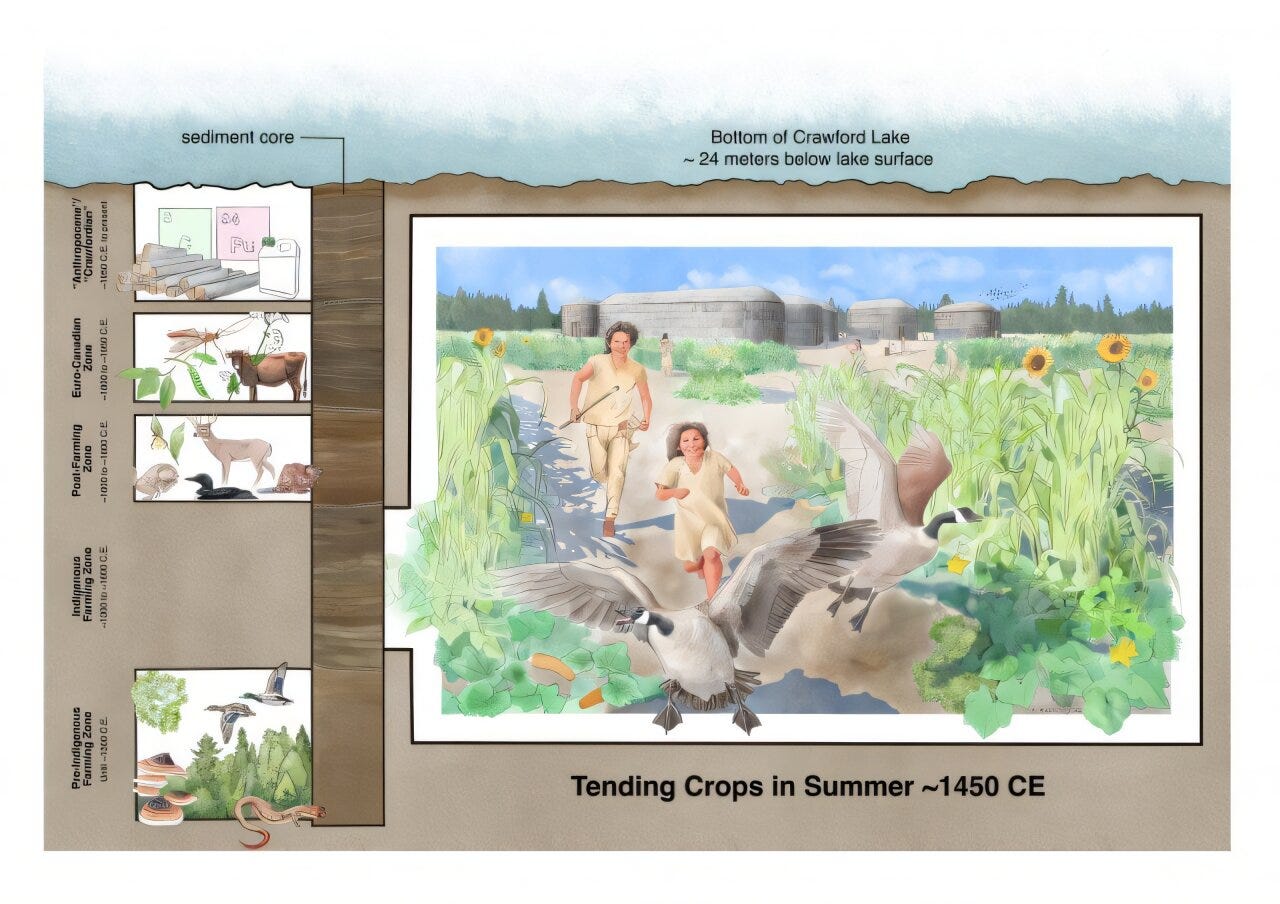
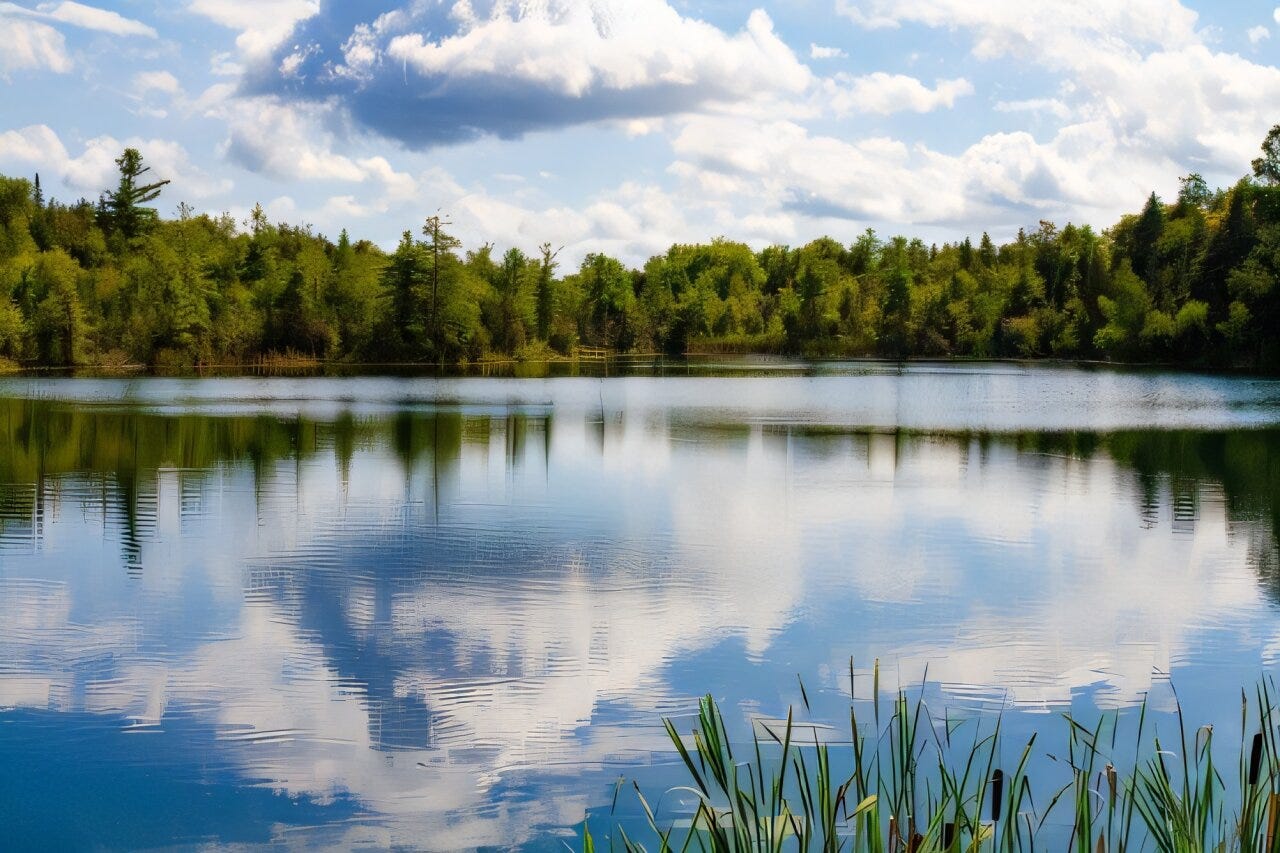
Twenty-two meters of black water separated the ice from the lake floor when a research team drilled through the surface of Crawford Lake on February 19, 2019, and lowered a gravity corer down to the bottom. What came back up was ninety centimeters of mud, laid down in seasonal layers across roughly thirteen centuries, from a lake just under six acres in size on Ontario’s Niagara Escarpment, about 65 kilometers west of Toronto. Buried in the top half meter of that mud was Canada goose DNA less than five hundred years old that had broken down more badly than DNA pulled from a mammoth bone fourteen thousand years old, and in places worse than DNA extracted from bone and dung roughly seven hundred thousand years old.
Ancient DNA researchers use a specific kind of damage to judge whether a sample is genuinely old. Cytosine bases near the broken ends of a DNA fragment convert into a form the sequencer reads as thymine, an error called deamination that accumulates the longer a molecule sits in the ground. More deamination is supposed to mean more time has passed. It is one of the field’s basic yardsticks, the reason a headline can credibly claim a genome is fifty thousand years old rather than five. Crawford Lake breaks that yardstick.
The finding comes from a paper in Molecular Ecology1 led by Tyler Murchie, of the Hakai Institute, and Matthew Emery, an assistant professor of anthropology at Binghamton University, with Hendrik Poinar, a professor of anthropology at McMaster University, as co-senior author. The team was not chasing a methods curiosity. They wanted a full ecological history of Crawford Lake, recovered not from pollen grains, beetle wings, or charcoal flecks, the proxies lake scientists have relied on for decades, but from environmental DNA shed by every organism that lived, died, or defecated near the water: plants, animals, fungi, and bacteria, all mixed into the sediment and sequenced together. Sedimentary ancient DNA, or sedaDNA, can do something those older proxies cannot: put a name, sometimes a species-level name, on organisms that left no visible trace at all.
The averages make the pattern clear. Reads assigned to Canada goose, Branta canadensis, showed a mean cytosine-to-thymine deamination rate of 32.4 percent. Permafrost-preserved mammoth bone from Alaska’s Tanana Valley, roughly fourteen thousand years old, averaged 18.8 percent. Permafrost sediment from the Klondike in Yukon, twenty to thirty thousand years old, averaged 11.9 percent. Only the oldest ancient DNA on record, bone and coprolites pushing past seven hundred thousand years, reached comparable numbers, around 40 to 45 percent, and a few individual Crawford Lake goose samples, pulled from sediment as young as five hundred years, hit 52 percent on their own. The lake’s DNA fragments were shorter too: goose DNA averaged fifty-one base pairs against fifty-four for the permafrost bone, and Crawford Lake’s plant DNA, corn, sunflower, and pine, averaged in the low forties.
Murchie, Emery, and their colleagues point to chemistry rather than time. Permafrost preserves DNA the way a freezer preserves food, by halting the reactions that break it down, while lake mud runs on a different chemistry entirely. Crawford Lake’s water column has measured between pH 5.8 and 8.5, acidic enough at its lower end to speed up the hydrolysis that strips bases off a DNA strand, though the team is careful to note that pH alone cannot explain damage this severe. Water content, temperature, mineral absorption, and microbial activity probably all played a part. So, they suspect, did a goose’s digestive system: much of this DNA did not fall into the lake so much as pass through a bird first.


