

The animal was enormous. Elephas recki dwarfed any elephant alive today, likely weighing somewhere north of eight thousand kilograms, and when it died on the margins of a shallow alkaline lake in what is now Tanzania, it left behind a carcass that was — by any reasonable metric — a spectacular opportunity. Dense in fat, massive in meat, loaded with marrow. A single individual could have sustained a group for weeks.
What happened next is what a team of researchers spent years trying to reconstruct, and the answer they arrived1 at has pushed back the known record of hominin megafaunal butchery at Olduvai Gorge by roughly 300,000 years.
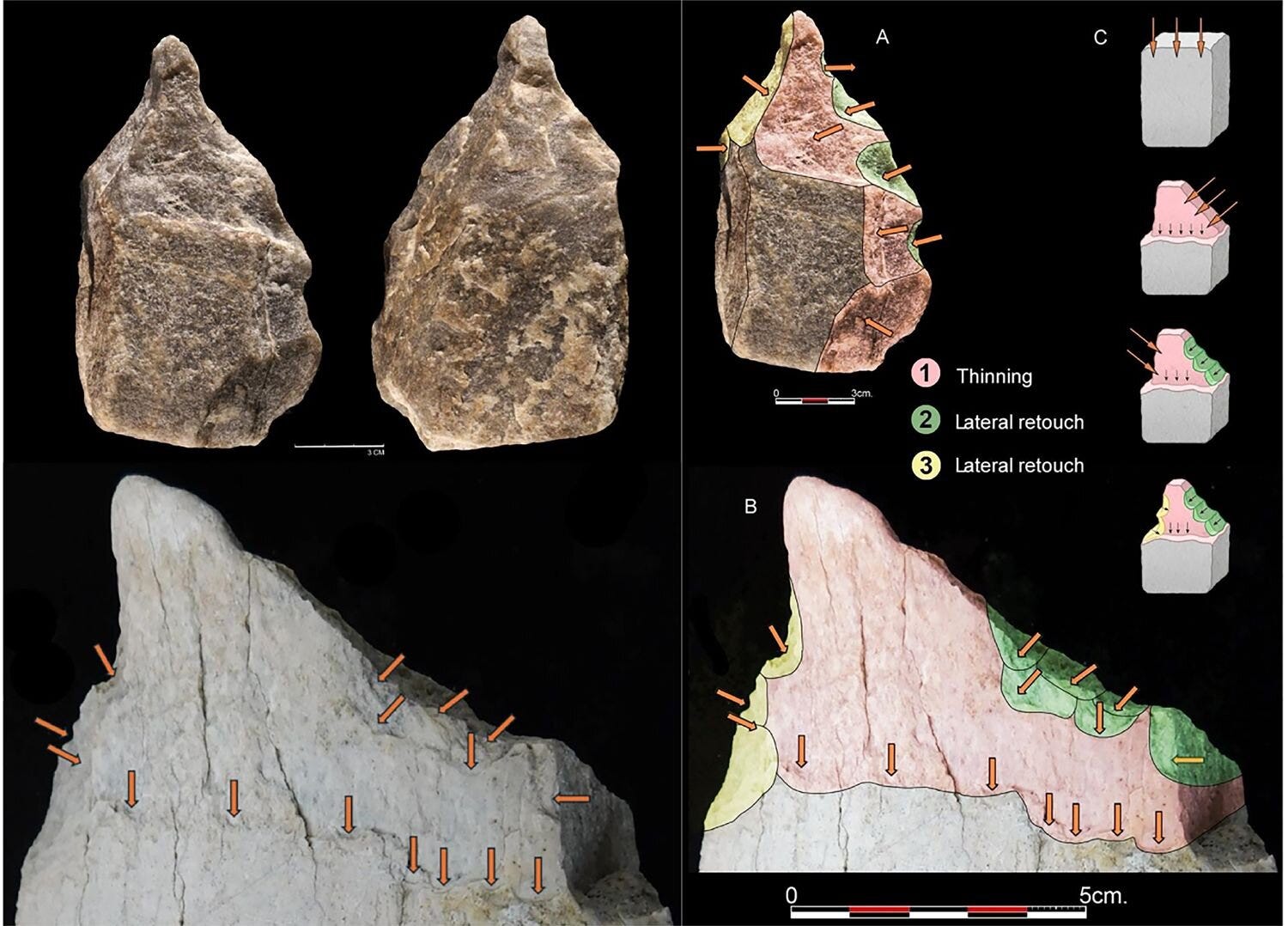
The site is called EAK — the Emiliano Aguirre Korongo — and it sits at the junction of Olduvai’s two gorges in Tanzania, sandwiched in time right at the Bed I/Bed II boundary, dated to approximately 1.78 million years ago. The partial remains of a single juvenile E. recki individual were excavated there beginning in 2022, after erosion from seasonal rains exposed bones that had been buried for nearly two million years. What emerged was a pelvis, both hindlimbs, portions of eight ribs, a skull positioned upside down with its tusks still projecting, and eighty stone tools scattered tightly among the bone. The tools were made mostly of quartz, mostly small flakes and their debris, the kind of expedient kit you’d expect from someone who came to work rather than to display.
The question — the one that has dogged every elephant site from East Africa to the Levant — is whether the tools and bones ended up together because hominins put them there, or because geology, carnivores, and coincidence assembled a convincing fake. That question is surprisingly hard to answer, and the researchers behind the EAK study put real methodological effort into taking it seriously.


